Musa was an Italian slave woman whom the emperor Augustus sent as a gift to the Parthian king Phraates IV around 20 BCE. She became his favourite wife, and after his death in 2 BCE she ruled Parthia jointly with her son Phraates V until the nobility drove them out around 4 CE. She is the only woman whose portrait appears on Parthian royal coins, which makes her one of the best-documented queens of ancient Iran and one of the least understood.
| Name | Musa; “Thermusa” in some texts of Josephus; on coins “Thea Ourania Mousa”, the heavenly goddess Musa |
|---|---|
| Origin | Italian slave, sent by Augustus to Phraates IV, c. 20 BCE |
| Title | Basilissa (queen), on coins |
| Ruled | 2 BCE – c. 4 CE, with her son Phraates V (Phraataces) |
| Main source | Josephus, Jewish Antiquities 18.39–43; her coins |
| Fate | Deposed with her son c. 4 CE; fled to Roman territory |
A gift from Augustus
Musa enters history through a single passage in the Jewish historian Josephus, written about a century after her death. He says that Augustus sent Phraates IV, among other gifts, an Italian slave girl named Thermusa (the name is usually read as Thea Musa). The gift belongs to the period of the peace of 20 BCE, when Phraates returned the Roman standards taken at Carrhae; the background is on the page Phraates IV and the Peace with Augustus.
Josephus says the king was taken with her beauty, made her first a concubine and then his wife, and had a son by her, Phraataces, born perhaps around 19 BCE. Some modern writers, such as Emma Strugnell, have suggested that Augustus chose her deliberately as an agent of Roman influence at the Parthian court. That is possible, but no ancient source says so.
Clearing the way for her son
Phraates IV had older sons by other wives. Around 10 or 9 BCE he sent four of them, with their families, to live in Rome under Augustus’s protection. Josephus presents this as Musa’s plan: with the older princes far away, Phraataces became the obvious heir. Strabo, writing closer to the time, explains the same decision as the king’s own way of protecting his throne from rebel nobles who might rally around a prince. The two explanations are not exclusive. A king who feared plots and a mother who wanted her son to rule could both welcome the same move.
In 2 BCE Phraates IV died. Josephus says Musa and Phraataces poisoned him. There is no independent evidence either way, and accusing a foreign queen of poison was a familiar device in ancient writing. What is certain is that Phraataces took the throne as Phraates V, and that his mother stood beside him in a way no Parthian queen had before.

The coins of a queen
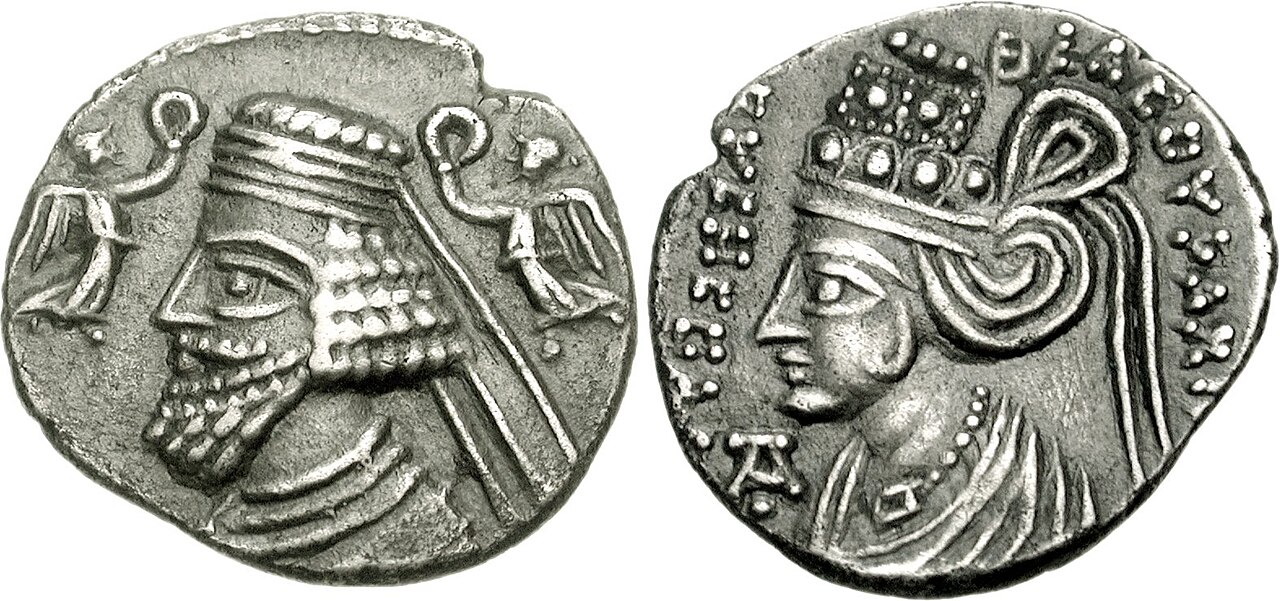
The strongest evidence for Musa’s power is her coinage. Silver drachms of Phraates V show the king on the obverse and, on the reverse, the crowned bust of Musa with a Greek legend naming her as the “goddess, heavenly Musa, queen” (Thea Ourania Mousa Basilissa). Parthian coins normally carried the king’s titles in a square arrangement around a seated archer, the founder Arsaces. Replacing that image with a queen’s portrait, and using a round legend for her, was a striking break with tradition.
Numismatists read this as a sign that Musa was a co-ruler, not simply a queen mother. The divine titles followed Hellenistic models: Seleucid and Ptolemaic queens had been called “goddess” on their coins. For a former slave from Italy, the claim to be “heavenly” was a bold statement of legitimacy, and perhaps a necessary one, since she had no Arsacid blood.
The marble head from Susa
In 1939 the French archaeologist Roland de Mecquenem found a marble head of a woman at Susa, wearing a tall crown and signed by a Greek sculptor named Antiochos. Franz Cumont identified it as Musa, and it is often shown under her name. The identification is not certain: the face does not closely match her coin portraits, and some scholars think it represents a city goddess such as Tyche. It is safest to call it a possible portrait.
Mother and son: what Josephus claims
Josephus adds that Phraataces married his mother, and that this outraged the Parthians. Modern historians treat the claim with great caution. Joan Bigwood has argued that it is misleading and echoes old Greek tales about the Assyrian queen Semiramis, and Leonardo Gregoratti calls the story pseudo-historical. Greek and Roman writers often accused Persian kings of incest as a sign of eastern decadence, and there is no reliable evidence that marriage between mother and son was practised in the Parthian royal house. The joint coinage proves a partnership in power; it does not prove a marriage.
Armenia, Rome and the fall
The new regime soon faced a test in Armenia. Parthia backed a candidate for the Armenian throne, and Augustus sent his grandson and heir Gaius Caesar east with an army. In 2 CE (some date it to 1 CE) Gaius and Phraates V met on an island in the Euphrates, each bringing an equal escort, and then dined on each bank in turn. The Roman officer Velleius Paterculus, who was present, described the scene. Phraates V accepted Roman influence in Armenia, and in return Rome stopped supporting his brothers in Rome as rival kings.
The bargain kept the peace with Rome but cost the king support at home. The great families resented both the concessions over Armenia and the power of a queen of slave origin. Around 4 CE they deposed Phraates V and Musa. Mother and son fled to Roman territory, and nothing more is known of Musa.
The nobles chose Orodes III, an Arsacid of another branch, who was killed within about two years. They then asked Rome to send one of the princes living there, and Vonones I, the eldest son of Phraates IV, arrived to rule. His Roman habits made him unpopular, and he was soon overthrown by Artabanus II, whose reign brought new energy and new quarrels with Rome.
How historians see Musa
Musa has often been told as a story of scandal: the slave who seduced a king, poisoned him and married her son. That version comes almost entirely from one Roman-era author with his own moral aims. The coins tell a different story, of a capable woman who held real authority for about six years at the head of a large empire. Recent work on Parthian queens, which also uses the Avroman documents and Babylonian texts that name royal wives, sees her as an exceptional but not impossible figure in a court where queens could hold titles and property.
Her short reign also shows the limits of Arsacid kingship. A king needed the consent of the great houses described on the page The Great Houses of Parthia, and a ruler who seemed too close to Rome, or whose legitimacy was in doubt, could be removed. For more on what coin portraits reveal about Parthian rulers, see Parthian Coins and What They Tell Us.
Persian words from this page
| ملکه | malake | queen |
| سکه | sekke | coin |
| کنیز | kaniz | slave woman, maid |
| فرهاد پنجم | Farhâd-e panjom | Phraates V |
| شوش | Shush | Susa |
| فرات | Forât | the Euphrates |
Sources and further reading
- Josephus, Jewish Antiquities 18.39–43.
- Strabo, Geography 16.1.28; Velleius Paterculus, Roman History 2.101.
- Joan M. Bigwood, “Queen Mousa, Mother and Wife (?) of King Phraatakes of Parthia: A Re-evaluation of the Evidence”, Mouseion 4 (2004).
- Joan M. Bigwood, “Some Parthian Queens in Greek and Babylonian Documents”, Iranica Antiqua 43 (2008).
- Emma Strugnell, “Thea Musa, Roman Queen of Parthia”, Iranica Antiqua 43 (2008).
- A. D. H. Bivar, “The Political History of Iran under the Arsacids”, in The Cambridge History of Iran, vol. 3(1) (1983).
- Encyclopaedia Iranica, “Arsacids ii. The Arsacid dynasty” (K. Schippmann).
Want to learn Persian? Get the free Starter Pack
Get the 14-page printable Starter Pack (all 32 letters, a 7-day reading plan, 100 core words and 20 survival phrases) and a short 5-email course. Free.
More in The Parthian Empire (247 BCE–224 CE)
- The Parni and Arsaces I
- Nisa: The First Parthian Capital
- Mithridates I and the Making of an Empire
- Phraates II, Artabanus I and the Saka Invasions
- Mithridates II the Great
- The Parthians and the Silk Road
- Parthian Cavalry: Cataphracts and the Parthian Shot
- Surena and the Battle of Carrhae (53 BCE)
- Orodes II and Prince Pacorus
- Mark Antony’s Parthian War
- Phraates IV and the Peace with Augustus
- Queen Musa of Parthia
- Artabanus II of Parthia
- Gotarzes II and Vardanes: A Royal Rivalry
- Vologases I and the War over Armenia
- Trajan’s Invasion of Parthia
- Osroes I and the Parthian Civil Wars
- Roman Campaigns of the 2nd Century: Lucius Verus and Septimius Severus
- The Last Parthian Kings: Vologases V, Vologases VI and Artabanus IV
- The Fall of the Parthian Empire
- Ctesiphon: Capital of Two Empires
- The Great Houses of Parthia
- Religion and Culture in Parthian Iran
- Parthian Art and Architecture
- Parthian Coins and What They Tell Us
- Hatra: The City that Resisted Rome
- The Parthian Language and Its Records
- The Indo-Parthians and Kushans
- The Parthian Legacy