Gotarzes II and Vardanes I were rival sons of Artabanus II who fought over the Parthian throne from about 40 to 46 CE. Vardanes won the first round and recovered the rebel city of Seleucia, but was murdered on a hunt; Gotarzes then ruled alone until about 51 CE and defeated a pretender sent by the emperor Claudius. The rivalry is best known from Tacitus, and Gotarzes left one of the few Parthian royal monuments in Iran, a relief at Behistun.
| Period | c. 40–51 CE |
|---|---|
| Vardanes I | c. 40–46 CE (dates of his death vary from 45 to 47) |
| Gotarzes II | c. 40–51 CE; last dated coin from 51 |
| Main source | Tacitus, Annals 11.8–10 and 12.10–14 |
| Monument | Relief of Gotarzes at Behistun (Bisotun), Kermanshah province |
| Persian name | Gudarz (گودرز) for Gotarzes |
An inheritance nobody could share
When Artabanus II died around 38–40 CE, he left several sons and no settled rule of succession. Parthian kings had to be members of the Arsacid family, but which Arsacid ruled was decided by power: the backing of the great noble houses, the loyalty of provincial governors and the ability to raise an army quickly. Gotarzes, who may have been an adopted rather than a natural son of Artabanus, moved first. Tacitus says he had his brother Artabanus killed, together with that prince’s wife and son. The killing frightened the nobles, and they turned to another brother, Vardanes.
Vardanes’ march and the fall of Seleucia
Vardanes acted with a speed Tacitus clearly admired, covering 3,000 stadia (more than 500 km) in two days and taking Gotarzes by surprise. Gotarzes fled east to the steppe frontier, and the governors of the neighbouring provinces declared for Vardanes.
One city refused him. Seleucia on the Tigris, the great Greek city opposite Ctesiphon, had broken away from Parthian rule around 35 CE. Vardanes besieged it, and Tacitus says it surrendered in the seventh year of its revolt, around 42 or 43. Its coinage, which had continued under the city’s own authority, passed back under royal control. The long siege, however, gave Gotarzes time to raise a new army in the east.

A truce, then a second war
The brothers met in the field but did not fight. According to Tacitus, Gotarzes revealed to Vardanes that nobles were plotting against both of them, and they agreed that Vardanes would keep the crown while Gotarzes withdrew to Hyrcania, the green land south of the Caspian around modern Gorgan.
Vardanes then turned west. He thought of recovering Armenia, where Rome had installed an Iberian prince, but drew back when the governor of Syria, Vibius Marsus, threatened war. Josephus adds that he tried to draw Izates, king of Adiabene, into a war with Rome, and that Izates refused. In this same period, according to the later and often fanciful Life of Apollonius of Tyana by Philostratus, the Greek sage Apollonius visited the Parthian king at Babylon on his way to India. The story is literature more than history, but it shows how Greek writers imagined a Parthian court.
The truce did not last. Gotarzes took up arms again, and Vardanes defeated him at a river Tacitus calls the Erindes, on the border between Media and Hyrcania. Vardanes then advanced through the eastern provinces as far as the river Sindes, which Tacitus says divided the Dahae from the Arians, and set up monuments there boasting that no Arsacid before him had taken tribute from those peoples. His soldiers refused to go further.
A death on the hunt
Around 46 CE Vardanes was killed while hunting by nobles who, Tacitus says, feared his ambition. He was still young. The great houses that had invited him in now preferred a weaker king, and Gotarzes was the only candidate. He became sole ruler, but his reputation for cruelty made the nobles uneasy almost at once.
Meherdates, Rome’s candidate
Some of the Parthian nobles sent envoys to Rome asking the emperor Claudius to give them Meherdates, a son of Vonones I and grandson of Phraates IV, who had grown up in Rome as a hostage. Tacitus gives Claudius a speech in which he urges the young man to rule as a just king rather than a master. In 49 CE the governor of Syria, Gaius Cassius Longinus, escorted Meherdates to the Euphrates.
The expedition went badly. Meherdates lingered at Edessa, where King Abgar entertained him, then took a long route through Armenia into Adiabene. By the time he met Gotarzes’ army, Abgar and Izates of Adiabene had both deserted him. After a hard battle Meherdates was handed over by one of his own allies. Gotarzes did not kill him. Instead, Tacitus says, he had his ears cut off, which by Parthian custom disqualified him from ever ruling, and let him live as a public reminder of his own clemency and of Rome’s failure.
Gotarzes died in 51 CE. Tacitus says he died of illness; Josephus says he was murdered. After the brief reign of Vonones II, Vonones’ son Vologases I took the throne and ended the period of feuding by placing his brothers on subordinate thrones, as told on Vologases I and the War over Armenia.
- c. 38–40 CE Death of Artabanus II; Gotarzes seizes power and kills his brother Artabanus
- c. 40 CE Vardanes’ rapid march; Gotarzes flees east
- c. 42–43 CE Seleucia surrenders to Vardanes
- c. 43–45 CE Truce; renewed war; Vardanes wins at the Erindes
- c. 46 CE Vardanes murdered while hunting
- 49–50 CE Meherdates’ failed invasion
- 51 CE Death of Gotarzes II
The relief at Behistun
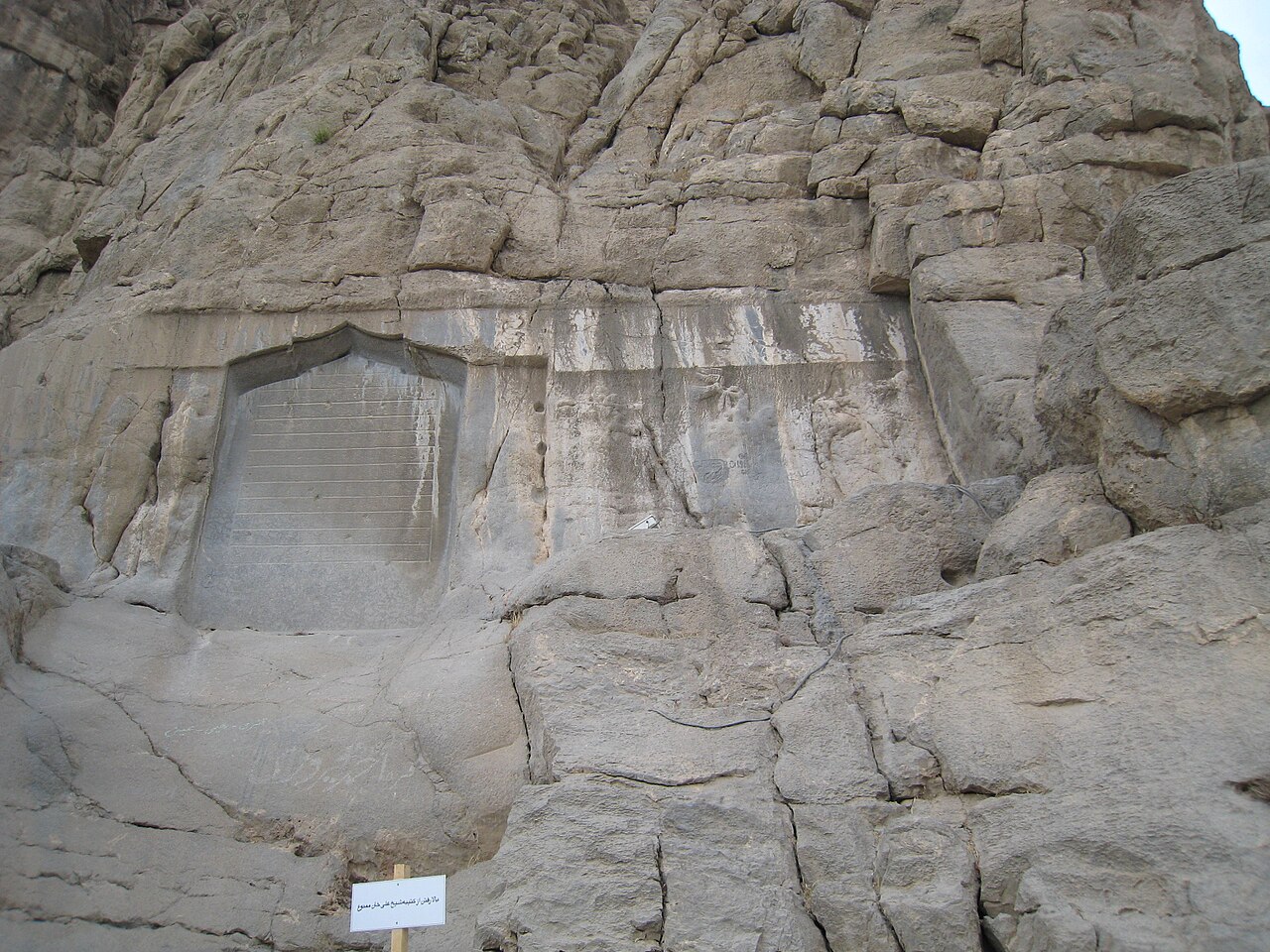
On the cliff at Behistun, below the famous inscription of Darius the Great, are two damaged Parthian reliefs. One shows Mithridates II receiving nobles. The other shows a horseman charging with a lance, an enemy falling before him and a winged Victory flying overhead to crown him. A Greek inscription beside it names him Gotarzes, with the epithet Geopothros, usually read as “son of Gew”.
Most scholars connect the relief with Gotarzes II and a victory such as the one over Meherdates, though some have argued for an earlier king of the same name, Gotarzes I, around 90 BCE. The epithet is a puzzle of its own: it does not name Artabanus as his father, which is one reason historians suspect Gotarzes II was adopted. The relief suffered further when a Persian inscription recording an endowment by Sheikh Ali Khan Zanganeh, a vizier of the late 17th century, was cut into the rock across it. For the art-historical side, see Parthian Art and Architecture; for visiting the site, see Behistun (Bisotun).
Gudarz and Giv in the Shahnameh
The name Gotarzes lived on in Persian as Gudarz. In Ferdowsi’s Shahnameh, Gudarz is a great warrior lord whose family, including his son Giv and grandson Bizhan, fights for the legendary Kayanian kings. The Behistun inscription offers a striking echo: a historical Gotarzes “son of Gew”, and an epic Gudarz father of Giv. Scholars such as Ehsan Yarshater have used parallels like this to argue that Parthian noble traditions, passed down by minstrels, fed into the Iranian national epic. The wider argument is set out on The Great Houses of Parthia.
Persian words from this page
| گودرز | Gudarz | Gotarzes; a Shahnameh hero |
| گیو | Giv | Giv, son of Gudarz in the Shahnameh |
| بیستون | Bisotun | Behistun |
| کرمانشاه | Kermânshâh | Kermanshah |
| گرگان | Gorgân | Gorgan (ancient Hyrcania) |
| شکار | shekâr | hunting, the hunt |
Sources and further reading
- Tacitus, Annals 11.8–10 and 12.10–14
- Josephus, Jewish Antiquities, book 20 (Izates of Adiabene and Vardanes)
- K. Schippmann, “Arsacids ii. The Arsacid dynasty”, Encyclopaedia Iranica
- A. D. H. Bivar, “The Political History of Iran under the Arsacids”, in The Cambridge History of Iran, vol. 3(1) (1983)
- Edward Dąbrowa, “Tacitus on the Parthians”, Electrum (2017)
- Ehsan Yarshater, “Iranian National History”, in The Cambridge History of Iran, vol. 3(1) (1983)
Want to learn Persian? Get the free Starter Pack
Get the 14-page printable Starter Pack (all 32 letters, a 7-day reading plan, 100 core words and 20 survival phrases) and a short 5-email course. Free.
More in The Parthian Empire (247 BCE–224 CE)
- The Parni and Arsaces I
- Nisa: The First Parthian Capital
- Mithridates I and the Making of an Empire
- Phraates II, Artabanus I and the Saka Invasions
- Mithridates II the Great
- The Parthians and the Silk Road
- Parthian Cavalry: Cataphracts and the Parthian Shot
- Surena and the Battle of Carrhae (53 BCE)
- Orodes II and Prince Pacorus
- Mark Antony’s Parthian War
- Phraates IV and the Peace with Augustus
- Queen Musa of Parthia
- Artabanus II of Parthia
- Gotarzes II and Vardanes: A Royal Rivalry
- Vologases I and the War over Armenia
- Trajan’s Invasion of Parthia
- Osroes I and the Parthian Civil Wars
- Roman Campaigns of the 2nd Century: Lucius Verus and Septimius Severus
- The Last Parthian Kings: Vologases V, Vologases VI and Artabanus IV
- The Fall of the Parthian Empire
- Ctesiphon: Capital of Two Empires
- The Great Houses of Parthia
- Religion and Culture in Parthian Iran
- Parthian Art and Architecture
- Parthian Coins and What They Tell Us
- Hatra: The City that Resisted Rome
- The Parthian Language and Its Records
- The Indo-Parthians and Kushans
- The Parthian Legacy