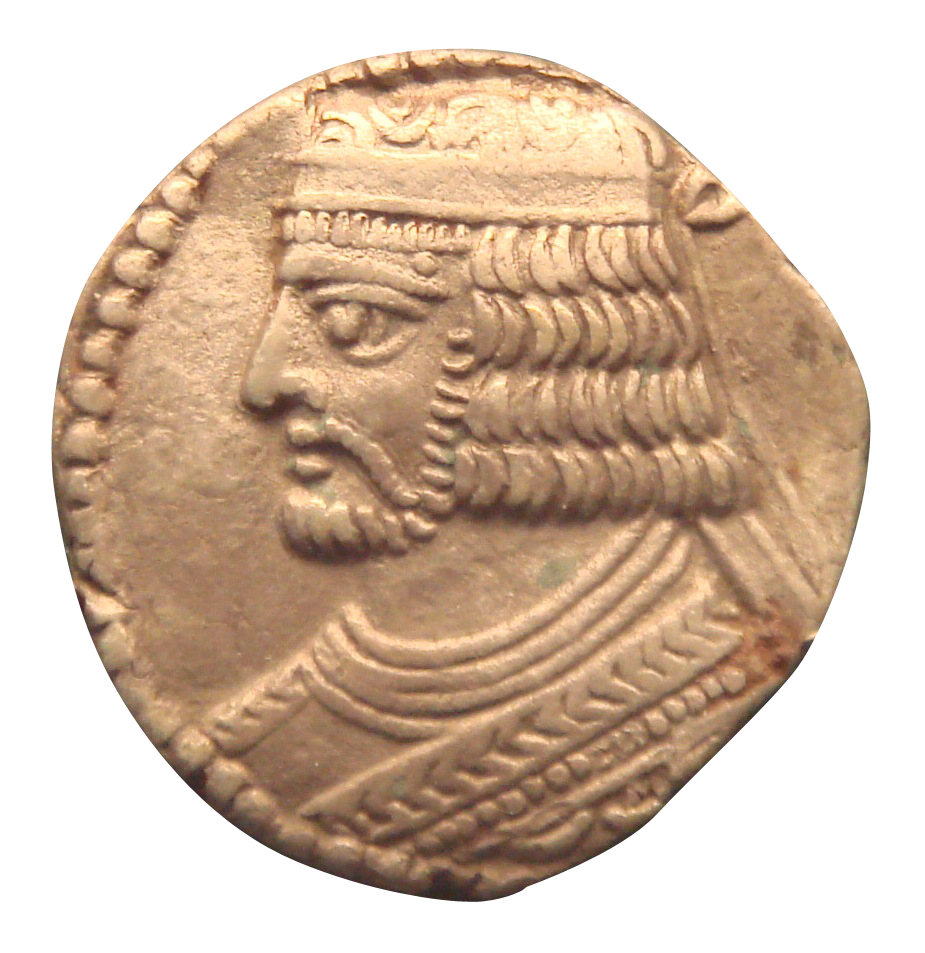
Vologases I ruled Parthia from about 51 to 78 CE and fought Rome for a decade over who would control Armenia. After a Roman army surrendered at Rhandeia in 62 CE, the two empires agreed that Armenia would be ruled by Vologases’s brother Tiridates, but that he would receive his crown from the Roman emperor. In 66 CE Tiridates travelled to Rome and was crowned by Nero, a compromise that kept the peace between Rome and Parthia for almost fifty years.
| Reign | c. 51–78 CE (end date uncertain; possibly 79 or 80) |
|---|---|
| Family | Son of Vonones II; brothers Pacorus (king of Media Atropatene) and Tiridates (king of Armenia) |
| War with Rome | c. 54–63 CE, mainly in Armenia |
| Roman commanders | Gnaeus Domitius Corbulo; Lucius Caesennius Paetus |
| Settlement | Rhandeia, 63 CE; coronation of Tiridates in Rome, 66 CE |
| Persian name | Balâsh (بلاش), from Parthian Walagash |
A king who placed his brothers on thrones
Vologases came to power around 51 CE after a long period of civil war in the Parthian royal family, described on the page Gotarzes II and Vardanes. Tacitus says his mother was a Greek concubine of Vonones II. He secured his position by sharing power with his brothers: Pacorus received Media Atropatene (in modern Iranian Azerbaijan), and Tiridates was to have Armenia.
Armenia lay between the two empires and had a mixed Iranian and local culture. Its nobility had strong Parthian ties, but since the peace of 20 BCE Rome had treated the choice of its king as a Roman matter. In 51 CE an Iberian prince, Radamistus, seized the Armenian throne by murdering his uncle. Vologases used the chaos to march in and install Tiridates in 52 or 53 CE. A harsh winter and an epidemic forced the Parthians out for a time, but by the time Nero became emperor in 54 CE, Tiridates was back in the Armenian capital, Artaxata.

Corbulo’s war, 58–60 CE
Nero’s government sent Gnaeus Domitius Corbulo, an experienced and strict general, to Cappadocia and Syria. Corbulo spent several years retraining legions that Tacitus describes as soft from years of garrison life in Syria, and he waited while Vologases was distracted by a revolt of his son Vardanes and a rising in Hyrcania, by the Caspian Sea.
In 58 CE Corbulo invaded Armenia. Tiridates avoided pitched battle, as Parthian commanders usually did against legions. Corbulo took Artaxata, which was burned, and in 59 or 60 CE he entered Tigranocerta, the second great city of the kingdom. Rome then crowned its own candidate, Tigranes VI, a descendant of Herod the Great of Judaea who had grown up in Rome.
Rhandeia: a Roman army surrenders, 62 CE
Tigranes overreached by raiding Adiabene, a kingdom under Parthian protection in northern Mesopotamia. Vologases could no longer ignore the war. He sent troops to besiege Tigranes in Tigranocerta and negotiated with Corbulo, who withdrew Roman forces from Armenia in return for a Parthian withdrawal.
Rome then sent a second commander, Lucius Caesennius Paetus, who announced that he would turn Armenia into a Roman province. In 62 CE he advanced with too few troops, spread them across winter camps, and was trapped by Vologases at Rhandeia, on the Arsanias river (the modern Murat in eastern Turkey). After a short siege, Paetus agreed to leave Armenia. Tacitus reports a rumour that his men were made to pass under a yoke of spears, the old sign of a defeated army, and says that Roman writers argued about it. The Parthians also required the Romans to build a bridge over the Arsanias as a monument to their victory.
The compromise of 63 CE
Rome restored Corbulo to command, and he advanced again into Armenia with a strong army. Neither side wanted a long war. In 63 CE Corbulo and Tiridates met at Rhandeia, the scene of Paetus’s humiliation. Tiridates took the royal diadem from his head and placed it before a statue of Nero, promising to go to Rome and receive it back from the emperor’s own hands.
The deal gave each side what it most needed. Parthia got an Arsacid king in Armenia, a branch of the family that went on to rule the country for centuries. Rome kept the formal right to grant the crown, so Nero could present the outcome as a victory. Historians such as Rose Mary Sheldon and Edward Dąbrowa see it as one of the most successful pieces of ancient diplomacy, because it removed the main cause of war for decades.
Tiridates in Rome, 66 CE
Tiridates made the journey in 66 CE with his wife, his sons and a large escort of Parthian cavalry. According to Pliny the Elder, he was a magus, a Zoroastrian priest, and travelled overland rather than by sea to avoid polluting the water, a detail that fits Zoroastrian purity rules. The journey took about nine months, and Cassius Dio says the Roman treasury paid for his entire progress.
In Rome, Nero received him in the Forum before crowds and soldiers. Tiridates knelt and addressed Nero as his lord, saying, in Dio’s account, that he came to worship him as he worshipped Mithra. Nero placed the diadem on his head and then closed the doors of the Temple of Janus, the Roman sign that the empire was at peace. Tiridates returned to Armenia with gifts and with craftsmen to rebuild Artaxata.
Vologases at home
Vologases was more than a war leader. He founded a new commercial city, Vologasocerta, near Seleucia on the Tigris, which Pliny describes as a rival to the Greek city of Seleucia. He was the first Parthian king to put letters in the Parthian script on his coins, alongside the usual Greek legends, a small change that historians often read as a turn toward Iranian rather than Hellenistic identity.
A later Zoroastrian text, the Denkard, says that a king named Valakhsh ordered the scattered parts of the Avesta to be collected. Many scholars identify this king with Vologases I, which would fit Tiridates’s role as a magus, but the identification is not certain. The background is on the page Religion and Culture in Parthian Iran.
His last years brought new dangers from the north. In the early 70s CE the Alans, a nomadic people from the steppe, broke through the Caucasus passes, plundered Media Atropatene and Armenia, and nearly captured Tiridates. Vologases asked the emperor Vespasian for help, and Vespasian refused. The reign ended around 78 CE, with Parthia at peace with Rome but facing rival claimants at home.
- c. 51 CE Vologases I becomes king
- 52/53 CE Tiridates installed in Armenia
- 58 CE Corbulo invades Armenia; Artaxata falls
- 59/60 CE Tigranocerta taken; Tigranes VI crowned by Rome
- 62 CE Paetus surrenders at Rhandeia
- 63 CE Agreement of Rhandeia
- 66 CE Nero crowns Tiridates in Rome
- early 70s CE Alan invasion of Media and Armenia
Persian words from this page
| بلاش | Balâsh | Vologases |
| تیرداد | Tirdâd | Tiridates |
| ارمنستان | Armanestân | Armenia |
| تاج | tâj | crown |
| مهر | Mehr | Mithra |
| مغ | mogh | magus, Zoroastrian priest |
The settlement lasted until 113 CE, when a quarrel over the Armenian throne gave Trajan his excuse for war: see Trajan’s Invasion of Parthia.
Sources and further reading
- Tacitus, Annals books 12–15.
- Cassius Dio, Roman History 62.19–23 and 63.1–7; Suetonius, Nero 13.
- Pliny the Elder, Natural History 6.122 and 30.16–17.
- Encyclopaedia Iranica, “Arsacids ii. The Arsacid dynasty” (K. Schippmann).
- Rose Mary Sheldon, Rome’s Wars in Parthia: Blood in the Sand (2010).
- Edward Dąbrowa, “The Arsacid Empire”, in Touraj Daryaee (ed.), The Oxford Handbook of Iranian History (2012).
Want to learn Persian? Get the free Starter Pack
Get the 14-page printable Starter Pack (all 32 letters, a 7-day reading plan, 100 core words and 20 survival phrases) and a short 5-email course. Free.
More in The Parthian Empire (247 BCE–224 CE)
- The Parni and Arsaces I
- Nisa: The First Parthian Capital
- Mithridates I and the Making of an Empire
- Phraates II, Artabanus I and the Saka Invasions
- Mithridates II the Great
- The Parthians and the Silk Road
- Parthian Cavalry: Cataphracts and the Parthian Shot
- Surena and the Battle of Carrhae (53 BCE)
- Orodes II and Prince Pacorus
- Mark Antony’s Parthian War
- Phraates IV and the Peace with Augustus
- Queen Musa of Parthia
- Artabanus II of Parthia
- Gotarzes II and Vardanes: A Royal Rivalry
- Vologases I and the War over Armenia
- Trajan’s Invasion of Parthia
- Osroes I and the Parthian Civil Wars
- Roman Campaigns of the 2nd Century: Lucius Verus and Septimius Severus
- The Last Parthian Kings: Vologases V, Vologases VI and Artabanus IV
- The Fall of the Parthian Empire
- Ctesiphon: Capital of Two Empires
- The Great Houses of Parthia
- Religion and Culture in Parthian Iran
- Parthian Art and Architecture
- Parthian Coins and What They Tell Us
- Hatra: The City that Resisted Rome
- The Parthian Language and Its Records
- The Indo-Parthians and Kushans
- The Parthian Legacy