The last Parthian kings, Vologases V (r. c. 191–208 CE) and his sons Vologases VI and Artabanus IV, ruled an empire weakened by Roman invasions and divided by civil war. Artabanus IV still defeated a Roman army at Nisibis in 217 CE and forced the emperor Macrinus to buy peace, but within seven years he was killed by Ardashir, the ruler of Pars, who founded the Sasanian Empire. The Arsacid dynasty, which had ruled Iran for almost five centuries, ended with him.
| Vologases V | c. 191–208 CE |
|---|---|
| Vologases VI | c. 208–228 CE (in Mesopotamia; coins to 227/228) |
| Artabanus IV | c. 213–224 CE; numbered Artabanus V in older books |
| Key battle | Nisibis, 217 CE: Artabanus IV defeats Macrinus |
| End | Artabanus killed by Ardashir at Hormozgan, 224 CE |
| Persian name | Ardavân (اردوان) for Artabanus |
Vologases V and the price of defeat
Vologases V came to the throne around 191 and soon faced Septimius Severus. When the Romans sacked Ctesiphon in 197 or 198 and annexed northern Mesopotamia as a new province, he fled east and kept his throne, but the loss of the capital and of Nisibis was a heavy blow to his prestige. Those wars are told on the page Roman Campaigns of the 2nd Century. Little is known of his later years, apart from coins and a few mentions in Roman writers. He died around 208.
Two brothers, two kingdoms
His son Vologases VI succeeded him, but within a few years a younger son, Artabanus, rose against his brother. By about 213 the empire was split. Vologases VI held Mesopotamia around Seleucia and Ctesiphon, where his coins continued to be struck. Artabanus IV controlled Media and most of the Iranian plateau, and was recognised as far south as Susa.
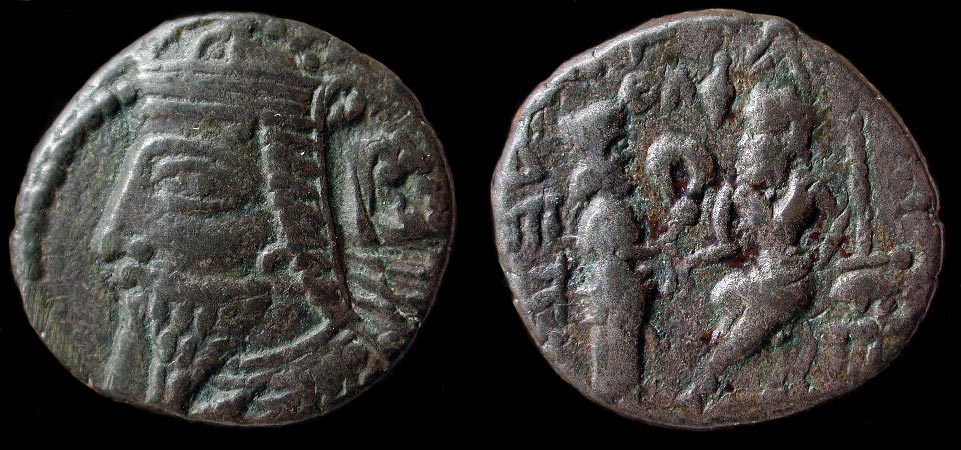
The evidence for this division is mostly numismatic. Coins of Vologases VI carry dates in the Seleucid era, which let historians follow his reign year by year. One of his tetradrachms is dated 539 of that era, equal to 227/228 CE, years after Artabanus’s death, so a Parthian king was still issuing coins in Mesopotamia while Ardashir was building his new empire.

The Susa stele of 215
A carved stone from Susa gives a rare Parthian view of Artabanus IV. It shows the king, seated, handing a ring, a symbol of authority, to the satrap of Susa, Khwasak, and carries a Parthian inscription dated to 215 CE. It is one of the very few dated monuments of a Parthian king and shows that Artabanus controlled Elymais and Susiana, the lowlands of today’s Khuzestan.
Caracalla’s treacherous war, 216–217
The Roman emperor Caracalla, son of Severus, saw the divided Parthian realm as an opportunity. Around 215 he asked Artabanus for the hand of his daughter in marriage, presenting it as a union of the two empires. Our two Roman sources disagree on what happened next. Cassius Dio says Artabanus refused, and Caracalla used the refusal as a pretext for war. Herodian tells a more dramatic story: Artabanus accepted, came out to meet the Roman emperor for the wedding celebrations, and Caracalla’s soldiers fell on the unarmed Parthian guests and massacred them. Herodian’s version is often treated as embellished, but both agree that Caracalla invaded in 216.
The Romans raided Media and Adiabene. Dio says that at Arbela (modern Erbil) Caracalla’s men broke open the royal tombs of the Parthians and scattered the bones, an insult that Iranians would not forget. Artabanus gathered a large army, but before the two sides met, Caracalla was murdered in April 217 near Carrhae by an officer acting for his praetorian prefect, Macrinus. Macrinus was proclaimed emperor.
The Battle of Nisibis, 217
Artabanus demanded that Rome rebuild the cities and forts it had destroyed, return the captives and give up northern Mesopotamia. Macrinus refused, and the two armies met near Nisibis in the summer of 217. Herodian describes fighting over three days, with Parthian cataphracts and camel-mounted troops pressing the legions, and the field so covered with bodies that the armies could hardly see each other. The Romans were not routed, but they could not win.
Macrinus sought peace. According to Dio, he paid Artabanus and the Parthian nobles some 200 million sesterces in gifts and compensation. Rome kept its province of Mesopotamia, but the payment was a clear acknowledgement of defeat. The kind of armoured cavalry that fought at Nisibis is described on the page Parthian Cavalry: Cataphracts and the Parthian Shot.
A victory that did not save the dynasty
Nisibis was the last great Parthian victory over Rome. It came too late. The wars with Rome had drained the treasury and damaged the king’s reputation, and the civil war with Vologases VI meant that the crown had no single centre. The great houses that made and unmade Arsacid kings, described on the page The Great Houses of Parthia, had less reason to stay loyal to a divided dynasty.
The challenge came from the south. In Pars, the old homeland of the Achaemenids, a local ruler named Ardashir, from a family of priests and princes at Istakhr, began conquering the neighbouring districts around 205–220. Artabanus treated him at first as a rebellious vassal. By the early 220s Ardashir had taken Kerman, Isfahan and Elymais, and the two met in battle on the plain of Hormozgan in 224. Artabanus was killed. Ardashir soon took Ctesiphon and was crowned King of Kings. Vologases VI disappears from the record after about 228, and Arsacid princes survived in Armenia, where the dynasty ruled until 428.
From Parthian to Sasanian
The story of Ardashir’s rise, the battle of 224 and the new state he built belongs to the next era: see The Origins of the Sasanian Family and Ardashir I, Founder of the Sasanian Empire. Several of the great Parthian families, including the Suren and Karen, made their peace with the new dynasty and kept their lands and rank under Sasanian rule, which is one reason Parthian traditions survived long after the Arsacids had gone.
- c. 191 Vologases V becomes king
- 197/198 Septimius Severus sacks Ctesiphon
- c. 208 Vologases VI succeeds
- c. 213 Artabanus IV rises against his brother
- 215 Susa stele of Artabanus and the satrap Khwasak
- 216 Caracalla invades; royal tombs at Arbela desecrated
- April 217 Caracalla murdered near Carrhae
- 217 Battle of Nisibis; Macrinus pays for peace
- 224 Artabanus IV killed by Ardashir at Hormozgan
- 227/228 Last dated coin of Vologases VI
Persian words from this page
| اردوان | Ardavân | Artabanus |
| اردشیر | Ardashir | Ardashir |
| ساسانیان | Sâsâniyân | the Sasanians |
| اشکانیان | Ashkâniyân | the Arsacids |
| انگشتر | angoshtar | ring |
| پارس | Pârs | Pars, Persis |
Sources and further reading
- Cassius Dio, Roman History books 78–79 (Caracalla and Macrinus).
- Herodian, History of the Empire 4.10–15.
- Encyclopaedia Iranica, “Arsacids ii. The Arsacid dynasty” (K. Schippmann).
- A. D. H. Bivar, “The Political History of Iran under the Arsacids”, in The Cambridge History of Iran, vol. 3(1) (1983).
- Touraj Daryaee, Sasanian Persia: The Rise and Fall of an Empire (I. B. Tauris, 2009).
Want to learn Persian? Get the free Starter Pack
Get the 14-page printable Starter Pack (all 32 letters, a 7-day reading plan, 100 core words and 20 survival phrases) and a short 5-email course. Free.
More in The Parthian Empire (247 BCE–224 CE)
- The Parni and Arsaces I
- Nisa: The First Parthian Capital
- Mithridates I and the Making of an Empire
- Phraates II, Artabanus I and the Saka Invasions
- Mithridates II the Great
- The Parthians and the Silk Road
- Parthian Cavalry: Cataphracts and the Parthian Shot
- Surena and the Battle of Carrhae (53 BCE)
- Orodes II and Prince Pacorus
- Mark Antony’s Parthian War
- Phraates IV and the Peace with Augustus
- Queen Musa of Parthia
- Artabanus II of Parthia
- Gotarzes II and Vardanes: A Royal Rivalry
- Vologases I and the War over Armenia
- Trajan’s Invasion of Parthia
- Osroes I and the Parthian Civil Wars
- Roman Campaigns of the 2nd Century: Lucius Verus and Septimius Severus
- The Last Parthian Kings: Vologases V, Vologases VI and Artabanus IV
- The Fall of the Parthian Empire
- Ctesiphon: Capital of Two Empires
- The Great Houses of Parthia
- Religion and Culture in Parthian Iran
- Parthian Art and Architecture
- Parthian Coins and What They Tell Us
- Hatra: The City that Resisted Rome
- The Parthian Language and Its Records
- The Indo-Parthians and Kushans
- The Parthian Legacy