Phraates IV ruled Parthia from about 37 to 2 BCE, through the wars with Mark Antony and into the reign of Augustus. In 20 BCE he returned the Roman standards and prisoners taken at Carrhae and in later defeats, and in exchange Rome stopped threatening war. This settlement set the pattern for Roman–Parthian relations for more than a century: rivalry over Armenia, but no Roman invasion of Iran.
| Reign | c. 37–2 BCE (interrupted by the rival king Tiridates, c. 31–26 BCE) |
|---|---|
| Dynasty | Arsacid (Parthian) |
| Predecessor | His father, Orodes II |
| Successor | His son Phraates V (Phraataces), with Queen Musa |
| Key event | Return of the Roman standards, 20 BCE |
| Persian name | Farhâd (فرهاد), from Parthian Frahât |
A violent accession
Phraates came to the throne after his father Orodes II had lost his favourite son and heir, Pacorus, in battle against the Romans in Syria in 38 BCE. Orodes named Phraates as successor. According to Plutarch and the Roman historian Justin, Phraates then murdered his father and some thirty brothers to remove every possible rival. The figures come from hostile Roman writers and may be exaggerated, but they show how dangerous the Arsacid succession could be: any male of the royal family had a claim, and the great noble houses were ready to back one against another.
Many nobles fled. One of them, Monaeses, went over to Mark Antony and encouraged him to invade. The result was Antony’s campaign of 36 BCE in Media Atropatene, which ended in a costly Roman retreat. That war is told on its own page, Mark Antony’s Parthian War; for Phraates it was a clear victory, won largely by cutting the Roman siege train and harassing the retreating army.

Tiridates and the kidnapped prince
Victory abroad did not end trouble at home. Around 31 BCE a pretender named Tiridates rose against Phraates with the support of part of the nobility and drove him from the throne for a time. Phraates came back with help from Saka (Scythian) nomads of the eastern steppe, and Tiridates fled into Roman Syria. He took with him a valuable hostage: a young son of Phraates.
Octavian, who had just defeated Antony and Cleopatra and would soon take the name Augustus, now held two cards: a rival claimant and the king’s own child. He let Tiridates live in Syria and kept the boy in Rome. Tiridates seems to have made a second attempt on the throne around 26 BCE and failed again. Coins struck in his name in Mesopotamia show how seriously he was taken for a few years.
In 23 BCE Augustus returned the son. In exchange he asked for something that mattered greatly to Roman public opinion: the legionary eagles and standards lost by Crassus at Carrhae in 53 BCE, together with those lost by Decidius Saxa in 40 BCE and by Antony’s army in 36 BCE, and any surviving prisoners.
The return of the standards, 20 BCE
Phraates delayed for three years. In 20 BCE Augustus came east in person, and his stepson Tiberius led an army into Armenia to install a pro-Roman king. Faced with this pressure, and with no wish for another war while his own throne was insecure, Phraates handed over the standards and the captives. No battle was fought.
For Phraates the cost was small. The standards were old trophies; the prisoners had spent more than thirty years in Parthian lands, and Roman poets complained that many had married local women and settled down. In return he gained recognition and an end to Roman threats. Armenia passed into the Roman orbit for the moment, but Parthian territory was untouched.
For Augustus the gain was enormous, because he presented a diplomatic deal as a military triumph. In his own account of his reign, the Res Gestae, he says he compelled the Parthians to give back the spoils and standards of three Roman armies and to seek the friendship of the Roman people as suppliants. Coins were struck showing a kneeling Parthian offering a standard, with the legend SIGNIS RECEPTIS (“the standards recovered”). The standards were later placed in the Temple of Mars Ultor, Mars the Avenger, in the new Forum of Augustus, dedicated in 2 BCE.
The Prima Porta statue
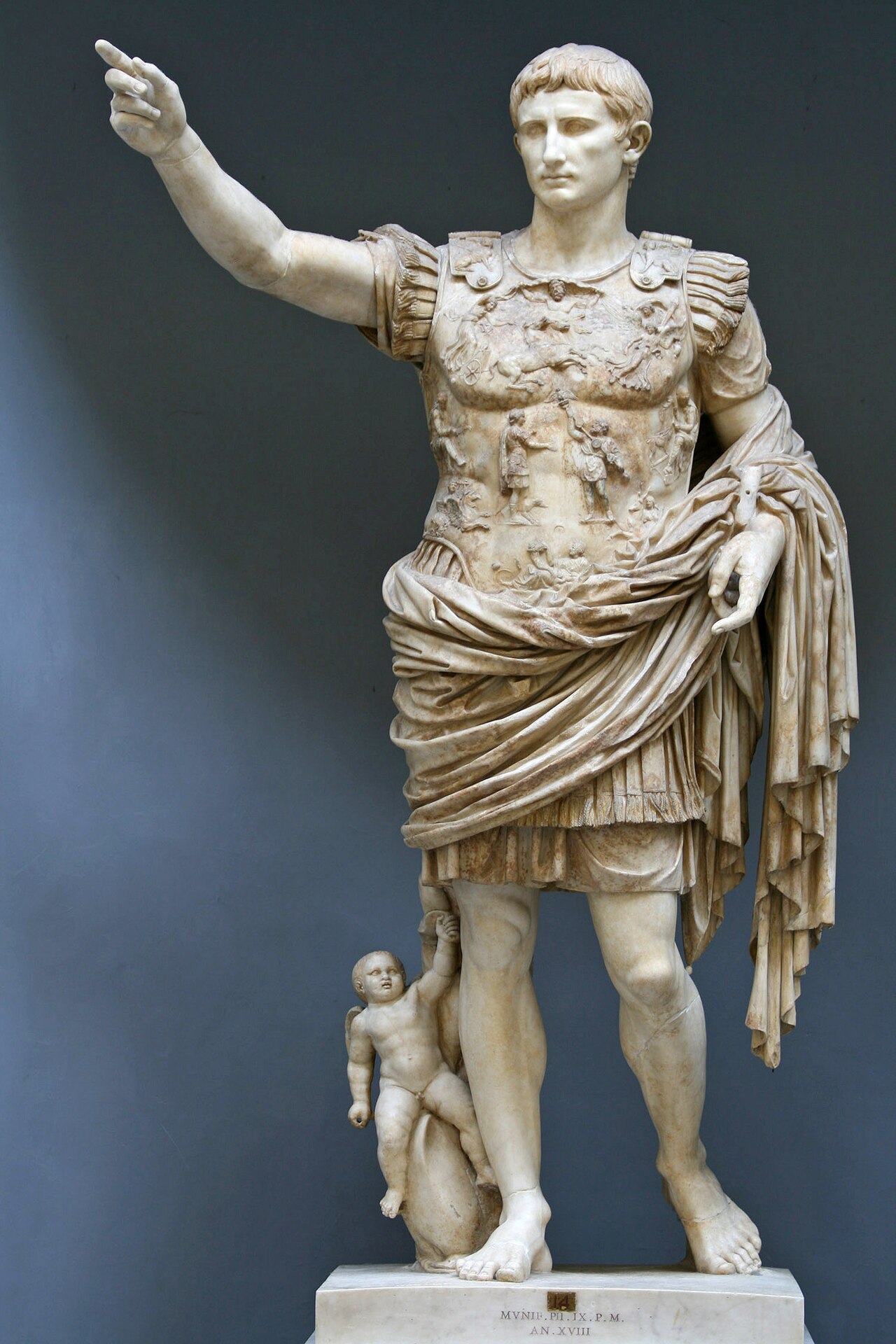
The best-known image of the event is on the breastplate of the marble statue of Augustus found at the villa of his wife Livia at Prima Porta, north of Rome. In its centre a figure in Parthian trousers hands a Roman military standard with an eagle to a figure in Roman armour. Scholars still debate who the Roman figure is (Tiberius, the god Mars, or a personification of the army), but the Parthian is clearly a symbol of the East yielding to Rome. Parthian sources tell no such story; Parthian coins of Phraates continue to call him King of Kings.
Musa and the sons sent to Rome
Around the time of the settlement, Augustus sent Phraates a gift: an Italian slave woman named Musa. The Jewish historian Josephus, our main source, says she became the king’s favourite and bore him a son, Phraataces. Her later career as queen is covered on the page Queen Musa of Parthia.
About 10 or 9 BCE Phraates did something unusual: he sent four of his older sons, with their wives and children, to live in Rome under the care of Augustus. Strabo explains it as a way to protect his throne, since princes far away in Rome could not be used by rebel nobles. Josephus adds that Musa encouraged it to clear the way for her own son. Augustus treated the princes as honoured guests, and Roman writers described them as hostages, a sign of Parthian submission. Both readings may be partly true. The move had long consequences: one of these princes, Vonones, was later sent back to rule Parthia as Rome’s candidate, and his Roman manners helped turn the nobles against him.
Death and assessment
Phraates IV died in 2 BCE. Josephus says that Musa and Phraataces poisoned him, and Phraataces took the throne as Phraates V. As with many palace stories in Josephus, this cannot be checked, but the sudden succession of a young son of a foreign concubine over older brothers living in Rome fits a court coup.
Historians judge Phraates in two ways. Roman sources made him a cruel tyrant who gave in to Augustus. Modern historians such as Josef Wiesehöfer and Marek Jan Olbrycht point out that he defeated the largest Roman invasion yet attempted, survived civil war, and kept his empire intact through a reign of some 35 years. The peace of 20 BCE gave Parthia a secure western frontier on the Euphrates, and the next serious Roman–Parthian conflicts, under Artabanus II and Vologases I, were fought over Armenia rather than over Iran itself.
- c. 37 BCE Phraates IV succeeds Orodes II
- 36 BCE Mark Antony’s invasion fails at Phraaspa
- c. 31–26 BCE Revolt of Tiridates; a son of Phraates taken to Rome
- 23 BCE Augustus returns the son
- 20 BCE Standards and prisoners returned to Rome
- c. 10/9 BCE Four sons sent to live in Rome
- 2 BCE Death of Phraates IV; Phraates V and Musa take power
Persian words from this page
| فرهاد | Farhâd | Phraates |
| اشکانیان | Ashkâniyân | the Arsacids, the Parthian dynasty |
| روم | Rum | Rome |
| ارمنستان | Armanestân | Armenia |
| درفش | derafsh | banner, standard |
| صلح | solh | peace |
Sources and further reading
- Augustus, Res Gestae Divi Augusti, chapters 29 and 32.
- Josephus, Jewish Antiquities 18.39–43 (Musa and the death of Phraates).
- Strabo, Geography 16.1.28; Cassius Dio, Roman History 53.33 and 54.8.
- Encyclopaedia Iranica, “Arsacids ii. The Arsacid dynasty” (K. Schippmann).
- A. D. H. Bivar, “The Political History of Iran under the Arsacids”, in The Cambridge History of Iran, vol. 3(1) (1983).
- Josef Wiesehöfer, Ancient Persia from 550 BC to 650 AD (I. B. Tauris).
- Rose Mary Sheldon, Rome’s Wars in Parthia: Blood in the Sand (Vallentine Mitchell, 2010).
Want to learn Persian? Get the free Starter Pack
Get the 14-page printable Starter Pack (all 32 letters, a 7-day reading plan, 100 core words and 20 survival phrases) and a short 5-email course. Free.
More in The Parthian Empire (247 BCE–224 CE)
- The Parni and Arsaces I
- Nisa: The First Parthian Capital
- Mithridates I and the Making of an Empire
- Phraates II, Artabanus I and the Saka Invasions
- Mithridates II the Great
- The Parthians and the Silk Road
- Parthian Cavalry: Cataphracts and the Parthian Shot
- Surena and the Battle of Carrhae (53 BCE)
- Orodes II and Prince Pacorus
- Mark Antony’s Parthian War
- Phraates IV and the Peace with Augustus
- Queen Musa of Parthia
- Artabanus II of Parthia
- Gotarzes II and Vardanes: A Royal Rivalry
- Vologases I and the War over Armenia
- Trajan’s Invasion of Parthia
- Osroes I and the Parthian Civil Wars
- Roman Campaigns of the 2nd Century: Lucius Verus and Septimius Severus
- The Last Parthian Kings: Vologases V, Vologases VI and Artabanus IV
- The Fall of the Parthian Empire
- Ctesiphon: Capital of Two Empires
- The Great Houses of Parthia
- Religion and Culture in Parthian Iran
- Parthian Art and Architecture
- Parthian Coins and What They Tell Us
- Hatra: The City that Resisted Rome
- The Parthian Language and Its Records
- The Indo-Parthians and Kushans
- The Parthian Legacy