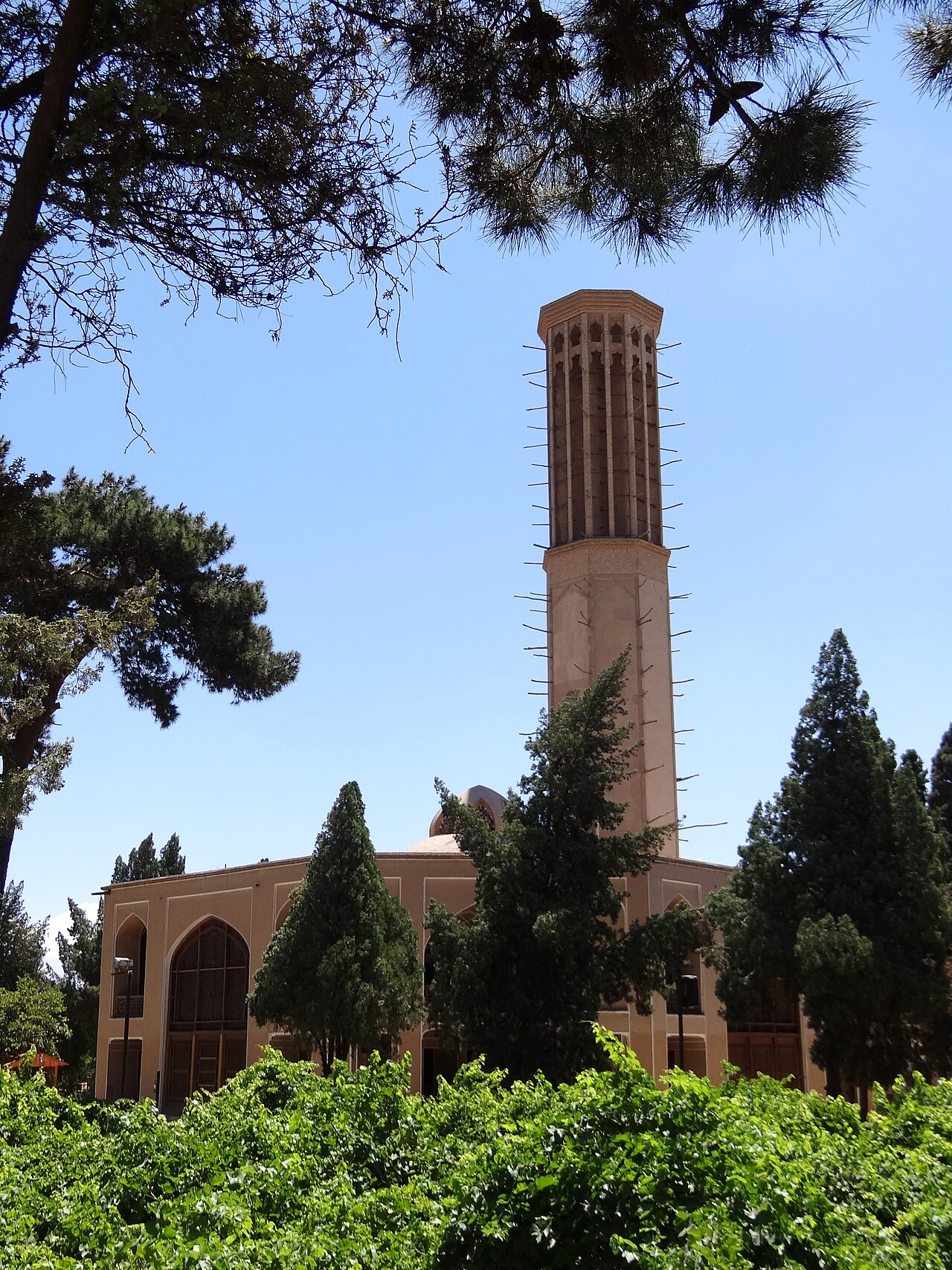
Dowlatabad Garden (باغ دولتآباد) in Yazd was laid out around 1750 as the residence and seat of government of Mohammad Taqi Khan, who ruled Yazd after the death of Nader Shah. Its windcatcher, about 33 metres high, is usually described as the tallest in Iran and the tallest mud-brick windcatcher in the world. The garden is one of the nine sites of UNESCO’s Persian Garden listing.
| Persian name | Bâgh-e Dowlatâbâd |
|---|---|
| Founded | c. 1747–1750 by Mohammad Taqi Khan Bafqi, governor of Yazd |
| Windcatcher | About 33.8 m, octagonal, over the main summer pavilion |
| Water | A qanat of about 65 km, brought from the Mehriz area |
| UNESCO | Part of “The Persian Garden” (2011); also inside the Historic City of Yazd (2017) |
A garden for a governor
The collapse of central power after Nader Shah was murdered in 1747 left local strongmen in charge across Iran. In Yazd this was Mohammad Taqi Khan, from Bafq, who held the city for decades and recognised Karim Khan Zand as his overlord. He wanted a residence worthy of a ruler, and the name he chose, Dowlatabad, means roughly “the abode of the state”.
Before anything could be planted, he needed water. He ordered a qanat dug from the foot of the mountains near Mehriz, south of Yazd, a tunnel of around 65 kilometres with several branches, sloping gently so that groundwater flowed by gravity all the way to the garden. Our page on qanats explains how these tunnels were dug and maintained. Only then did he build his palace, offices and the garden around them.
The garden was divided in the usual way into an outer part, for public business and receptions, and an inner part for the household. Later governors of Yazd used it, and it declined in the 20th century before restoration by the heritage authorities.

How the great windcatcher works
Yazd is called the city of windcatchers, and Dowlatabad has the biggest. The tower rises from the roof of the summer pavilion, the Emârat-e Bâdgir, at the end of the long pool. It is octagonal, so it can catch a breeze from any direction. Inside, the shaft is divided by thin walls into separate channels.
When wind strikes the tower, air is pushed down the channels on the windward side into the hall below. There it passes over a pool and fountain set in the floor directly under the shaft. The water cools the air further by evaporation, and the cool air spreads into the rooms. On the side away from the wind, the lower pressure draws warm air up and out. Even on a still day, the sun heating the tower creates a draught that pulls air through the building. Standing under the shaft on a hot afternoon, you feel the difference at once. Our page on the historic houses of Kashan shows smaller windcatchers at work on ordinary houses.
What to see
The long pool
From the entrance a long, narrow pool runs straight to the windcatcher pavilion, lined with fountains and with rows of pine and cypress on both sides. Beds of pomegranates and vines fill the spaces between. The garden is laid out so that the windcatcher closes the view at the end of the axis.
The windcatcher pavilion
The pavilion under the tower has an octagonal central hall with the pool and fountain, surrounded by smaller rooms. Its doors and windows are filled with orosi, wooden lattices with coloured glass in red, blue, green and yellow. When the sun shines through, the floor and walls are covered in coloured light.
The other buildings
Around the garden are the remains of the governor’s establishment: a mirror hall, the women’s quarters, servants’ rooms, stables, a kitchen and a cistern. Some are restored and used for displays, others are plain mud-brick shells.
Visiting
- The garden is in the west of central Yazd, a short taxi ride or a long walk from the old town.
- Go in the afternoon to feel the windcatcher working at its best, and stay until dusk, when the lights come on along the pool.
- There is often a teahouse in the garden, a pleasant place to rest between visits to the old city.
- Opening hours and ticket prices change. Check current information locally.
Combine the garden with the sights on our Yazd page. For another UNESCO garden built around water, see Fin Garden in Kashan.
Persian words from this page
| بادگیر | bâdgir | windcatcher |
| باد | bâd | wind |
| قنات | qanât | underground water channel |
| دولت | dowlat | state, government |
| عمارت | emârat | building, pavilion |
| حوض | howz | pool |
| انار | anâr | pomegranate |
Sources and further reading
- UNESCO World Heritage Centre, “The Persian Garden“.
- UNESCO World Heritage Centre, “Historic City of Yazd“.
- Encyclopaedia Iranica, “BĀDGĪR“.
- Encyclopaedia Iranica, “YAZD“.
- Mehdi Khansari, M. Reza Moghtader and Minouch Yavari, The Persian Garden: Echoes of Paradise (Mage, 1998).
Want to learn Persian? Get the free Starter Pack
Get the 14-page printable Starter Pack (all 32 letters, a 7-day reading plan, 100 core words and 20 survival phrases) and a short 5-email course. Free.
More in Top Places to Visit in Iran
- Naqsh-e Jahan Square
- Shah (Imam) Mosque, Isfahan
- Sheikh Lotfollah Mosque
- Ali Qapu Palace
- Jameh Mosque of Isfahan
- Si-o-se Pol and Khaju Bridge
- Vank Cathedral
- Hasht Behesht Palace
- Naqsh-e Rostam
- Eram Garden, Shiraz
- Nasir al-Molk (Pink) Mosque
- Tomb of Hafez (Hafezieh)
- Tomb of Saadi (Saadieh)
- Shah Cheragh Shrine
- Arg of Karim Khan
- Fin Garden, Kashan
- Historic Houses of Kashan
- Jameh Mosque of Yazd
- Yazd Fire Temple and Towers of Silence
- Dowlatabad Garden and Windcatcher
- Amir Chakhmaq Complex
- Golestan Palace
- National Museum of Iran
- Treasury of National Jewels
- Tehran Grand Bazaar
- Milad Tower
- Imam Reza Shrine, Mashhad
- Tomb of Ferdowsi, Tus
- Tomb of Omar Khayyam, Neyshabur
- Tomb of Avicenna, Hamadan
- Ganjnameh Inscriptions, Hamadan
- Behistun (Bisotun): Visiting the Site
- Taq-e Bostan: Visiting the Site
- Tabriz Historic Bazaar
- Takht-e Soleyman
- Armenian Monastic Ensembles of Iran
- Sheikh Safi al-Din Shrine, Ardabil
- Dome of Soltaniyeh
- Alamut Castle
- Falak-ol-Aflak Castle
- Shushtar Historical Hydraulic System
- Chogha Zanbil: Visiting the Ziggurat
- Susa Archaeological Site
- Arg-e Bam
- Ganjali Khan Complex, Kerman
- Shazdeh Garden, Mahan
- Rayen Castle
- Dasht-e Lut (Lut Desert)
- Maranjab Desert and Caravanserai
- Varzaneh Desert
- Mount Damavand
- Hyrcanian Forests
- Lake Urmia
- Badab-e Surt Springs
- Ali Sadr Cave
- The Kaluts of Shahdad
- Qeshm Geopark
- Hormuz Island Colours
- Visiting Persepolis: A Day Trip from Shiraz
- Visiting Pasargadae
- Persian Caravanserais
- The Qanat of Gonabad
- Meymand Village
- Sasanian Sites of Fars: Firuzabad, Bishapur and Sarvestan
- Gonbad-e Qabus: Visiting the Tower
- Zayandeh Rud and Isfahan’s Bridges
- Tochal and Darband: Hiking Above Tehran
- Mount Sabalan
- Skiing in Iran: Dizin and Shemshak
- Golestan National Park