The Qanat of Gonabad, also called the Qasabeh qanat (قنات قصبه), is a network of underground water tunnels in Razavi Khorasan that has watered the town of Gonabad for well over two thousand years. With 427 vertical shafts, tens of kilometres of channels and a mother well hundreds of metres deep, it is one of the largest and deepest qanats in the world, and in 2016 it became part of the UNESCO World Heritage Site “The Persian Qanat”.
| Place | Qasabeh quarter, Gonabad, Razavi Khorasan province, north-east Iran |
|---|---|
| Local name | Kariz-e Kay Khosrow, “the qanat of Kay Khosrow” |
| Shafts | 427 wells, by the figures used for the World Heritage listing |
| Length | About 33 km of channels in the commonly cited figure; some accounts give up to 45 km |
| Mother well | Reported at more than 300 m deep (some sources give over 360 m) |
| UNESCO | One of 11 qanats in “The Persian Qanat”, inscribed 2016 |
How a qanat works, and how the technology spread across Iran and beyond, is explained in Qanats: Iran’s Ancient Water Tunnels. This page is about one qanat in particular, and about what you can see of it on the ground.

Water from under the desert edge
Gonabad sits at about 1,150 metres on the edge of the great central deserts, where rain is scarce and summer evaporation fierce. Open canals would lose most of their water to the sun. The qanat avoids this by tapping groundwater far back under the foot of the hills and leading it through a tunnel that slopes very gently down towards the town, so that the water runs out at the surface by gravity, without pumps.
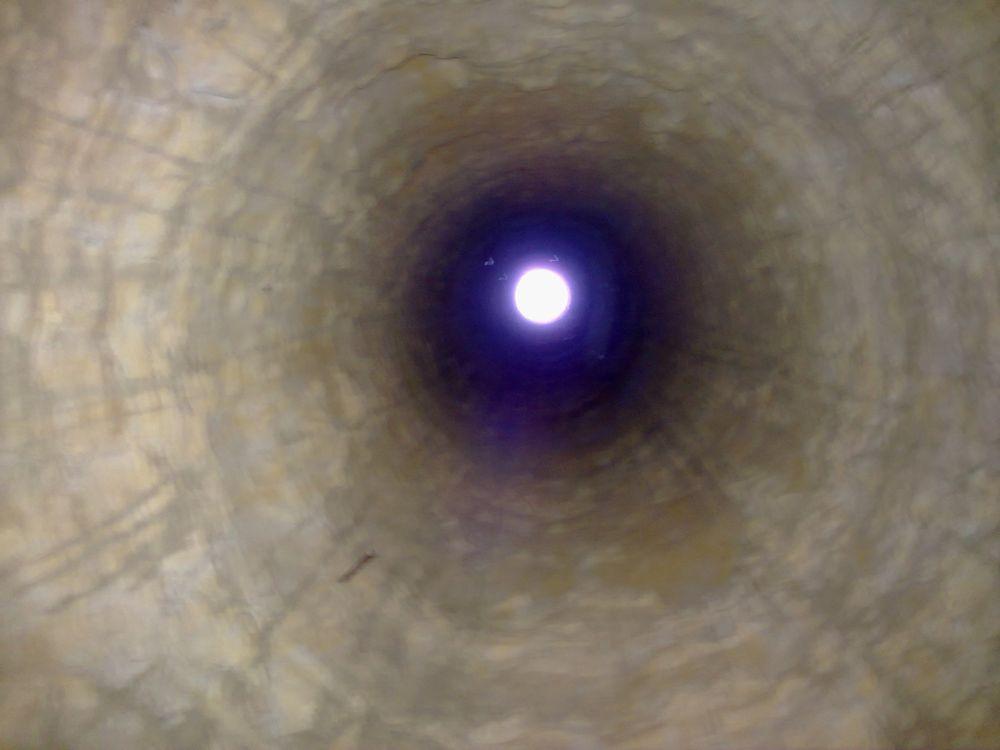
What makes Qasabeh exceptional is depth. At the head of the system, the mother well (مادرچاه, mâdar-châh) reaches down hundreds of metres to the water table. Every few dozen metres along the route another shaft was sunk, so that diggers could lift out the spoil and air could reach the men working below. Seen from the air or from a nearby hill, the shafts show as a long row of round mounds, like a dotted line drawn across the plain. Exact figures for depth and length differ between sources, partly because a qanat is a living system that has been extended, cleaned and re-routed many times.
Legends and early records
The local name connects the qanat with Kay Khosrow, a legendary king of the Shahnameh, and Gonabadis tell that it was dug on his orders. That is legend, not history. Iranian heritage literature often dates the system to the Achaemenid period, roughly 700 to 500 BCE; this is plausible for the region but cannot be proven, because qanats leave little datable material and are constantly re-dug.
The written record is firmer from the Islamic period. The 10th-century geographer al-Istakhri noted that Gonabad drew its water from underground channels, so a qanat system was clearly well established by then. Later geographers describe the town as a prosperous oasis of gardens, and saffron, grain and fruit are still grown on qanat water today.
Sharing the water: the water clock
A qanat’s flow is limited, so the fair division of water between families was as important as the tunnel itself. In Gonabad, as in other desert towns, water rights were measured in time, and the timekeeper was the fenjân (فنجان), a water clock. A small bowl with a hole in its base was set floating in a larger vessel; when it filled and sank, one unit of time had passed. A water master (میراب, mirâb) counted the sinkings and opened or closed each farmer’s channel accordingly. Water clocks of this kind stayed in use in parts of Iran into living memory, and the method is one of the things visitors to Gonabad are often shown.
The qanat was also maintained by a specialist craft. The moqanni (مقنی), the qanat digger, worked in narrow, dark tunnels where collapse and bad air were real dangers. The skill passed down in families, and the UNESCO listing names this body of knowledge and the community rules for sharing water as part of what makes the Persian qanats outstanding.
Visiting the Qasabeh qanat
Gonabad is a quiet provincial town, usually reached by road from Mashhad to the north (a drive of roughly four hours) or as a stop on the long road between Mashhad and Yazd or Kerman. The qanat is in the Qasabeh area of the town.
What to see
- The outlet, where the water emerges from the tunnel into open channels that run through gardens and fields. This is the easiest place to see the qanat working.
- The line of shafts stretching back towards the hills, best seen from a vantage point outside the town.
- Water-clock displays, where available, showing how the fenjân was used to time each share.
- Gonabad’s old town and the surrounding saffron fields, which flower purple in late autumn.
Practical notes and safety
- Never climb into or lean over an open qanat shaft. They are very deep, often unmarked and unprotected, and the ground around them can give way.
- Access arrangements, any entry charges and opening times change; ask locally or check with the provincial heritage office before travelling.
- Summer days are very hot; the spring and autumn months are more comfortable. See Climate of Iran and the Best Time to Visit.
- Check your own government’s current travel advice for Iran before planning a trip.
Qanats were the lifeline of desert cities, and Iran’s other great water monuments make good companions to this one: the bridge-weirs and mills of the Shushtar Historical Hydraulic System and the qanat-fed gardens of Shazdeh Garden at Mahan.
Persian words from this page
| قنات | qanât | qanat, underground water channel |
| کاریز | kâriz | qanat (the usual word in Khorasan) |
| مادرچاه | mâdar-châh | mother well, the head shaft |
| میراب | mirâb | water master |
| فنجان | fenjân | bowl; here, the water clock |
| مقنی | moqanni | qanat digger |
| گناباد | Gonâbâd | Gonabad |
Sources and further reading
- UNESCO World Heritage Centre, The Persian Qanat (inscribed 2016).
- Encyclopaedia Iranica, “Gonābād”, including al-Istakhri’s note on its qanats.
- Encyclopaedia Iranica, “Kāriz”.
- Henri Goblot, Les qanats: une technique d’acquisition de l’eau (Paris, 1979).
- Paul Ward English, “The Origin and Spread of Qanats in the Old World”, Proceedings of the American Philosophical Society 112 (1968).
Want to learn Persian? Get the free Starter Pack
Get the 14-page printable Starter Pack (all 32 letters, a 7-day reading plan, 100 core words and 20 survival phrases) and a short 5-email course. Free.
More in Top Places to Visit in Iran
- Naqsh-e Jahan Square
- Shah (Imam) Mosque, Isfahan
- Sheikh Lotfollah Mosque
- Ali Qapu Palace
- Jameh Mosque of Isfahan
- Si-o-se Pol and Khaju Bridge
- Vank Cathedral
- Hasht Behesht Palace
- Naqsh-e Rostam
- Eram Garden, Shiraz
- Nasir al-Molk (Pink) Mosque
- Tomb of Hafez (Hafezieh)
- Tomb of Saadi (Saadieh)
- Shah Cheragh Shrine
- Arg of Karim Khan
- Fin Garden, Kashan
- Historic Houses of Kashan
- Jameh Mosque of Yazd
- Yazd Fire Temple and Towers of Silence
- Dowlatabad Garden and Windcatcher
- Amir Chakhmaq Complex
- Golestan Palace
- National Museum of Iran
- Treasury of National Jewels
- Tehran Grand Bazaar
- Milad Tower
- Imam Reza Shrine, Mashhad
- Tomb of Ferdowsi, Tus
- Tomb of Omar Khayyam, Neyshabur
- Tomb of Avicenna, Hamadan
- Ganjnameh Inscriptions, Hamadan
- Behistun (Bisotun): Visiting the Site
- Taq-e Bostan: Visiting the Site
- Tabriz Historic Bazaar
- Takht-e Soleyman
- Armenian Monastic Ensembles of Iran
- Sheikh Safi al-Din Shrine, Ardabil
- Dome of Soltaniyeh
- Alamut Castle
- Falak-ol-Aflak Castle
- Shushtar Historical Hydraulic System
- Chogha Zanbil: Visiting the Ziggurat
- Susa Archaeological Site
- Arg-e Bam
- Ganjali Khan Complex, Kerman
- Shazdeh Garden, Mahan
- Rayen Castle
- Dasht-e Lut (Lut Desert)
- Maranjab Desert and Caravanserai
- Varzaneh Desert
- Mount Damavand
- Hyrcanian Forests
- Lake Urmia
- Badab-e Surt Springs
- Ali Sadr Cave
- The Kaluts of Shahdad
- Qeshm Geopark
- Hormuz Island Colours
- Visiting Persepolis: A Day Trip from Shiraz
- Visiting Pasargadae
- Persian Caravanserais
- The Qanat of Gonabad
- Meymand Village
- Sasanian Sites of Fars: Firuzabad, Bishapur and Sarvestan
- Gonbad-e Qabus: Visiting the Tower
- Zayandeh Rud and Isfahan’s Bridges
- Tochal and Darband: Hiking Above Tehran
- Mount Sabalan
- Skiing in Iran: Dizin and Shemshak
- Golestan National Park