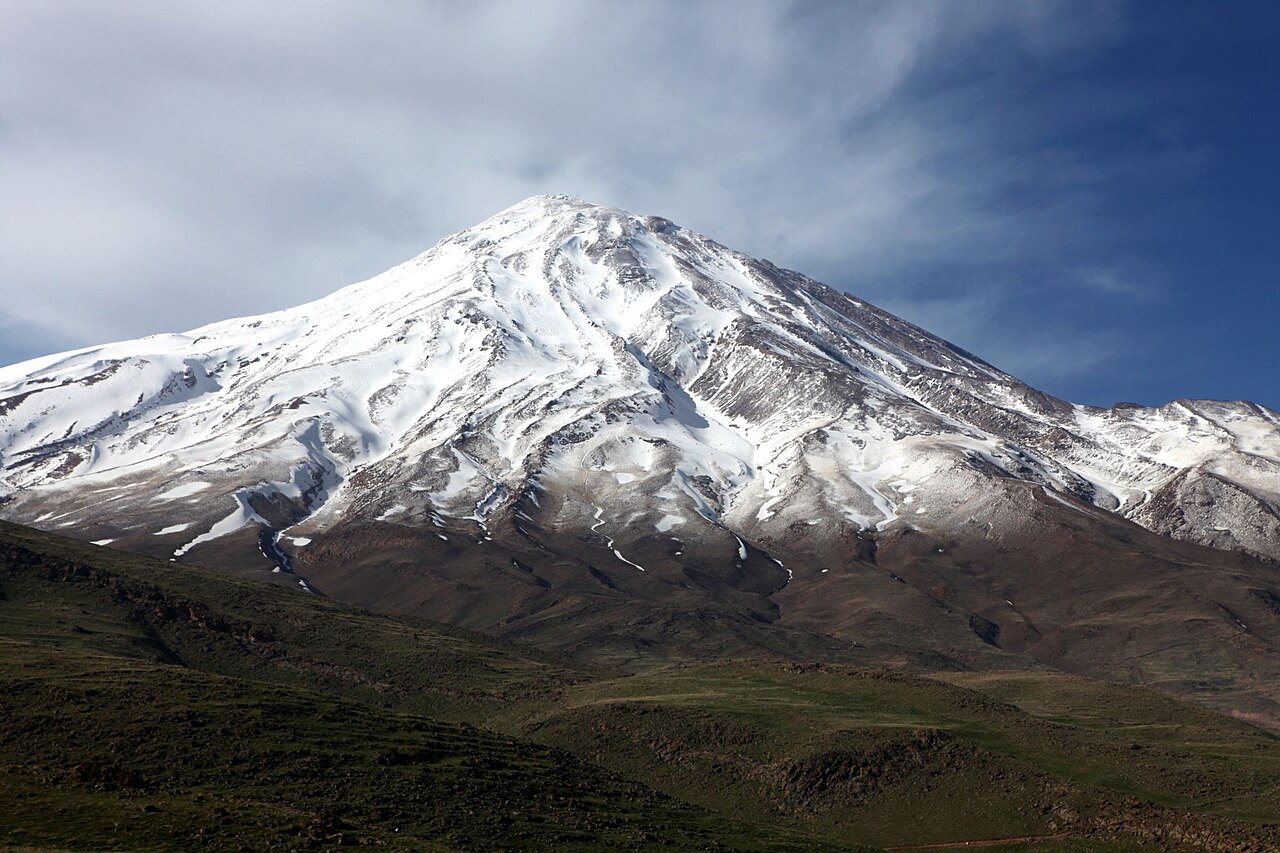
Mount Damavand (دماوند) is a dormant volcano in the Alborz range, 66 km north-east of Tehran, and at about 5,610 metres the highest mountain in Iran and in Western Asia. It is a non-technical but serious climb, done by thousands of Iranians every summer, and it is also the mountain of Persian myth: the place where, in the Shahnameh, the tyrant Zahhak lies chained.
| Height | About 5,610 m by recent survey; older figures of 5,670 m or 5,671 m are still widely quoted |
|---|---|
| Type | Stratovolcano, dormant; last eruption about 7,000 years ago |
| Location | Central Alborz, Amol county, Mazandaran province |
| Main routes | South (from Polur), north-east (from Nandal), west, north |
| Climbing season | Roughly July to mid-September for the standard routes |
| Status | Registered in 2008 as Iran’s first national natural monument |

A volcano that is not quite asleep
Damavand is a near-perfect cone sitting on top of the folded rocks of the Alborz. Volcanic activity in the area began about 1.8 million years ago, and the present cone has been building for around 600,000 years from lava flows and ash. The most recent eruption is dated to roughly 5300 BCE.
The mountain is still warm inside. Hot springs rise around its base, and fumaroles near the summit release sulphurous gas. The small summit crater is stained yellow with sulphur deposits, and climbers often smell it before they see it. Geologists class the volcano as dormant rather than extinct.
The height is a small puzzle. Iranian textbooks long gave 5,671 metres, a figure you will also see on this site’s older Damavand Mountain article, which describes its waterfalls and ice falls. More recent measurements give about 5,610 metres, the figure now used in most international references. Either way it is the highest volcano in Asia and one of the most prominent peaks on Earth.
Damavand in myth and poetry
Few mountains carry so much story. In Ferdowsi’s Shahnameh, the hero-king Fereydun defeats Zahhak, the tyrant from whose shoulders grow two snakes that feed on human brains, and chains him inside a cave on Damavand rather than kill him. Folk tradition says the rumbling and the sulphur are Zahhak still struggling in his chains. The story is told more fully on Myth and history in the Shahnameh.
A second legend, recorded by the 10th-century historian Bal’ami, makes Damavand the place from which the archer Arash shot the arrow that fixed the border between Iran and Turan; in the story Arash gave his life with the shot.
In the modern era the mountain became a symbol of resistance to tyranny. The poet Mohammad-Taqi Bahar opened his famous ode to it with the line ای دیو سپید پای در بند: “O white giant with feet in chains.” Since 2008 the 13th of Tir (early July), the day of the old festival of Tirgan, has been marked as National Damavand Day.
Climbing Damavand
There are at least 16 routes to the summit. None of the standard summer routes needs ropes, but all of them climb to an altitude where the air holds about half the oxygen of sea level, and that is what turns back most people.
South route
The most popular route starts from Polur, on the Haraz road from Tehran to Amol. Climbers are usually driven up to Gusfand Sara, where there is a small mosque, and walk to the Bargah-e Sevom shelter (Camp 3) at about 4,220 m. Summit day is a long slog up scree and snow on a marked path, often in sulphur fumes near the top, followed by a descent back to the shelter.
North-east and west routes
The north-east route from Nandal is longer and usually takes two days to the summit, with a night at the Takht-e Fereydun shelter at about 4,300 m. The west route has the Simorgh shelter at about 4,100 m and is known for its sunset views. These routes are quieter and suit people who want to avoid the summer crowds of the south side.
Winter
Winter ascents are a different matter: deep snow, strong winds and temperatures far below freezing make them a serious expedition for experienced mountaineers only.
Altitude and safety
- Acclimatise. Spend at least one night around 3,000 m and one at the high shelter before the summit, or climb a lower peak first. Going from Tehran to 5,600 m in two days is how people get altitude sickness.
- Know the warning signs. Headache, nausea and poor sleep are common. Confusion, loss of balance or breathlessness at rest are signs of serious illness; the only reliable treatment is going down at once.
- Watch the weather. Storms, wind chill and whiteout are the usual causes of accidents. Start summit day early and set a turn-around time.
- Sulphur gas. Near the summit fumes can be strong; do not linger in the crater area if breathing becomes difficult.
- Go with a guide or club, at least for a first ascent, and check current permit and shelter arrangements with Iran’s mountaineering federation or a licensed local operator. Make sure your insurance covers high-altitude trekking, and follow your own government’s travel advice for Iran.
Seeing Damavand without climbing it
You do not need to reach the summit to enjoy the mountain. On clear days, especially in winter after rain, it is visible from Tehran’s northern districts and from the Tochal ridge. The Haraz road passes close under its south face, and the Lar valley on the west side has meadows, a dam lake and summer camps. The Caspian snowcock lives on the high scree, and cushion plants such as milk-vetch cover the upper slopes.
Damavand is the high point of the mountains described on Geography of Iran and looks down on the forests of the Caspian side, covered on the Hyrcanian forests page and in the guide to the north of Iran. Iran’s other great volcano, in the north-west, is Mount Sabalan.
Persian words from this page
| کوه | kuh | mountain |
| قله | qolle | summit |
| آتشفشان | âtashfeshân | volcano |
| گوگرد | gugerd | sulphur |
| پناهگاه | panâhgâh | mountain shelter |
| ضحاک | Zahhâk | Zahhak, the tyrant of the Shahnameh |
| فریدون | Fereydun | Fereydun, the king who chains him |
Sources and further reading
- Ferdowsi, Shahnameh, the story of Zahhak and Fereydun (trans. Dick Davis, Shahnameh: The Persian Book of Kings, 2006).
- Encyclopaedia Iranica, “Damāvand” (mountain).
- Smithsonian Institution, Global Volcanism Program, “Damavand”.
- Mohammad-Taqi Bahar, “Damavandiyeh” (ode to Damavand), in his Divan.
Want to learn Persian? Get the free Starter Pack
Get the 14-page printable Starter Pack (all 32 letters, a 7-day reading plan, 100 core words and 20 survival phrases) and a short 5-email course. Free.
More in Top Places to Visit in Iran
- Naqsh-e Jahan Square
- Shah (Imam) Mosque, Isfahan
- Sheikh Lotfollah Mosque
- Ali Qapu Palace
- Jameh Mosque of Isfahan
- Si-o-se Pol and Khaju Bridge
- Vank Cathedral
- Hasht Behesht Palace
- Naqsh-e Rostam
- Eram Garden, Shiraz
- Nasir al-Molk (Pink) Mosque
- Tomb of Hafez (Hafezieh)
- Tomb of Saadi (Saadieh)
- Shah Cheragh Shrine
- Arg of Karim Khan
- Fin Garden, Kashan
- Historic Houses of Kashan
- Jameh Mosque of Yazd
- Yazd Fire Temple and Towers of Silence
- Dowlatabad Garden and Windcatcher
- Amir Chakhmaq Complex
- Golestan Palace
- National Museum of Iran
- Treasury of National Jewels
- Tehran Grand Bazaar
- Milad Tower
- Imam Reza Shrine, Mashhad
- Tomb of Ferdowsi, Tus
- Tomb of Omar Khayyam, Neyshabur
- Tomb of Avicenna, Hamadan
- Ganjnameh Inscriptions, Hamadan
- Behistun (Bisotun): Visiting the Site
- Taq-e Bostan: Visiting the Site
- Tabriz Historic Bazaar
- Takht-e Soleyman
- Armenian Monastic Ensembles of Iran
- Sheikh Safi al-Din Shrine, Ardabil
- Dome of Soltaniyeh
- Alamut Castle
- Falak-ol-Aflak Castle
- Shushtar Historical Hydraulic System
- Chogha Zanbil: Visiting the Ziggurat
- Susa Archaeological Site
- Arg-e Bam
- Ganjali Khan Complex, Kerman
- Shazdeh Garden, Mahan
- Rayen Castle
- Dasht-e Lut (Lut Desert)
- Maranjab Desert and Caravanserai
- Varzaneh Desert
- Mount Damavand
- Hyrcanian Forests
- Lake Urmia
- Badab-e Surt Springs
- Ali Sadr Cave
- The Kaluts of Shahdad
- Qeshm Geopark
- Hormuz Island Colours
- Visiting Persepolis: A Day Trip from Shiraz
- Visiting Pasargadae
- Persian Caravanserais
- The Qanat of Gonabad
- Meymand Village
- Sasanian Sites of Fars: Firuzabad, Bishapur and Sarvestan
- Gonbad-e Qabus: Visiting the Tower
- Zayandeh Rud and Isfahan’s Bridges
- Tochal and Darband: Hiking Above Tehran
- Mount Sabalan
- Skiing in Iran: Dizin and Shemshak
- Golestan National Park