A qanat (قنات), called kâriz in eastern Iran, is a gently sloping tunnel that carries groundwater from the foot of the mountains to villages and fields far out on the plain, using gravity alone. Iranians have built them for nearly three thousand years, and tens of thousands still flow. In 2016 UNESCO listed eleven of them as the World Heritage Site “The Persian Qanat”.
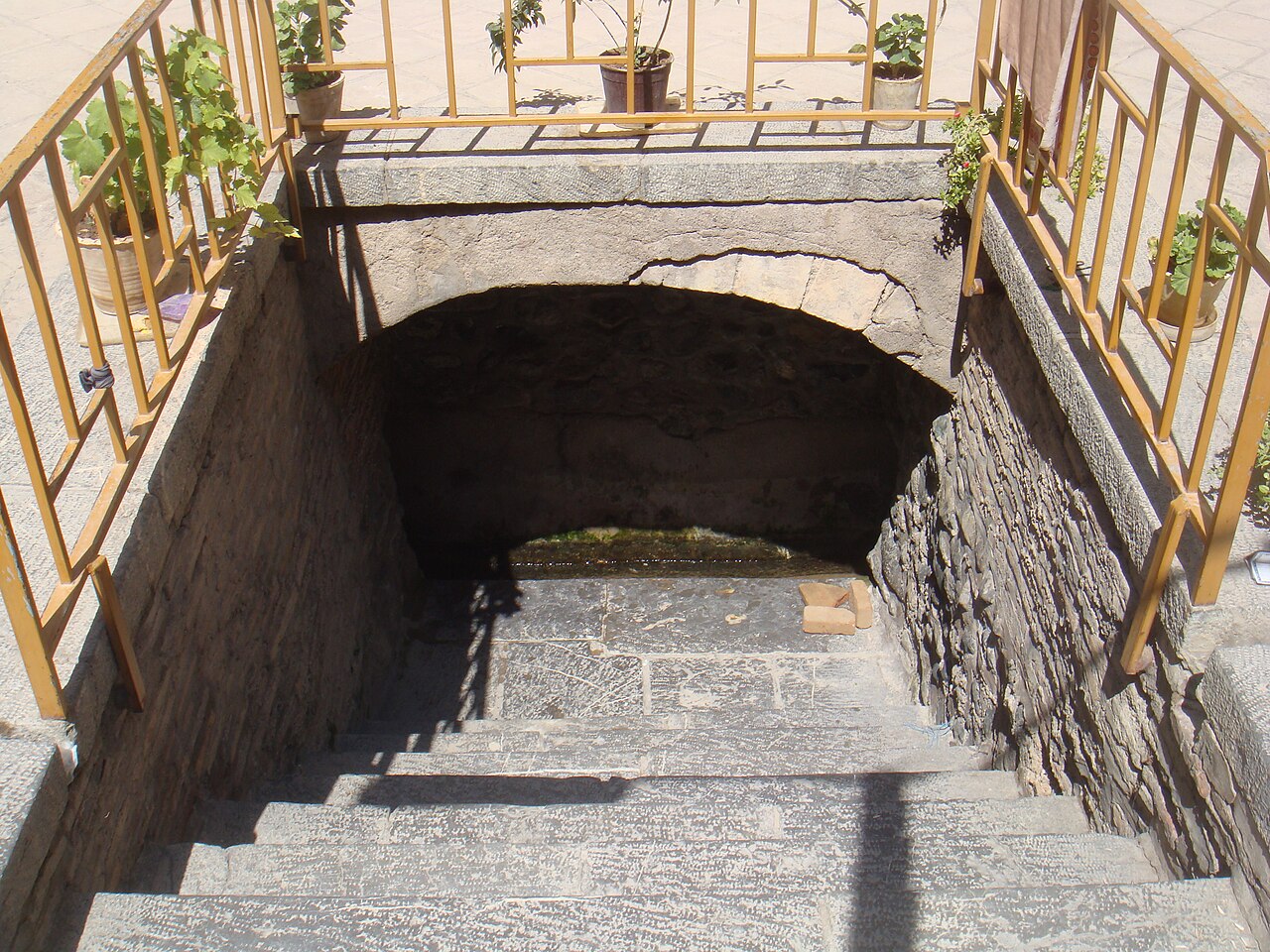

| Persian names | qanât; kâriz (east Iran, Afghanistan) |
|---|---|
| Origin | Iranian plateau, probably early 1st millennium BCE (debated) |
| How it works | Mother well taps the water table; a tunnel with a slight downhill gradient brings water to the surface; vertical shafts every few dozen metres for air and spoil |
| Best-known example | Qasabeh qanat, Gonabad: 427 wells, about 33 km of channels |
| UNESCO | “The Persian Qanat”, 11 qanats, inscribed 2016 |
How a qanat works
Most of Iran gets little rain, but the snow on the Zagros and Alborz soaks into the gravel fans at the foot of the mountains. A qanat taps that hidden water. Diggers first sink a trial well, the mother well (mâdar-châh), until they reach the water table. They then start at the other end, where the water is wanted, and dig a tunnel back towards the mother well, rising very slightly, so that water will flow out without any pump. Every 20 to 50 metres a vertical shaft links the tunnel to the surface, to bring up spoil and let in air and light. From the air a qanat looks like a line of craters running across the desert.
The tunnel is usually just tall enough for a man to stoop in. Where the ground is soft it is lined with fired clay hoops. The slope matters: too steep and the water erodes the tunnel, too gentle and it silts up. Getting it right over many kilometres, underground, with simple tools, was the skill of the moqanni, the qanat digger, whose craft passed from father to son, especially in Yazd and Kerman.
Ancient beginnings
Where and when the first qanat was dug is disputed. Most historians place the invention on the Iranian plateau, or the highlands of north-west Iran, early in the 1st millennium BCE; some archaeologists argue that the falaj channels of Oman are as old or older. What is clear is that the Achaemenid Persians spread the technique. Persian-period qanats have been excavated in Egypt’s Western Desert, at the time when Egypt was under Persian rule.
The first written description comes from the Greek historian Polybius in the 2nd century BCE. Writing of the Persian period, he says that the kings granted the profits of the land for five generations to anyone who brought water underground to land that had none. Whether or not the rule was exactly as he describes, it shows how highly water-finders were valued.
Law, books and the Islamic centuries
Because one qanat could ruin another by drawing down its water, qanats led to some of the earliest water law. According to the historian Gardizi, the Tahirid governor of Khorasan, Abdallah ibn Tahir, had jurists compile a Book of Qanats in the 9th century to settle disputes (see the Tahirids of Khorasan). In the early 11th century the mathematician al-Karaji, working in the Buyid world, wrote The Extraction of Hidden Waters, a technical manual on finding groundwater, levelling tunnels and keeping qanats in repair.
Each village shared its qanat water by time, in turns measured with a bowl that sank in a basin of water, and a water master (mirâb) kept the schedule. Ownership of shares in a qanat was bought, sold and inherited like land.
Cities built on underground water
Qanats made the oasis cities of central Iran possible. Yazd, Kerman and Kashan were fed by long qanats, and the water shaped how people built. Houses reached the water by steep stairways called pâyâb; cisterns (âb-anbâr), cooled by windcatchers, stored it for summer; ice houses (yakhchâl) froze it in winter. Qanat water also fed the Persian garden: the Dowlatabad Garden in Yazd and the Fin Garden in Kashan both depend on it. Tehran itself grew in the Qajar period on qanat water flowing down from the Alborz.
The qanat is not the only Iranian water system. At Shushtar in Khuzestan, Sasanian engineers built weirs, canals and tunnels on the Karun river, a different technology described on our page on the Shushtar hydraulic system.
The eleven UNESCO qanats
The Persian Qanat World Heritage Site gathers eleven qanats from Khorasan to Kerman, chosen to show different settings and ages. The most famous is the Qasabeh qanat of Gonabad in Razavi Khorasan, traditionally said to be about 2,700 years old. Its 427 wells and about 33 km of channels still supply water to farms around the town, and its mother well is said to be some 300 metres deep. Our place page on the Qanat of Gonabad covers a visit. Others include the Zarch qanat at Yazd, one of the longest in Iran, and qanats in Kerman province and around Ardestan near Isfahan. See also UNESCO sites in Iran.
Decline and survival
In the 20th century the qanat system came under strain. Land reform in the 1960s broke up the estates whose owners had paid for upkeep, and cheap diesel and electric pumps made deep wells far easier than maintaining a qanat (see the White Revolution). Deep wells lowered the water table, and many qanats dried up. Estimates of how many qanats Iran once had vary widely, from about 30,000 to more than 50,000; tens of thousands still flow, but many are neglected. Iran’s wider water shortage, from falling aquifers to shrinking Lake Urmia, has renewed interest in qanats as a way to use groundwater without exhausting it.
Persian words from this page
| قنات | qanât | underground water channel |
| کاریز | kâriz | qanat (eastern usage) |
| مقنی | moqanni | qanat digger |
| مادرچاه | mâdar-châh | mother well |
| آبانبار | âb-anbâr | water cistern |
| میراب | mirâb | water master |
| یخچال | yakhchâl | ice house |
Sources and further reading
- Polybius, Histories 10.28.
- UNESCO World Heritage Centre, The Persian Qanat (no. 1506).
- Encyclopaedia Iranica, “Kāriz”.
- Paul Ward English, “The Origin and Spread of Qanats in the Old World”, Proceedings of the American Philosophical Society 112 (1968).
- Henri Goblot, Les qanats: une technique d’acquisition de l’eau, Paris, 1979.
Want to learn Persian? Get the free Starter Pack
Get the 14-page printable Starter Pack (all 32 letters, a 7-day reading plan, 100 core words and 20 survival phrases) and a short 5-email course. Free.
More in Themes Across Iranian History (3000 BCE–today)
- A History of the Persian Language
- Zoroastrianism through the Ages
- Shi’a Islam in Iranian History
- The Jews of Iran
- The Armenians of Iran
- Christians of Iran
- The Baha’i Faith in Iran
- The Kurds in Iranian History
- Azerbaijanis in Iranian History
- The History of the Iranian Calendar
- Nowruz through History
- The Persian Garden (Pardis) through History
- Qanats: Iran’s Ancient Water Tunnels
- A History of Persian Carpets
- A History of Persian Architecture
- A History of Persian Painting
- A History of Persian Music
- Science in Iranian History
- Women in Iranian History
- Iran and the Silk Road
- Iran and China through History
- Iran and India through History
- Iran and Greece: Perceptions and Exchanges
- Persia and Rome: Seven Centuries of Rivalry
- Iran and the Ottoman Empire
- Iran and Russia through History
- Iran and Britain through History
- Iran and the United States
- How Iran’s Borders Changed
- The Capitals of Iran through History
- Coins of Iran through History: From the Daric to the Rial
- Flags and Symbols of Iran through History
- Myth and History in the Shahnameh: The Epic’s Kings and the Real Past
- Timeline of Iranian History: Key Dates from Elam to Today
- A History of Persian Cuisine: From Royal Banquets to Chelow Kabab
- A History of Persian Poetry: From Rudaki to Forough
- Wine in Iranian History: From Hajji Firuz to Hafez and Prohibition
- Sports in Iranian History: Polo, the Zurkhaneh and Wrestling
- List of Iranian Dynasties and Rulers