The Iran–Iraq War began on 22 September 1980, when Iraq under Saddam Hussein bombed Iranian airfields and sent its army across the border into the oil province of Khuzestan. Saddam aimed to win control of the Shatt al-Arab waterway, overturn the 1975 border treaty and strike at a revolutionary government that was calling on Iraqis to rise against him. He expected a short war; it lasted almost eight years.
| Invasion | 22 September 1980 |
|---|---|
| Iraqi leader | Saddam Hussein (president from July 1979) |
| Iranian leaders | Ayatollah Khomeini; President Abolhassan Bani-Sadr |
| Disputed border | Shatt al-Arab (Persian: اروندرود, Arvandrud) |
| Iranian names for the war | “The Imposed War” and “The Sacred Defence” |
| UN finding | A 1991 report by Secretary-General Javier Pérez de Cuéllar named Iraq’s attack as the aggression |
A river border with a long history
The Shatt al-Arab is formed where the Tigris and Euphrates meet, and it runs to the Persian Gulf past the Iraqi port of Basra and the Iranian cities of Khorramshahr and Abadan. A 1937 treaty, signed when Iraq was close to Britain, placed the border on the Iranian bank, giving Iraq control of almost the whole waterway. Mohammad Reza Shah rejected that arrangement in 1969 and pressed Iraq by arming the Kurdish rebels of Mustafa Barzani in northern Iraq.
In March 1975, at an OPEC summit in Algiers, the shah and Saddam Hussein, then Iraq’s vice-president, settled the dispute. The Algiers Agreement moved the border to the deepest channel in the middle of the river, as Iran wanted, and Iran in return stopped helping the Kurds, whose revolt then collapsed. Saddam saw the deal as a humiliation forced on Iraq at a time of weakness.
Revolution next door
The Iranian Revolution changed the balance. Khomeini had lived in exile in Najaf from 1965 until Iraq expelled him in 1978, and he despised the secular Ba’th Party. After 1979 Iranian radio and officials called on Iraq’s Shi’a majority to overthrow the Ba’thist government. Iraqi Shi’a activists of the Dawa Party carried out attacks, including a grenade attack on Deputy Prime Minister Tariq Aziz in Baghdad in April 1980. Saddam’s government responded by executing the leading Shi’a cleric Ayatollah Mohammad Baqir al-Sadr and his sister Amina, known as Bint al-Huda, and by deporting tens of thousands of Iraqis said to be of Iranian origin.
Border clashes and artillery exchanges grew through the summer of 1980. Each side accused the other of starting them; Iraq later named 4 September 1980 as the date of Iranian shelling that, in its account, began the war. On 17 September Saddam appeared on television, declared the Algiers Agreement void and claimed the whole Shatt al-Arab for Iraq.
Why Saddam thought he could win quickly
Iran in 1980 looked vulnerable. Many senior officers had been executed, retired or had fled, and a coup plot uncovered at the Nojeh air base in July 1980 led to further purges. The hostage crisis had cut Iran off from American spare parts for its mostly American-built weapons. The government in Tehran was divided between President Bani-Sadr and the Islamic Republic Party (see power struggles after the revolution), and Kurdish and Arab unrest flared in the provinces.
Iraq also had wider ambitions. With Egypt isolated in the Arab world after its 1979 peace treaty with Israel, Saddam hoped to lead the Arab states. Iraqi propaganda called Khuzestan “Arabistan” and claimed to be liberating its Arabic-speaking population, though the hoped-for uprising among Iran’s Arabs did not come.
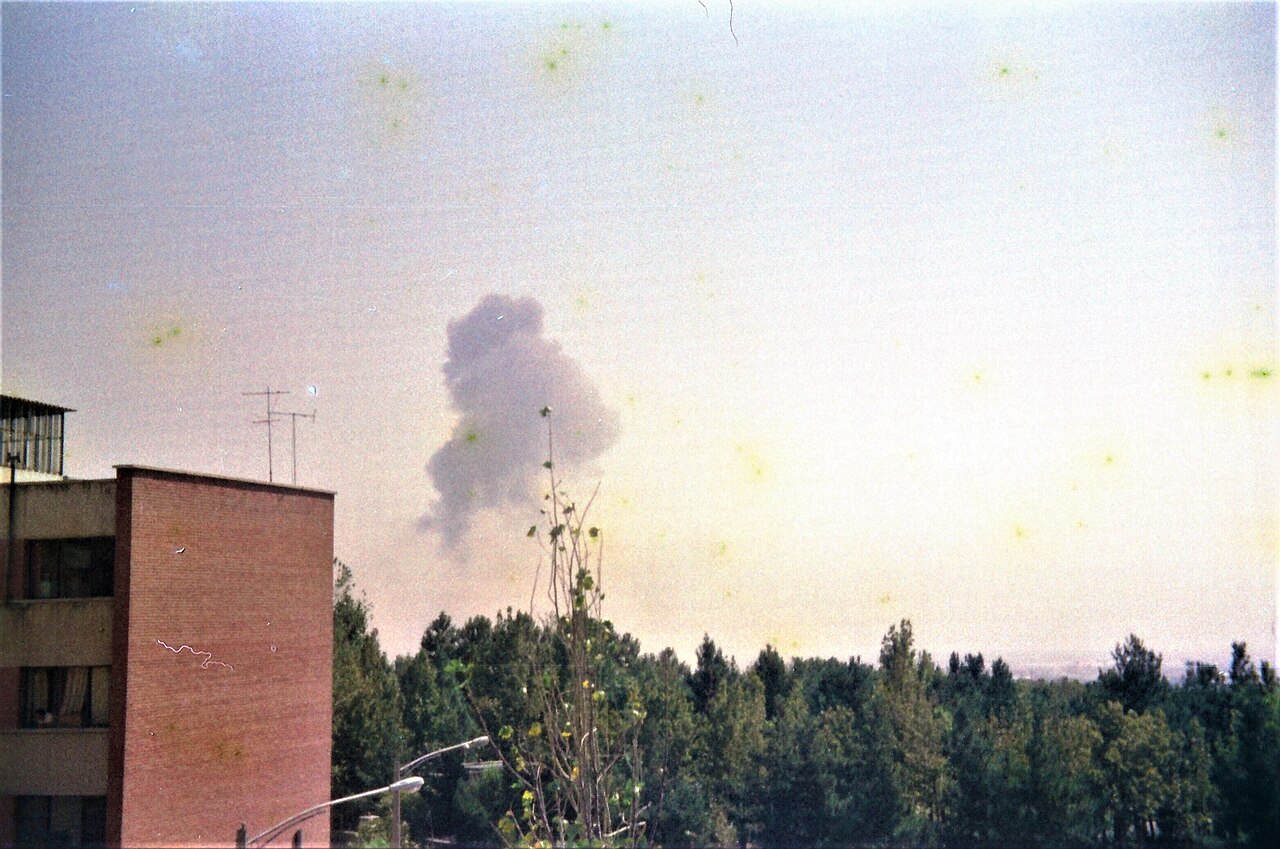

The invasion of 22 September 1980
The war opened with Iraqi air strikes on about ten Iranian air bases, including Mehrabad in Tehran, an attempt to destroy the Iranian air force on the ground as Israel had done to Egypt in 1967. It largely failed: Iranian aircraft were protected in hardened shelters, and the next day the Iranian air force struck back at targets across Iraq.
Iraqi ground forces advanced on several fronts. In the centre they took Qasr-e Shirin and Mehran. The main effort went south into Khuzestan, where armoured columns moved on Dezful, Ahvaz and Susangerd and towards the Shatt al-Arab cities. Khorramshahr fell after weeks of street fighting (see Khorramshahr: fall and liberation), and Abadan, with its huge oil refinery, was besieged. By December 1980 the Iraqi advance had stalled well short of its goals. Iraq held a strip of Iranian territory usually estimated at 10,000 to 15,000 square kilometres, but Iran had not collapsed.
- March 1975 Algiers Agreement sets the Shatt al-Arab border in mid-channel
- February 1979 Revolution in Iran
- July 1979 Saddam Hussein becomes president of Iraq
- April 1980 Attack on Tariq Aziz; execution of Ayatollah Mohammad Baqir al-Sadr
- 17 September 1980 Saddam renounces the Algiers Agreement
- 22 September 1980 Iraqi air strikes and invasion
- 28 September 1980 UN Security Council Resolution 479 calls for an end to fighting
- October 1980 Khorramshahr falls; Abadan besieged
How Iran responded
The invasion rallied Iranians behind the new state. Volunteers poured into the Revolutionary Guards and the Basij militia, and the clerical leadership presented the war as a defence of Islam and the nation. Khomeini rejected any ceasefire while Iraqi troops occupied Iranian land. In Iran the conflict is still officially called Jang-e Tahmili, the Imposed War, and Defa’-e Moqaddas, the Sacred Defence.
The United Nations response deepened Iranian distrust. Resolution 479 of 28 September 1980 called on both sides to stop fighting but did not name an aggressor or ask Iraq to withdraw. Only in December 1991, after Iraq had invaded Kuwait, did a report by Secretary-General Javier Pérez de Cuéllar state that Iraq’s attack of 22 September 1980 could not be justified under the UN Charter.
Historians on the causes
Historians weigh Saddam’s motives differently. Williamson Murray and Kevin Woods, who studied captured Iraqi government records after 2003, argue that Saddam was driven by a mix of opportunism and fear of Iranian subversion, and that his planning assumed a short, limited war. Efraim Karsh has emphasised the defensive side, Saddam’s fear that the revolution would spread to Iraq’s Shi’a. Pierre Razoux and Dilip Hiro also stress Saddam’s ambition to become the leading power in the Persian Gulf. Iranian accounts, both official and scholarly, see the war as an attempt by Iraq, with Arab and Western encouragement, to destroy the revolution while it was weak. Critics of the Iranian leadership, while accepting that Iraq was the aggressor, argue that Tehran’s calls for revolution in Iraq helped provoke the conflict.
The war’s next phase, when Iran recovered its territory and carried the fighting into Iraq, is covered in the Iran–Iraq War, 1982–1986. The front-line cities are described in Abadan and Khorramshahr.
Persian words from this page
| جنگ تحمیلی | jang-e tahmili | the Imposed War |
| دفاع مقدس | defâ’-e moqaddas | the Sacred Defence |
| اروندرود | Arvandrud | the Shatt al-Arab |
| خوزستان | Khuzestân | Khuzestan province |
| مرز | marz | border |
| بسیج | basij | mobilisation; the volunteer militia |
Sources and further reading
- Williamson Murray and Kevin M. Woods, The Iran–Iraq War: A Military and Strategic History (Cambridge University Press, 2014)
- Pierre Razoux, The Iran–Iraq War (Harvard University Press, 2015)
- Dilip Hiro, The Longest War: The Iran–Iraq Military Conflict (Routledge, 1989)
- Efraim Karsh, The Iran–Iraq War 1980–1988 (Osprey, 2002)
- UN Security Council Resolution 479 (1980); Report of the Secretary-General to the Security Council on Resolution 598, 9 December 1991
- Michael Axworthy, Revolutionary Iran: A History of the Islamic Republic (Allen Lane, 2013)
Want to learn Persian? Get the free Starter Pack
Get the 14-page printable Starter Pack (all 32 letters, a 7-day reading plan, 100 core words and 20 survival phrases) and a short 5-email course. Free.
More in The Islamic Revolution and the Islamic Republic (1979–present)
- Causes of the 1979 Revolution
- Khomeini’s Return and the Fall of the Monarchy
- Ruhollah Khomeini
- The 1979 Referendum and the New Constitution
- The Iran Hostage Crisis (1979–1981)
- Power Struggles after the Revolution
- The Cultural Revolution and University Closures
- The Iran–Iraq War: Causes and Iraqi Invasion
- Khorramshahr: Fall and Liberation
- The Iran–Iraq War, 1982–1986
- The Basij and Child Soldiers in the Iran–Iraq War
- Chemical Weapons in the Iran–Iraq War
- The Tanker War and Iran Air Flight 655
- The Iran–Contra Affair
- The End of the Iran–Iraq War (1988)
- The 1988 Executions of Political Prisoners
- The Death of Khomeini and the Succession of Khamenei (1989)
- Ali Khamenei
- Rafsanjani and Post-War Reconstruction (1989–1997)
- Khatami and the Reform Era (1997–2005)
- The 1999 Student Protests (18 Tir)
- The Ahmadinejad Presidency (2005–2013)
- The 2009 Election and the Green Movement
- Iran’s Nuclear Program
- Sanctions on Iran
- Rouhani and the Nuclear Deal (JCPOA)
- The Protests of 2017–2018 and November 2019
- The Killing of Soleimani and Flight 752 (January 2020)
- Iran and the COVID-19 Pandemic
- The Raisi Presidency and His Death (2021–2024)
- The 2022 Mahsa Amini Protests: “Woman, Life, Freedom”
- Iran and Israel: From Allies to Open Conflict
- The Pezeshkian Presidency
- The Twelve-Day War of June 2025
- The Protests of Late 2025 and January 2026
- The 2026 War with the United States and Israel
- The Killing of Ali Khamenei (28 February 2026)
- Mojtaba Khamenei and the 2026 Succession
- The Iranian Diaspora
- Iran and Hezbollah
- Major Earthquakes in Modern Iran
- Iranian Cinema after 1979