Bandar Abbas is the capital of Hormozgan province and Iran’s busiest port, a city of about 530,000 people on the Strait of Hormuz, where the Persian Gulf meets the Gulf of Oman. It took its name from Shah Abbas I, who seized it from the Portuguese in 1614 and made it Iran’s main gateway to the sea after the capture of Hormuz in 1622, and it is still the departure point for the islands of Hormuz, Qeshm and beyond.
| Persian name | بندرعباس (Bandar Abbâs), “port of Abbas” |
|---|---|
| Older names | Gamrun; in European sources Gombroon or Comorão |
| Province | Hormozgan (capital) |
| Population | 526,648 (city, 2016 census, Statistical Centre of Iran) |
| Climate | Hot and very humid from April to October; warm, pleasant winters |
| Languages heard | Persian, the local Bandari dialect, Achomi (Larestani), Balochi |
| Distance | About 1,300 km south of Tehran by road; about 490 km south of Kerman |

From Gamrun to “port of Abbas”
For most of the Middle Ages the great port of this coast was not on the mainland but on the island of Hormuz, a few kilometres offshore, which controlled the trade between India, the Persian Gulf and Iran. In 1507 the Portuguese under Afonso de Albuquerque made Hormuz a vassal state, and they built a fort at Gamrun, the small mainland landing opposite, to secure water and supplies.
Shah Abbas I took Gamrun in 1614. In 1622, with the help of English East India Company ships, his forces captured Hormuz itself and expelled the Portuguese, and the trade of the island moved to the mainland port, which was renamed Bandar-e Abbas in the shah’s honour. The campaign is described on the page about the capture of Hormuz from the Portuguese (1622).
The English and Dutch at Gombroon
Through the seventeenth century Bandar Abbas was Safavid Iran’s main port. The English East India Company and the Dutch East India Company (VOC), which opened a trading post in 1623, both kept factories here, buying silk and selling spices, sugar, cloth and Indian goods. European travellers such as Jean Chardin and Engelbert Kaempfer passed through and described a hot, unhealthy town where merchants made fortunes and many Europeans died of fever.
The fall of the Safavids in 1722 and the wars that followed ruined the trade. By the 1760s the English and Dutch had moved up the coast to Bushehr and to Basra. From the 1790s the port was leased to the sultans of Muscat (Oman), who held it, with interruptions, until the Qajar government took it back in 1868.
The modern port
In the twentieth century Bandar Abbas grew from a small town into a major city. The road to Kerman and the railway, which reached the city in the 1990s, tied it to the interior, and the Shahid Rajaee port, west of the old town, became Iran’s largest container port, handling the bulk of the country’s container traffic. A naval base, refineries, a steel plant and other industry have grown up along the coast. Because almost all of Iran’s sea trade with Asia passes through it, the city’s economy rises and falls with sanctions and the shipping on the Strait of Hormuz.
The Hindu temple and the old town
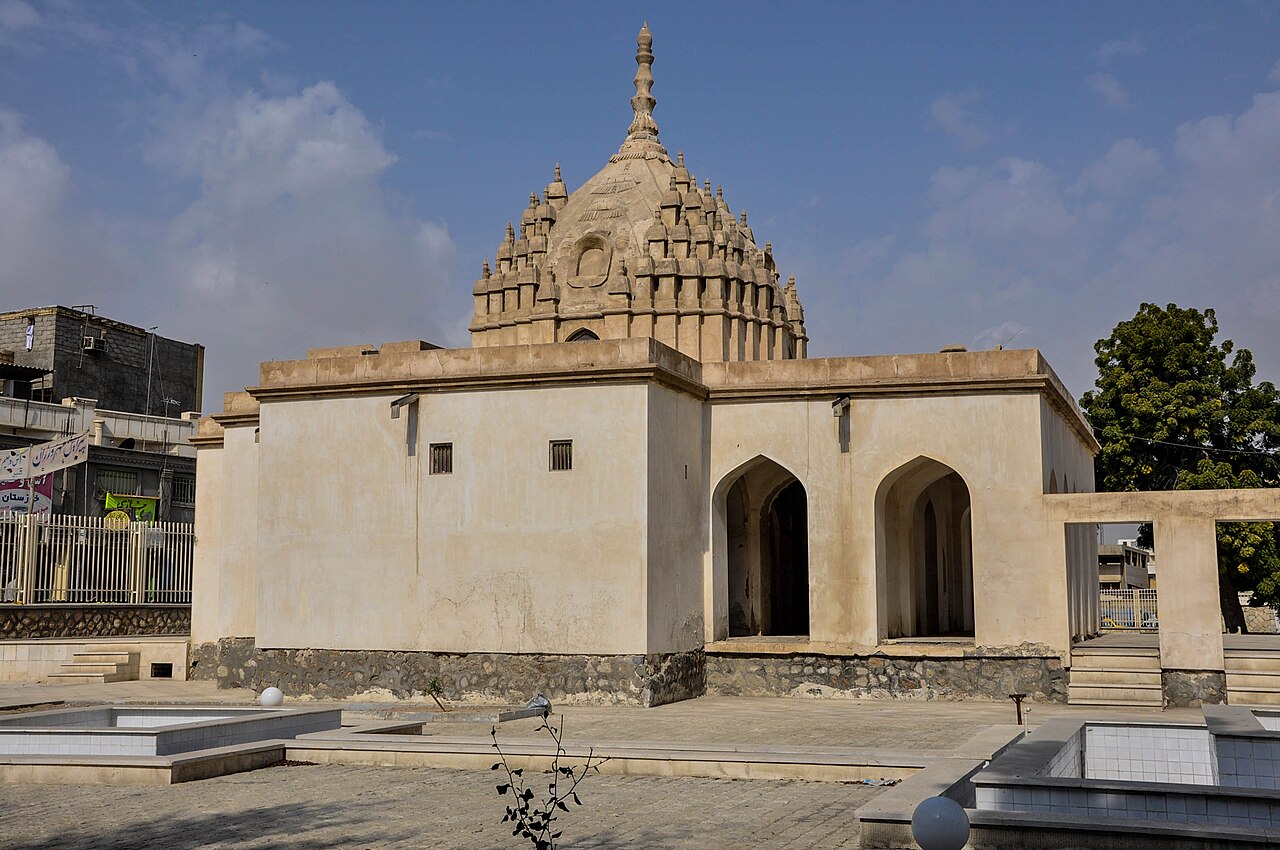
Indian merchants were an important part of Bandar Abbas’s trading community for centuries. In the 1890s, under the Qajar governor Mohammad Hasan Khan Sa’d al-Molk, a temple was built for them. The معبد هندوها (Ma’bad-e Hendu-hâ), “temple of the Hindus”, is a square building with a central dome surrounded by smaller domes, a style that mixes Indian and local architecture. It has been restored and can be visited.
Near it are the old bazaar, the fish market on the waterfront, and the seafront promenade, which fills with families after sunset when the heat breaks. Traditional wooden dhows, لنج (lenj), still work along the coast; lenj building and sailing knowledge was inscribed by UNESCO on the List of Intangible Cultural Heritage in Need of Urgent Safeguarding in 2011.
Bandari culture
The people of the coast, called Bandari (“of the ports”), have a culture shaped by centuries of contact with Arabia, India and East Africa. Some older women wear the برقع (borqa’), a stiff face mask, often red or black, with embroidery. Bandari music, with its fast drumming and dance, is popular all over Iran. The coast also has rituals of African origin, such as the zar ceremonies for healing those believed to be possessed by winds or spirits, which have been studied by anthropologists since the 1960s.
The food is hot and sour, with fish, shrimp, tamarind, chilli and dates. Look for ghalieh mahi, a fish stew with tamarind and coriander; meygu polo, shrimp rice; and mahyaveh, a pungent fermented fish sauce eaten with bread. Hormozgan is also a major date-growing province.
The islands and the coast
From the jetties of Bandar Abbas, boats run to the islands of the strait:
- Hormuz Island, with the ruins of the Portuguese fort and its red and ochre soils; see Hormuz Island colours.
- Qeshm Island, the largest island in the Persian Gulf, with the canyons and mangroves of the Qeshm Geopark.
- Larak and Hengam, smaller islands reached from Qeshm.
Kish Island, further west, is usually reached by air. On the mainland, the Geno mountain north of the city has hot springs and a protected area.
Getting there
Bandar Abbas has an airport with flights from Tehran, Shiraz, Isfahan and other cities, a railway line to Tehran via Kerman and Yazd, and long-distance buses. The best months to visit are November to March; summer heat combined with humidity is hard for most visitors. For ferry timetables, entry rules for the islands and safety, check current official information and your own government’s travel advice.
Persian words from this page
| بندر | bandar | port |
| هرمزگان | Hormozgân | Hormozgan province |
| تنگه هرمز | tangeh-ye Hormoz | Strait of Hormuz |
| جزیره | jazireh | island |
| لنج | lenj | dhow |
| برقع | borqa’ | face mask worn by Bandari women |
| ماهی | mâhi | fish |
| خرما | khormâ | date (fruit) |
Sources and further reading
- Encyclopaedia Iranica, “Bandar-e ʿAbbās”.
- Willem Floor, The Persian Gulf: A Political and Economic History of Five Port Cities, 1500–1730, Mage, 2006.
- Rudi Matthee, The Politics of Trade in Safavid Iran: Silk for Silver, 1600–1730, Cambridge University Press, 1999.
- UNESCO Intangible Cultural Heritage, Traditional skills of building and sailing Iranian Lenj boats in the Persian Gulf (2011).
- Statistical Centre of Iran, General Population and Housing Census 2016 (1395).
Want to learn Persian? Get the free Starter Pack
Get the 14-page printable Starter Pack (all 32 letters, a 7-day reading plan, 100 core words and 20 survival phrases) and a short 5-email course. Free.
More in Cities of Iran
- Tehran: Iran’s Capital
- Mashhad
- Isfahan
- Shiraz
- Tabriz
- Yazd
- Kashan
- Kerman
- Hamadan
- Qom
- Ahvaz
- Rasht
- Kermanshah
- Urmia
- Ardabil
- Zanjan
- Qazvin
- Sanandaj
- Khorramabad
- Bandar Abbas
- Bushehr
- Zahedan
- Birjand
- Gorgan
- Sari
- Semnan
- Arak
- Ilam
- Yasuj
- Shahr-e Kord
- Bojnurd
- Karaj
- Abadan and Khorramshahr
- Kish Island
- Qeshm Island
- Hormuz Island
- Masuleh
- Abyaneh
- Kandovan
- Bam
- Neyshabur (Nishapur)
- Shush (Susa) Today