For about seven centuries, from a first meeting on the Euphrates around 96 BCE to Heraclius’s victory over Khosrow II in 628 CE, Iran and Rome were the two great powers of western Eurasia. Parthian and then Sasanian kings fought Roman and Byzantine emperors over Mesopotamia, Armenia and the Caucasus, yet neither side ever destroyed the other, and the long rivalry left both exhausted on the eve of the Arab conquests.
| Dates | c. 96 BCE to 628 CE |
|---|---|
| Iranian dynasties | Arsacids (Parthians) to 224 CE; Sasanians 224 to 651 |
| Main battlegrounds | Upper Mesopotamia, Armenia, Syria, the Caucasus |
| Emperors killed or captured | Crassus (general) killed 53 BCE; Gordian III died 244; Valerian captured 260; Julian killed 363 |
| Persian name for Rome | Rum; the emperor was Qeysar (Caesar) |
A frontier on the Euphrates
Rome and Parthia first met diplomatically when the Roman commander Sulla received a Parthian envoy, Orobazus, on the Euphrates around 96 BCE. According to Plutarch, Sulla took the central seat between the Parthian and an Armenian king, and the Parthian king later had his envoy executed for allowing the insult. The incident set the tone: equal powers, and quarrels over rank.
War came in 53 BCE, when Marcus Licinius Crassus invaded Mesopotamia and was destroyed at Carrhae by the Parthian general Surena, whose horse archers and armoured cataphracts overwhelmed the legions. A Parthian counter-invasion of Syria under Pacorus followed, and then Mark Antony’s costly campaign of 36 BCE. Augustus chose diplomacy: in 20 BCE Phraates IV returned the captured Roman standards, which Roman propaganda treated as a triumph.
Armenia, the prize between empires
For most of the next six centuries the hottest question was Armenia. Its kings were often Arsacids, related to the Parthian royal house, yet Rome claimed the right to approve them. Under Vologases I a compromise was found: his brother Tiridates ruled Armenia but went to Rome to receive his crown from Nero in 66 CE. The arrangement kept the peace for half a century.
The 2nd century brought three Roman invasions of Mesopotamia. Trajan took Ctesiphon in 116 but could not hold it; the generals of Lucius Verus and later Septimius Severus sacked Seleucia and Ctesiphon in 165 and 197. These blows weakened the Arsacids and helped the rise of the Sasanians in 224 (see the fall of the Parthians).

Shapur I and the humbling of emperors
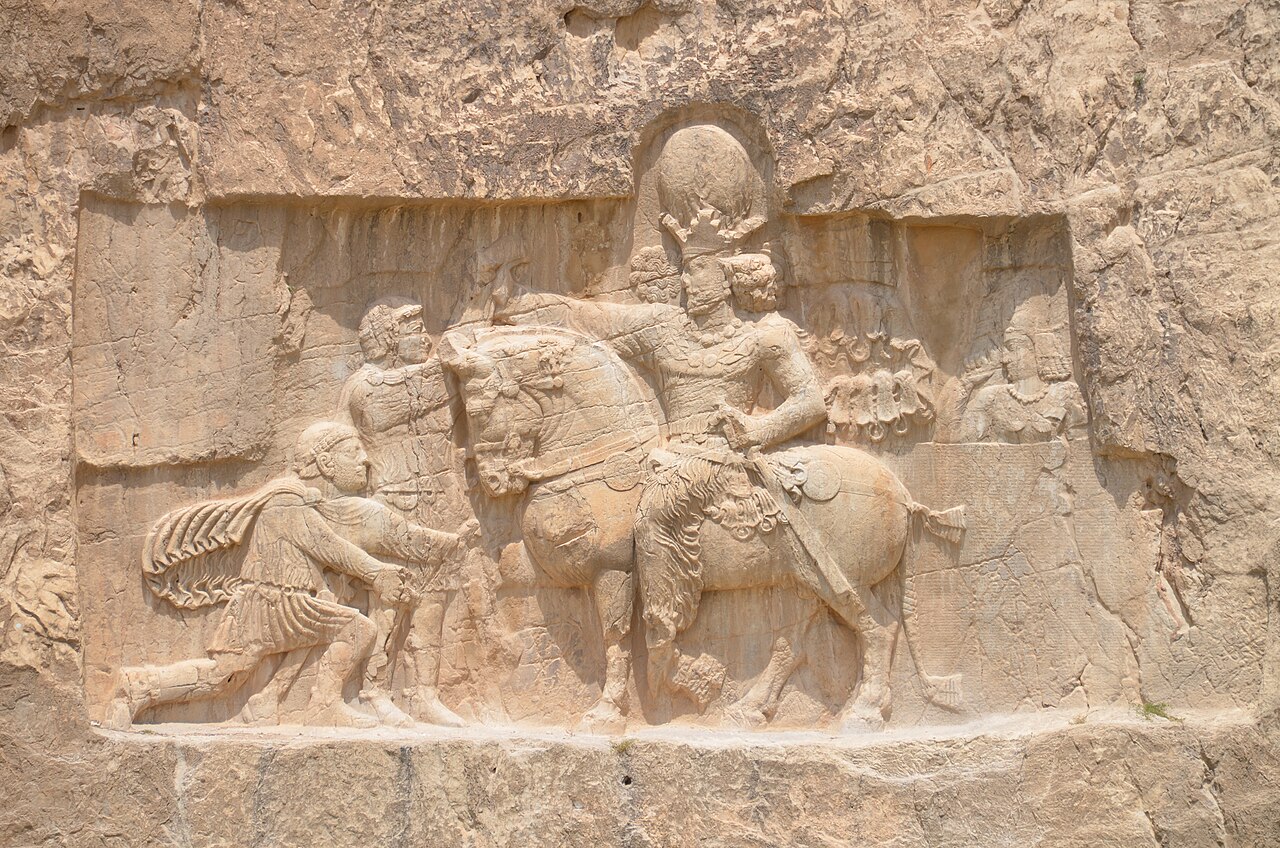
The Sasanians were more aggressive. Shapur I recorded in his trilingual inscription at the Ka’ba-ye Zartosht that the emperor Gordian III died after a battle in 244, that his successor Philip the Arab paid 500,000 denarii for peace, and that in 260 he captured the emperor Valerian at Edessa. Roman deportees were settled in Iran, and Iranian tradition credits them with building the bridge-dam at Shushtar (see the Shushtar water system). The scenes carved at Naqsh-e Rostam and Bishapur show emperors kneeling before the Persian king.
Rome struck back. The emperor Galerius defeated Narseh in 298 and imposed the Peace of Nisibis, which pushed the frontier east of the Tigris. Shapur II spent decades reversing it, and when Julian invaded in 363 and was killed in retreat, his successor Jovian gave back the lost provinces and the fortress city of Nisibis. Around 387 the two powers partitioned Armenia, with the larger eastern part going to Iran.
Religion enters the rivalry
Once Rome became Christian, religion shaped the conflict. Sasanian kings sometimes suspected their Christian subjects of loyalty to Constantinople, and Shapur II persecuted them during his wars; the Church of the East later separated from Byzantine doctrine, which made it easier for Iranian kings to tolerate (see Christians in Sasanian Iran). In Armenia, the Persian attempt to impose Zoroastrianism led to the battle of Avarayr in 451.
Cooperation in the 5th century
The 5th century was mostly peaceful. Both empires faced nomads from the steppe, and Constantinople sometimes paid towards Persian garrisons in the Caucasus passes that kept the Huns out of both empires. Yazdegerd I was, according to Procopius, named guardian of the young emperor Theodosius II, a story historians treat cautiously. Short wars in 421 to 422 and 440 changed little.
The last great wars
Fighting resumed in 502 when Kavad I, short of money, demanded Roman subsidies and took Amida. Under Justinian and Khosrow I the wars grew larger: the Roman victory at Dara in 530, the “Eternal Peace” of 532, Khosrow’s sack of Antioch in 540, the Lazic War on the Black Sea, and a Fifty Years’ Peace in 562 that lasted ten (see the 6th-century wars).
In 591 the emperor Maurice helped Khosrow II regain his throne from the rebel Bahram Chobin. When Maurice was murdered in 602, Khosrow used revenge as his reason for the war of 602 to 628, the last and greatest. Persian armies took Syria, Jerusalem (614) and Egypt and camped opposite Constantinople during the siege of 626. Then Heraclius’s counter-attack through the Caucasus and into Mesopotamia brought Khosrow’s overthrow in 628 and a peace that restored the old frontier.
Who won
Neither. Historians such as James Howard-Johnston and Touraj Daryaee stress that the two empires were roughly matched and learned from each other: Roman armies copied Persian heavy cavalry, and both courts used a language of brotherhood, the Persian king and the emperor calling each other brothers in letters. The cost was immense. Within a decade of 628 the Arab armies defeated both, taking Syria and Egypt from Byzantium and destroying the Sasanian state at Qadisiyyah and Nahavand.
Persian words from this page
| روم | Rum | Rome, Byzantium |
| قیصر | Qeysar | Caesar, the emperor |
| والرین | Vâleriyân | Valerian |
| ارمنستان | Armanestân | Armenia |
| تیسفون | Tisfun | Ctesiphon |
| شاپور | Shâpur | Shapur |
The rivalry’s earlier, Greek chapter is told in Iran and Greece; its Islamic-era successor, a new contest for Mesopotamia and Armenia, is Iran and the Ottoman Empire.
Sources and further reading
- Plutarch, Lives of Sulla, Crassus and Antony.
- Shapur I’s inscription at the Ka’ba-ye Zartosht (Res Gestae Divi Saporis).
- Procopius, History of the Wars, Books 1 and 2; Ammianus Marcellinus, Books 23 to 25.
- Beate Dignas and Engelbert Winter, Rome and Persia in Late Antiquity: Neighbours and Rivals (2007).
- Matthew P. Canepa, The Two Eyes of the Earth: Art and Ritual of Kingship between Rome and Sasanian Iran (2009).
- James Howard-Johnston, The Last Great War of Antiquity (2021).
Want to learn Persian? Get the free Starter Pack
Get the 14-page printable Starter Pack (all 32 letters, a 7-day reading plan, 100 core words and 20 survival phrases) and a short 5-email course. Free.
More in Themes Across Iranian History (3000 BCE–today)
- A History of the Persian Language
- Zoroastrianism through the Ages
- Shi’a Islam in Iranian History
- The Jews of Iran
- The Armenians of Iran
- Christians of Iran
- The Baha’i Faith in Iran
- The Kurds in Iranian History
- Azerbaijanis in Iranian History
- The History of the Iranian Calendar
- Nowruz through History
- The Persian Garden (Pardis) through History
- Qanats: Iran’s Ancient Water Tunnels
- A History of Persian Carpets
- A History of Persian Architecture
- A History of Persian Painting
- A History of Persian Music
- Science in Iranian History
- Women in Iranian History
- Iran and the Silk Road
- Iran and China through History
- Iran and India through History
- Iran and Greece: Perceptions and Exchanges
- Persia and Rome: Seven Centuries of Rivalry
- Iran and the Ottoman Empire
- Iran and Russia through History
- Iran and Britain through History
- Iran and the United States
- How Iran’s Borders Changed
- The Capitals of Iran through History
- Coins of Iran through History: From the Daric to the Rial
- Flags and Symbols of Iran through History
- Myth and History in the Shahnameh: The Epic’s Kings and the Real Past
- Timeline of Iranian History: Key Dates from Elam to Today
- A History of Persian Cuisine: From Royal Banquets to Chelow Kabab
- A History of Persian Poetry: From Rudaki to Forough
- Wine in Iranian History: From Hajji Firuz to Hafez and Prohibition
- Sports in Iranian History: Polo, the Zurkhaneh and Wrestling
- List of Iranian Dynasties and Rulers