Shapur I (co-ruler from 240, sole ruler c. 242 to 270 CE) was the second Sasanian king and the one who made the new dynasty a world power. He defeated three Roman emperors, pushed Iranian rule deep into the former Kushan lands, resettled tens of thousands of Roman captives in new Iranian cities, and was the first king to call himself “king of kings of Iran and non-Iran”.
| Reign | Crowned co-ruler 12 April 240; sole ruler c. 242; died c. 270 (some scholars prefer 272) |
|---|---|
| Father | Ardashir I |
| Title | King of kings of Iran and non-Iran (Middle Persian shahan shah Eran ud Aneran) |
| Main victories | Misiche 244, Barbalissos c. 252/253, Edessa 260 |
| Cities founded | Weh-Andiyok-Shabuhr (Gondishapur), Bishapur, Nev-Shabuhr (Nishapur), among others |
| Died | Bishapur, of illness |
| Successor | Hormizd I |
Prince and co-ruler
Shapur fought beside his father from the start. On the rock relief in the Tang-ab gorge near Firuzabad, the young prince is shown unhorsing a Parthian noble while Ardashir kills Artabanus IV. Ardashir crowned him co-ruler in April 240, a date confirmed independently by the Cologne Mani Codex, the Greek biography of the prophet Mani, which records Mani’s second revelation in the same year. Father and son together captured Hatra, the desert city that had defied Ardashir for years, around 240 or 241. Ardashir died about 242 and Shapur ruled alone for nearly three decades.

Three wars with Rome
Shapur’s wars with Rome are the best-documented part of his reign, partly because he described them himself in a long trilingual inscription at Naqsh-e Rostam, the subject of our page on the Ka’ba-ye Zartosht inscription. Roman writers tell the same events very differently.
Gordian III and Philip the Arab
In 243 the young emperor Gordian III invaded and defeated a Persian force at Resaena. Early the next year the armies met at Misiche on the Euphrates, near modern Fallujah. Shapur claims Gordian was killed in the battle; Roman sources say he died afterwards, perhaps murdered by his own officers. His successor, Philip the Arab, made peace and paid 500,000 denarii. Shapur renamed Misiche Peroz-Shabuhr, “victorious is Shapur”.
Barbalissos and Antioch
When Rome interfered in Armenia, Shapur struck again. Around 252 or 253 he destroyed a Roman army at Barbalissos on the Euphrates (his inscription speaks of 60,000 men) and went on to take Antioch, one of the greatest cities of the Roman East, along with dozens of other towns in Syria. The caravan city of Dura-Europos on the Euphrates fell around 256 and was never resettled, which is why its houses, synagogue and church survived to be excavated in the twentieth century.
Valerian
The third war brought his most famous success: the defeat and capture of the emperor Valerian near Edessa in 260. That story has its own page, The Battle of Edessa and the Capture of Valerian. After it, Persian forces raided as far as Cappadocia and Cilicia in Asia Minor.
Shapur did not try to hold Syria. On the way home his army was harassed by Odaenathus, ruler of Palmyra, who then led Roman and Palmyrene forces into Mesopotamia and even reached the neighbourhood of Ctesiphon. Shapur’s wars brought prestige, booty and people, rather than a permanent new frontier.
The east and the north
The Roman wars overshadow Shapur’s other campaigns, but in the east he did something new. His inscription claims that the Kushan lands as far as Peshawar were part of his realm, along with Turan, Makran and Sistan. Coins struck by the “Kushanshahs”, Sasanian princes ruling the former Kushan territory in what is now Afghanistan and Pakistan, show that Sasanian authority there was real, even if it was exercised through relatives. In the north he held Armenia and Georgia (Iberia) and the Caucasus lands as far as the “Gates of the Alans”.
He gave the main provinces to his sons. Hormizd ruled Armenia, Bahram ruled Gilan, and Narseh was king of the Sakas in Sistan. All three later became king of kings; see Hormizd I and Bahram I and Narseh and the Peace of Nisibis.
Captives and new cities
Shapur brought back huge numbers of prisoners from Syria and Asia Minor, soldiers and civilians alike, and settled them in Khuzestan, Fars and Mesopotamia. This was a deliberate policy. Skilled people built roads, dams and cities, wove cloth and worked metal, and paid taxes.
- Weh-Andiyok-Shabuhr, “Shapur’s better than Antioch”, in Khuzestan, later known as Gondishapur, was settled with people from Antioch. Its later fame as a centre of learning is discussed on The Academy of Gondishapur.
- Bishapur in Fars, with its grid plan, mosaics in the Roman manner and a monumental temple, was built with captive labour; see Bishapur: Shapur’s City.
- The Band-e Kaisar (“Caesar’s dam”) at Shushtar, a dam and bridge across the Karun river, is remembered in Persian and Arabic tradition as the work of Roman prisoners, in some versions under Valerian himself.
The captives included many Christians, who carried their faith deeper into Iran. Several later bishops of Gondishapur were their descendants. The story continues on Christians in the Sasanian Empire.
Religion at Shapur’s court
Shapur was a Zoroastrian king. In his inscription he lists the fires he founded for the souls of his family members and the lambs, bread and wine offered at them. But he was also open to other voices. The prophet Mani was received at court, accompanied the king on campaign according to Manichaean tradition, and dedicated to him a book in Middle Persian, the Shabuhragan. Shapur never converted, and the scholar P. O. Skjærvø has called him a “lukewarm Zoroastrian”. At the same time a young priest named Kartir was beginning his career. Under Shapur’s sons, Kartir’s power grew and Mani was put to death. See Mani and Manichaeism and Kartir.
Shapur in stone and memory
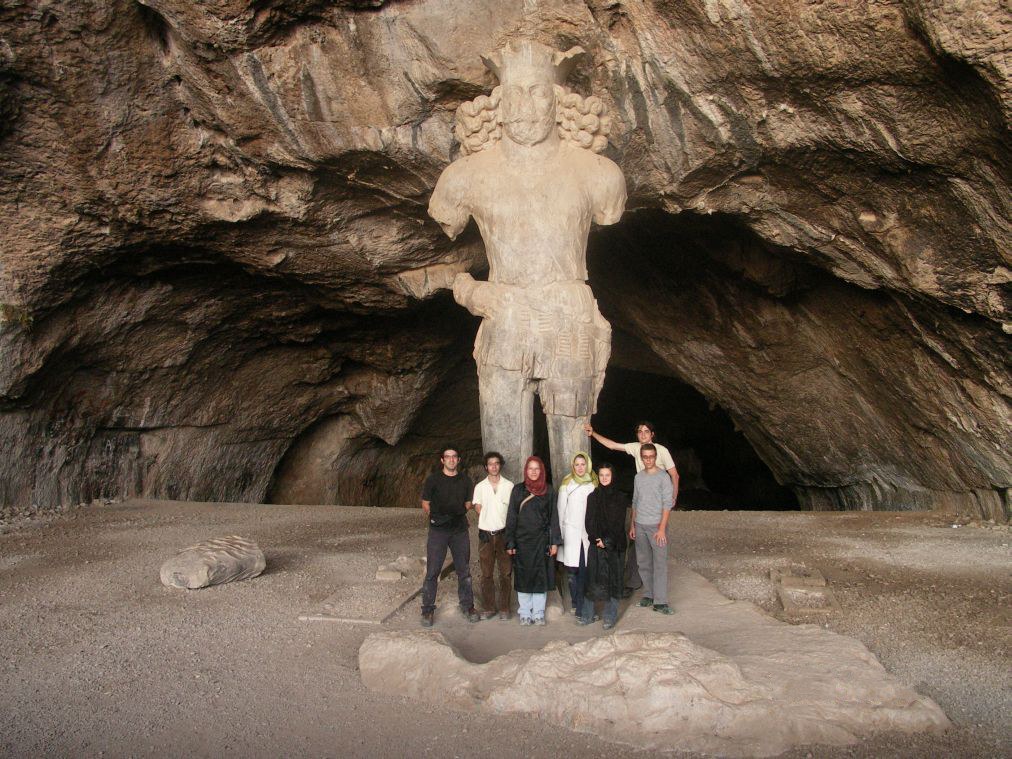
No Sasanian king left more images. Rock reliefs at Naqsh-e Rostam, Naqsh-e Rajab, Bishapur and Darabgerd show him on horseback receiving the submission of Roman emperors. In a cave in the mountains above Bishapur stands a statue about seven metres tall, carved from a stalagmite, which is generally identified as Shapur I. In later Persian tradition, including the Shahnameh, he is remembered more vaguely than his father, and many of his deeds were mixed up with those of his namesake Shapur II.
He died around 270, probably at Bishapur. His long reign set the pattern for the Sasanian state: a warrior king, rivalry with Rome, a strong Zoroastrian identity, and an empire whose wealth depended on settled farmers, cities and trade.
Persian words from this page
| شاپور | Shâpur | Shapur |
| ایران و انیران | Irân va Anirân | Iran and non-Iran |
| بیشاپور | Bishâpur | Bishapur |
| جندیشاپور | Jondishâpur | Gondishapur |
| نیشابور | Neyshâbur | Nishapur |
| شوشتر | Shushtar | Shushtar |
| اسیر | asir | captive, prisoner |
Sources and further reading
- Shapur I, trilingual inscription at the Ka’ba-ye Zartosht (ŠKZ), ed. Philip Huyse, Die dreisprachige Inschrift Šābuhrs I. an der Ka’ba-i Zardušt (Corpus Inscriptionum Iranicarum, 1999).
- Michael H. Dodgeon and Samuel N. C. Lieu, The Roman Eastern Frontier and the Persian Wars, AD 226–363: A Documentary History (Routledge, 1991).
- Encyclopaedia Iranica, “Šāpur I: History” by A. Sh. Shahbazi.
- Touraj Daryaee, Sasanian Persia: The Rise and Fall of an Empire (I.B. Tauris, 2009).
- Richard N. Frye, “The Political History of Iran under the Sasanians”, in The Cambridge History of Iran, vol. 3(1) (1983).
Want to learn Persian? Get the free Starter Pack
Get the 14-page printable Starter Pack (all 32 letters, a 7-day reading plan, 100 core words and 20 survival phrases) and a short 5-email course. Free.
More in The Sasanian Empire (224–651 CE)
- The Origins of the Sasanian Family
- Ardashir I, Founder of the Sasanian Empire
- Firuzabad: Ardashir’s Round City
- Shapur I, King of Kings of Iran and Non-Iran
- Bishapur: Shapur’s City
- The Battle of Edessa and the Capture of Valerian
- The Ka’ba-ye Zartosht Inscription of Shapur I
- Mani and Manichaeism
- Hormizd I and Bahram I
- Kartir and the Zoroastrian Church
- Bahram II
- Narseh and the Peace of Nisibis
- Shapur II the Great
- Julian’s Invasion of Persia (363)
- Christians in the Sasanian Empire
- Shapur III and the Partition of Armenia
- Yazdegerd I
- Bahram V Gur
- Yazdegerd II
- The Battle of Avarayr (451)
- The Hephthalites and Iran’s Eastern Frontier
- Peroz I and the Hephthalite Disaster
- Kavad I
- Zamasp and Kavad’s Return
- Mazdak and the Mazdakite Movement
- Khosrow I Anushirvan the Just
- The Sasanian–Byzantine Wars of the 6th Century
- The Battle of Dara (530)
- Khosrow I Sacks Antioch (540)
- The Lazic War (541–562)
- The Reforms of Khosrow I
- The Academy of Gondishapur: History and Legend
- Borzuya, Chess and Kalila wa Dimna
- Taq Kasra: The Arch of Ctesiphon
- The Sasanian Conquest of Yemen
- The Sasanians and the Western Turks
- Hormizd IV
- Bahram Chobin’s Rebellion
- Khosrow II Parviz
- The Last Great War: Byzantium and Persia, 602–628
- The Siege of Constantinople (626)
- Heraclius Strikes Back
- Shirin: Queen and Legend
- Shahrbaraz, the General Who Became King
- Civil War and the Queens Boran and Azarmidokht
- Yazdegerd III, the Last Sasanian King
- The Sasanian Army
- Sasanian Society and the Class System
- Zoroastrianism under the Sasanians
- Sasanian Art: Silver, Reliefs and Silk
- The Sasanian Reliefs of Naqsh-e Rostam
- Taq-e Bostan
- Sasanian Cities, Palaces and Bridges
- Middle Persian (Pahlavi) Language and Literature
- Sasanian Coins and Silverwork
- Women in the Sasanian Empire
- Polo, Hunting and Games at the Sasanian Court
- The Sasanian Legacy