In the spring of 363 CE the Roman emperor Julian invaded the Sasanian Empire with one of the largest armies Rome ever sent east. He fought his way down the Euphrates to the walls of Ctesiphon and won a battle outside the city, but could not take it. During the retreat he was mortally wounded, and his successor Jovian had to accept a peace with Shapur II that handed Nisibis and five frontier regions to Iran.
| Date | March to July 363 CE |
|---|---|
| Roman commander | Emperor Julian (r. 361–363); then Jovian |
| Sasanian king | Shapur II |
| Roman forces | Main army often put at about 65,000, with a second force of about 30,000 in the north (figures from Zosimus; disputed) |
| Key battle | Battle before Ctesiphon, late May 363: Roman victory |
| Julian’s death | Wounded 26 June 363 near Samarra; died the same night |
| Outcome | Thirty-year peace; Rome cedes Nisibis, Singara and five regions beyond the Tigris |
Why Julian invaded
Julian, the last pagan emperor of Rome, inherited a war that had dragged on since 337. Shapur II had taken Amida, Singara and Bezabde in 359–360 (see Shapur II), and Julian’s cousin Constantius II had died before he could respond. Julian wanted a decisive victory, both to secure the frontier and to win the prestige he needed for his religious programme at home. Ancient writers also compared him to Alexander the Great, and he may have seen himself in that light.
He rejected a Persian offer to negotiate. His most reliable historian, Ammianus Marcellinus, a soldier who marched with the army and later wrote Books 23 to 25 of his history about the campaign, admired Julian but did not hide his mistakes.
The march down the Euphrates
Julian left Antioch on 5 March 363. At Carrhae he divided his forces. A northern army under his relative Procopius and the general Sebastianus was to join the Armenian king Arshak II and advance down the Tigris. Julian led the main army, with a large river fleet carrying supplies, down the Euphrates.
The army moved fast. Fortresses along the river surrendered or were stormed: Anatha gave up without a fight, Pirisabora was captured and burned, and Maiozamalcha, near Ctesiphon, was taken after a siege in which Roman soldiers tunnelled under the walls. Persian forces flooded fields by breaking the irrigation dykes and harried the column, but did not risk a full battle. To reach the Tigris, the Romans reopened an old canal, the Naarmalcha, and brought the fleet across.

The battle before Ctesiphon
At the end of May, Julian forced a crossing of the Tigris at night and attacked the Persian army drawn up on the east bank in front of Ctesiphon. The Persians fielded armoured cavalry and elephants, but the Roman infantry broke them, and the survivors fled behind the city walls. Ammianus reports Persian losses of about 2,500 against some 70 Romans, figures that probably flatter the Romans.
It was a victory, but not the one Julian needed. Ctesiphon was strongly fortified, the Roman siege train was inadequate, and Shapur’s main army was approaching. The northern force under Procopius never arrived. After a council of war, Julian decided not to besiege the city.
The burning of the fleet and the retreat
Julian then made the most criticised decision of the campaign: he burned most of his fleet, which could not be dragged back up the river and might fall into Persian hands, and marched inland, apparently hoping to meet his northern army or to draw Shapur into battle. Persian guides, whom some sources describe as deliberate deceivers, led the army into burned and flooded country. The Persians destroyed crops ahead of the Romans and attacked their flanks and rear without offering a pitched battle. Food ran short, and the army turned north along the Tigris towards Roman territory.
The death of Julian
On 26 June 363, near Samarra, the rearguard came under sudden attack. Julian rushed into the fight without his breastplate. A cavalry spear struck him in the side and pierced his liver. He was carried to his tent, where, according to Ammianus, he spent his last hours discussing the soul with his philosophers. He died that night, aged 31 or 32.
Who threw the spear
Nobody knew who struck the blow. Ammianus is uncertain. Julian’s friend Libanius later claimed the killer was a Christian in Julian’s own army, angered by the emperor’s attempt to revive paganism. Other sources name a Saracen (Arab) auxiliary fighting for Persia, or a Persian horseman. Christian writers made the death a miracle: a later legend says the soldier-saint Mercurius killed him at God’s command, and an often-repeated but late story puts the words “You have won, Galilean” in Julian’s mouth. Historians regard both as legends.
Jovian’s treaty
The next morning the officers chose Jovian, the commander of the imperial guard, as emperor. The army was hungry, far from home and on the wrong side of the Tigris, with Shapur’s forces all around. Shapur offered terms, and Jovian accepted them within days:
- A peace for thirty years.
- Rome returned to Persia the five regions beyond the Tigris gained in 299 (Ammianus names Arzanene, Moxoene, Zabdicene, Rehimene and Corduene), with fifteen fortresses.
- Rome handed over Nisibis, Singara and the fort of Castra Maurorum.
- Rome would no longer support the king of Armenia against Persia.
The inhabitants of Nisibis were allowed to leave and most moved west into Roman territory. Among them was the poet and theologian Ephrem the Syrian, who settled in Edessa. Ammianus calls the treaty shameful, and Roman writers blamed Jovian for it for generations. Modern historians are kinder: with the army facing starvation, Jovian may have had little choice.
Remembering the victory
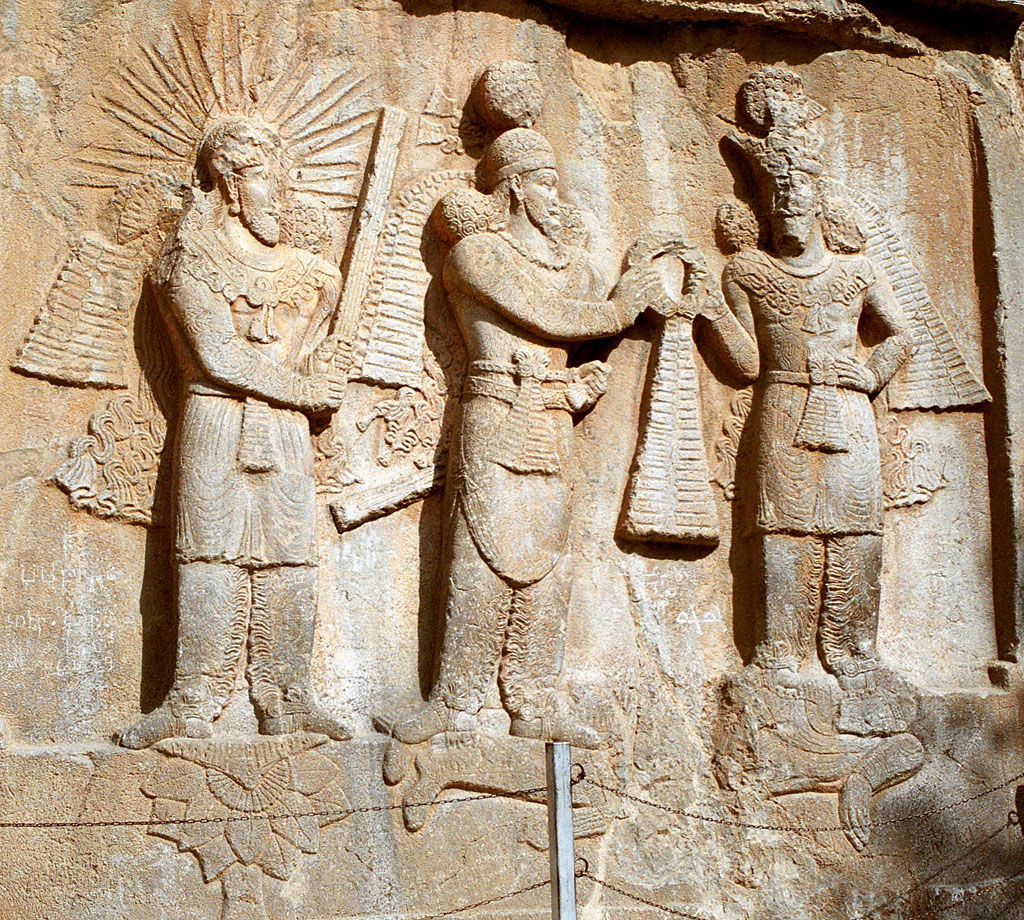
For the Sasanians, 363 undid the defeat of Narseh (see Narseh and the Peace of Nisibis) and confirmed Shapur II as the greatest king of his line. At Taq-e Bostan near Kermanshah, a relief of his successor Ardashir II shows the king and Ahura Mazda standing over a fallen enemy. Many scholars identify the fallen man as Julian, although this is not certain. The frontier set in 363 lasted, with small changes, until the great war of the seventh century. For the wider pattern, see Persia and Rome: Seven Centuries of Rivalry, and for the city Julian failed to take, Ctesiphon: Capital of Two Empires.
- 5 March 363 Julian leaves Antioch
- April–May 363 March down the Euphrates; Pirisabora and Maiozamalcha taken
- Late May 363 Battle before Ctesiphon; decision not to besiege
- June 363 Fleet burned; retreat north along the Tigris
- 26 June 363 Julian mortally wounded near Samarra
- 27 June 363 Jovian proclaimed emperor
- July 363 Treaty with Shapur II
Persian words from this page
| تیسفون | Tisfun | Ctesiphon |
| فرات | Forât | the Euphrates |
| دجله | Dejle | the Tigris |
| طاق بستان | Tâgh-e Bostân | Taq-e Bostan |
| امپراتور | emperâtur | emperor |
| عقبنشینی | aghab-neshini | retreat |
Sources and further reading
- Ammianus Marcellinus, Res Gestae, Books 23–25.
- Zosimus, New History, Book 3; Libanius, Oration 18 (Funeral Oration for Julian).
- Touraj Daryaee, Sasanian Persia: The Rise and Fall of an Empire (I.B. Tauris, 2009).
- Michael H. Dodgeon and Samuel N. C. Lieu, The Roman Eastern Frontier and the Persian Wars, AD 226–363 (Routledge, 1991).
- G. W. Bowersock, Julian the Apostate (Harvard University Press, 1978).
Want to learn Persian? Get the free Starter Pack
Get the 14-page printable Starter Pack (all 32 letters, a 7-day reading plan, 100 core words and 20 survival phrases) and a short 5-email course. Free.
More in The Sasanian Empire (224–651 CE)
- The Origins of the Sasanian Family
- Ardashir I, Founder of the Sasanian Empire
- Firuzabad: Ardashir’s Round City
- Shapur I, King of Kings of Iran and Non-Iran
- Bishapur: Shapur’s City
- The Battle of Edessa and the Capture of Valerian
- The Ka’ba-ye Zartosht Inscription of Shapur I
- Mani and Manichaeism
- Hormizd I and Bahram I
- Kartir and the Zoroastrian Church
- Bahram II
- Narseh and the Peace of Nisibis
- Shapur II the Great
- Julian’s Invasion of Persia (363)
- Christians in the Sasanian Empire
- Shapur III and the Partition of Armenia
- Yazdegerd I
- Bahram V Gur
- Yazdegerd II
- The Battle of Avarayr (451)
- The Hephthalites and Iran’s Eastern Frontier
- Peroz I and the Hephthalite Disaster
- Kavad I
- Zamasp and Kavad’s Return
- Mazdak and the Mazdakite Movement
- Khosrow I Anushirvan the Just
- The Sasanian–Byzantine Wars of the 6th Century
- The Battle of Dara (530)
- Khosrow I Sacks Antioch (540)
- The Lazic War (541–562)
- The Reforms of Khosrow I
- The Academy of Gondishapur: History and Legend
- Borzuya, Chess and Kalila wa Dimna
- Taq Kasra: The Arch of Ctesiphon
- The Sasanian Conquest of Yemen
- The Sasanians and the Western Turks
- Hormizd IV
- Bahram Chobin’s Rebellion
- Khosrow II Parviz
- The Last Great War: Byzantium and Persia, 602–628
- The Siege of Constantinople (626)
- Heraclius Strikes Back
- Shirin: Queen and Legend
- Shahrbaraz, the General Who Became King
- Civil War and the Queens Boran and Azarmidokht
- Yazdegerd III, the Last Sasanian King
- The Sasanian Army
- Sasanian Society and the Class System
- Zoroastrianism under the Sasanians
- Sasanian Art: Silver, Reliefs and Silk
- The Sasanian Reliefs of Naqsh-e Rostam
- Taq-e Bostan
- Sasanian Cities, Palaces and Bridges
- Middle Persian (Pahlavi) Language and Literature
- Sasanian Coins and Silverwork
- Women in the Sasanian Empire
- Polo, Hunting and Games at the Sasanian Court
- The Sasanian Legacy