Takht-e Soleyman (تخت سلیمان, “Throne of Solomon”) is a walled oval hilltop near Takab in West Azerbaijan province, built around a deep, warm, spring-fed lake. In the Sasanian period it held Adur Gushnasp, one of the three most sacred fires of Zoroastrianism, and in the 13th century the Mongol Ilkhan Abaqa built a summer palace on its ruins. With the extinct volcano of Zendan-e Soleyman nearby, it became a UNESCO World Heritage Site in 2003.
| Location | North-east of Takab, West Azerbaijan province, in the mountains between Zanjan and Urmia |
|---|---|
| Main periods | Sasanian (5th–7th centuries CE); Ilkhanid (from the 1270s) |
| Ancient name | Shiz; sanctuary of the fire Adur Gushnasp |
| The lake | About 80 m across and more than 60 m deep, fed by a warm spring (about 21°C) |
| UNESCO | Inscribed 2003 (site 1077) |
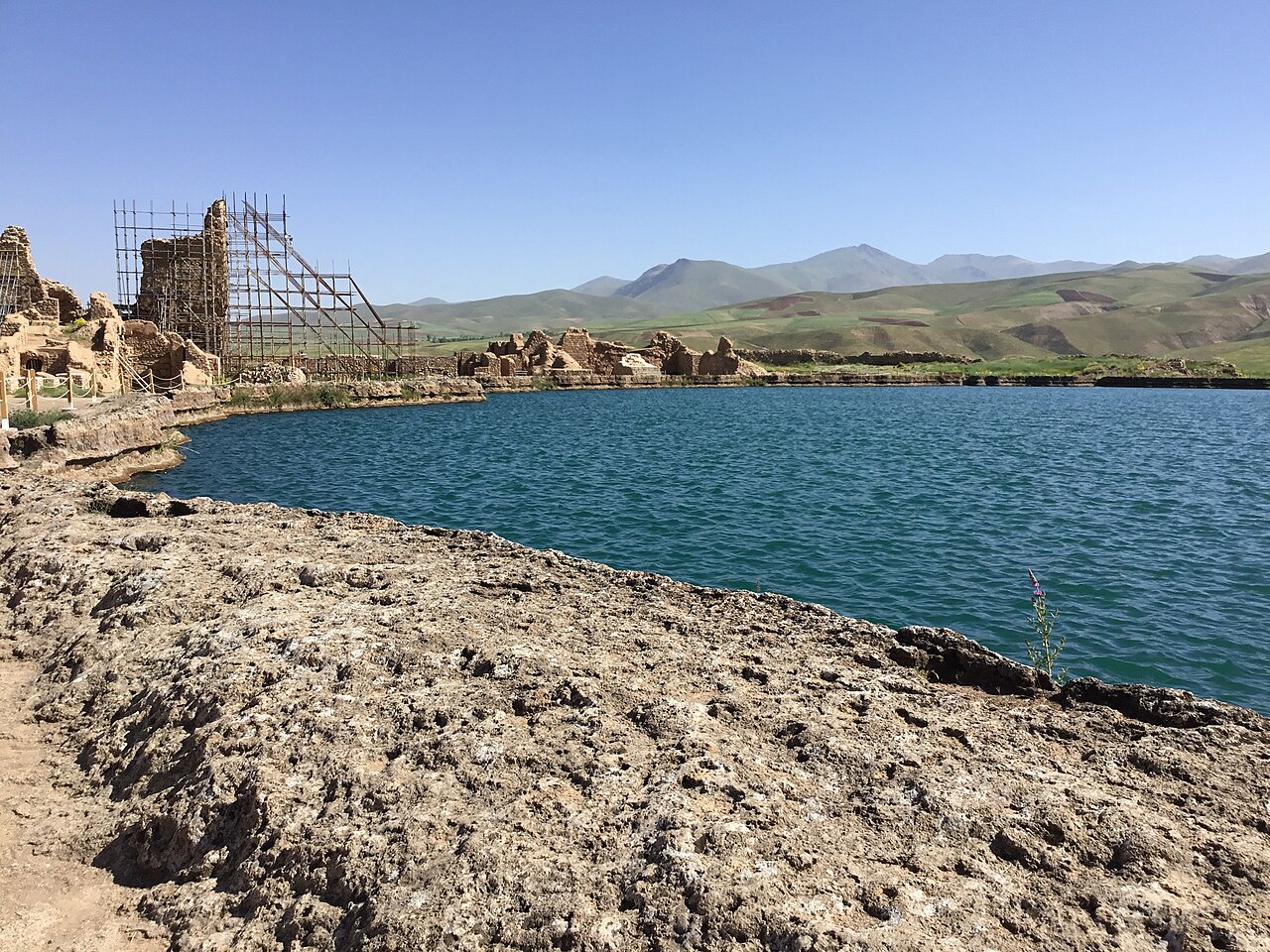

A lake on a hill
The site begins with geology. Mineral-rich water rising from a spring has, over thousands of years, built up a limestone mound about 60 m above the valley, with the lake itself at the top. The water overflows constantly and deposits calcium as it goes, so the hill keeps growing. To the west, the same process created Zendan-e Soleyman, “Solomon’s prison”, a hollow cone about 100 m high whose spring dried up long ago, leaving a deep shaft. Local legend says Solomon imprisoned demons in it.
A place where water rises from the earth and stays warm in a cold mountain climate seemed holy to people long before the Sasanians. Remains of shrines from the first millennium BCE have been found on the summit of Zendan-e Soleyman.
The fire of the warrior kings
The Sasanians made the hill one of the great sanctuaries of their empire. Clay seal impressions found in the excavations, together with Middle Persian texts and later Islamic writers, identify it with Adur Gushnasp, the fire associated with the warrior class and the kings. Sasanian rulers are said to have walked here on pilgrimage after coming to the throne. Coins of Peroz (459–484) are among the early finds; the main buildings belong to the 6th and early 7th centuries, the time of Khosrow I and Khosrow II. The fire temple and its halls stood by the lake inside a massive stone wall with many towers and gates to the north and south. The religious background is on our page on Zoroastrianism under the Sasanians.
The sanctuary was sacked by the Byzantine emperor Heraclius during his campaign deep into Iran in 624, an event he reported to Constantinople as the destruction of a pagan temple; see Heraclius Strikes Back. After the Arab conquest the town of Shiz lived on, but the fire temple lost its royal role.
A Mongol summer palace
Shortly after coming to the throne in 1265, the Ilkhan Abaqa, son of Hulagu, had the old town’s inhabitants moved and built a summer and hunting palace on the Sasanian foundations, reusing the lake and the old layout. Its walls were covered in lustre and turquoise tiles, some decorated with dragons and phoenixes borrowed from Chinese art, and others with scenes and verses from Ferdowsi’s Shahnameh. Many of these tiles are now in museums in Tehran and abroad. The name Takht-e Soleyman, linking the site to Solomon, appears in the Islamic period.
What to see
- The walls and gates: you enter through the restored southern gate in the oval wall. Walk part of the wall for views over the site.
- The lake: clear blue-green water, with channels carrying the overflow out through the walls. Do not swim: it is deep and the site is protected.
- The fire temple: north of the lake, the remains of the square domed fire temple and the halls around it, built of stone and baked brick.
- The Ilkhanid palace: the remains of the large ayvân and courtyard on the west side of the lake.
- The site museum: displays of finds and tiles, and models of the site.
- Zendan-e Soleyman: about 3 km to the west. A path climbs to the rim, from where you look down into the shaft and back over the plateau to the walled lake. The rim is unfenced in places; take care.
Practical notes
- Getting there: the site is remote. The nearest town is Takab; most visitors come by car from Zanjan, Tabriz or Urmia, and some combine it with the Dome of Soltaniyeh.
- When: late spring to early autumn. Winters at this altitude are long, cold and snowy, and roads can be closed.
- Time needed: two to three hours including Zendan-e Soleyman.
- Tickets and hours: check current official information.
- Safety: follow your own government’s travel advice for Iran.
For nearby cities, see Zanjan and Urmia.
Persian words from this page
| تخت | takht | throne |
| سلیمان | Soleymân | Solomon |
| زندان | zendân | prison |
| آتشکده | âtashkadeh | fire temple |
| دریاچه | daryâcheh | lake |
| چشمه | cheshmeh | spring |
Sources and further reading
- UNESCO World Heritage Centre, “Takht-e Soleyman” (inscribed 2003).
- Encyclopaedia Iranica, “TAḴT-E SOLAYMĀN“.
- Encyclopaedia Iranica, “ĀDUR GUŠNASP“.
- Rudolf Naumann, Die Ruinen von Tacht-e Suleiman und Zendan-e Suleiman (Berlin, 1977), on the German excavations.
Want to learn Persian? Get the free Starter Pack
Get the 14-page printable Starter Pack (all 32 letters, a 7-day reading plan, 100 core words and 20 survival phrases) and a short 5-email course. Free.
More in Top Places to Visit in Iran
- Naqsh-e Jahan Square
- Shah (Imam) Mosque, Isfahan
- Sheikh Lotfollah Mosque
- Ali Qapu Palace
- Jameh Mosque of Isfahan
- Si-o-se Pol and Khaju Bridge
- Vank Cathedral
- Hasht Behesht Palace
- Naqsh-e Rostam
- Eram Garden, Shiraz
- Nasir al-Molk (Pink) Mosque
- Tomb of Hafez (Hafezieh)
- Tomb of Saadi (Saadieh)
- Shah Cheragh Shrine
- Arg of Karim Khan
- Fin Garden, Kashan
- Historic Houses of Kashan
- Jameh Mosque of Yazd
- Yazd Fire Temple and Towers of Silence
- Dowlatabad Garden and Windcatcher
- Amir Chakhmaq Complex
- Golestan Palace
- National Museum of Iran
- Treasury of National Jewels
- Tehran Grand Bazaar
- Milad Tower
- Imam Reza Shrine, Mashhad
- Tomb of Ferdowsi, Tus
- Tomb of Omar Khayyam, Neyshabur
- Tomb of Avicenna, Hamadan
- Ganjnameh Inscriptions, Hamadan
- Behistun (Bisotun): Visiting the Site
- Taq-e Bostan: Visiting the Site
- Tabriz Historic Bazaar
- Takht-e Soleyman
- Armenian Monastic Ensembles of Iran
- Sheikh Safi al-Din Shrine, Ardabil
- Dome of Soltaniyeh
- Alamut Castle
- Falak-ol-Aflak Castle
- Shushtar Historical Hydraulic System
- Chogha Zanbil: Visiting the Ziggurat
- Susa Archaeological Site
- Arg-e Bam
- Ganjali Khan Complex, Kerman
- Shazdeh Garden, Mahan
- Rayen Castle
- Dasht-e Lut (Lut Desert)
- Maranjab Desert and Caravanserai
- Varzaneh Desert
- Mount Damavand
- Hyrcanian Forests
- Lake Urmia
- Badab-e Surt Springs
- Ali Sadr Cave
- The Kaluts of Shahdad
- Qeshm Geopark
- Hormuz Island Colours
- Visiting Persepolis: A Day Trip from Shiraz
- Visiting Pasargadae
- Persian Caravanserais
- The Qanat of Gonabad
- Meymand Village
- Sasanian Sites of Fars: Firuzabad, Bishapur and Sarvestan
- Gonbad-e Qabus: Visiting the Tower
- Zayandeh Rud and Isfahan’s Bridges
- Tochal and Darband: Hiking Above Tehran
- Mount Sabalan
- Skiing in Iran: Dizin and Shemshak
- Golestan National Park