Iran has made its own money for about 2,500 years, from the gold daric of Darius the Great to the rial of today. The names on Iranian coins tell the story of the country: the Greek drachma became the Sasanian drahm and the Islamic dirham, the Mongol word for ten thousand became the toman, and a Qajar coin, the qiran, is about to return as a unit of the new rial.
| First Persian coin | Gold daric and silver siglos, late 6th century BCE (Darius I) |
|---|---|
| Longest-lived design | Sasanian silver drachm, 3rd to 7th century CE |
| Toman | From Mongol tümen, “ten thousand”; a unit of account from Mongol times, now 10 rials |
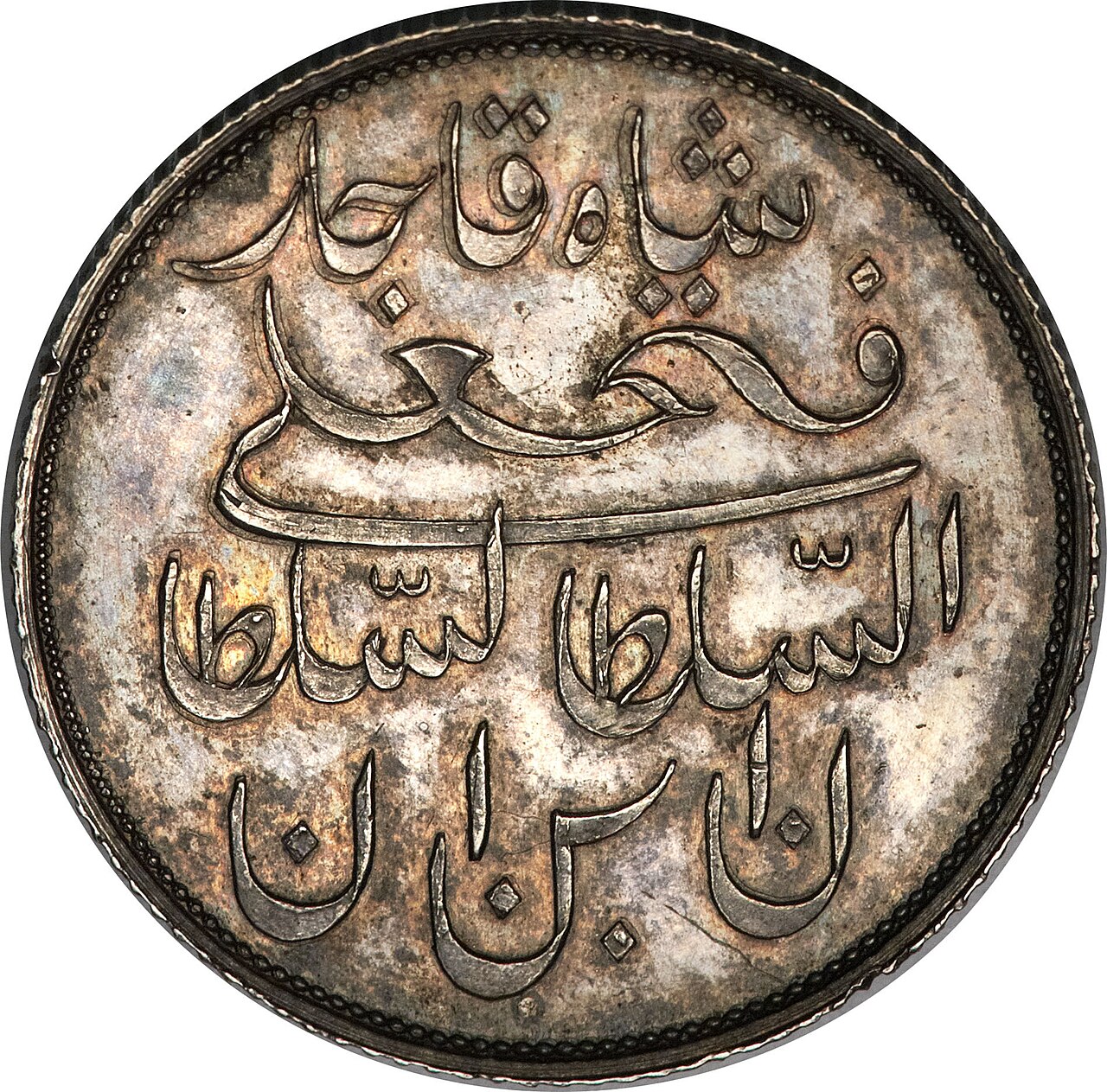
| Qiran | Silver coin of Fath-Ali Shah, introduced 1825 |
| Rial | Introduced 1932, replacing the qiran at par |
| Persian for “coin” | سکه (sekke) |
Gold archers: the first Persian coins
Coins were invented next door to Iran, in Lydia in western Anatolia, around 600 BCE. When Cyrus the Great took Sardis in the 540s BCE (see Cyrus’s conquest of Lydia), the Persians inherited a working mint. For a generation they seem to have gone on striking Lydian-type coins. Then, probably under Darius I, the empire issued its own: the gold daric and the silver siglos, both showing the Great King as a crowned archer, kneeling or running with his bow.
The daric was struck to a fixed weight of a little over 8 grams of almost pure gold and kept that standard for nearly two centuries. It was minted mainly in western Anatolia, and inside Iran most payments were still made in weighed silver and in kind, as the Persepolis tablets show. The daric’s real fame was abroad: Greek writers grumbled that Persian kings won more battles with “archers” in Greek pockets than with archers in the field. The page on Darius’s coinage and the Achaemenid economy tells this part in detail.
Drachms from Alexander to the Parthians
Alexander’s conquest replaced the archer with Greek types. The Seleucid kings struck silver tetradrachms and drachms on the Attic standard, with portraits of the king and Greek gods. In Persis, the old Persian heartland, local rulers known as the Frataraka issued coins with Aramaic legends and fire-temple scenes, a sign that Persian identity survived under Greek rule.
The Arsacid kings of Parthia kept the drachm as their main coin for nearly five centuries. On the reverse a seated archer, the founder Arsaces, holds a bow; on the obverse is the reigning king, whose beard, tiara and earrings let numismatists tell one ruler from another even though all of them call themselves “Arsaces” in Greek. For a dynasty with few surviving written records, these coins are a main source. See Parthian coins.
The Sasanian drahm and its Islamic heirs
From Ardashir I in the 220s CE, the Sasanians struck a broad, thin silver drahm with the king’s bust on one side and a Zoroastrian fire altar, usually flanked by two attendants, on the other. Each king wore his own crown, so a Sasanian coin can be dated by its headgear alone. Later coins carry a mint signature and a regnal year in Pahlavi letters, which makes them precise historical documents. Gold dinars were struck too but in far smaller numbers. Our page on Sasanian silver and coins explains how to read one.
The Arab conquerors did not invent a new coinage at once. For about half a century, governors in Iran struck “Arab-Sasanian” coins: the old king’s bust and fire altar, with a short Arabic phrase such as bism Allah (“in the name of God”) added in the margin and sometimes the governor’s name in Pahlavi. The Umayyad caliph Abd al-Malik replaced them in the 690s with purely epigraphic coins carrying Quranic texts. Their names kept the older layers: dirham comes from Greek drachma through Middle Persian, and dinar from the Roman denarius. See Umayyad rule in Iran.
Samanid silver and the Viking trade
In the 10th century the Samanids of Bukhara and Samarqand minted silver dirhams in enormous quantities, partly from the mines of the Hindu Kush and Transoxiana. Traders carried them north along the Volga, and tens of thousands have been found in hoards in Russia, the Baltic and Scandinavia, where Vikings valued them by weight. A Samanid dirham dug up on a Swedish island is one of the clearest proofs of how far Iranian trade reached.
Mongols, Ilkhans and an experiment with paper money
The Mongol conquest brought a Turkic-Mongol word into Iranian finance: tümen, meaning ten thousand, used both for an army unit and a sum of money. It became the toman, a unit of account long before it was a coin. In 1294 the Ilkhan Gaykhatu tried to introduce paper money on the Chinese model, the chao, printed in Tabriz. Merchants refused it, the bazaars closed, and the experiment was abandoned within months. Ghazan Khan’s reforms a few years later instead standardised the weight of silver coins across the realm (see Ghazan Khan and Tabriz under the Ilkhans).
Shahis, abbasis and ashrafis: Safavid money
Safavid Iran ran on silver. The common coins were the shahi and the abbasi, named after Shah Abbas I, worth four shahis. Gold coins, often called ashrafi, were used for large payments and gifts. Safavid coins carry the Shi’a profession of faith and the names of the Twelve Imams, a visible sign of the new state religion. The toman remained an account unit: 1 toman = 50 abbasis = 10,000 dinars, a dinar by then being only a tiny fraction of a coin. Iran had few silver mines and paid for its imports partly by importing bullion, a constant worry for Safavid treasurers (see the Safavid silk trade). In 1739 Nader Shah’s sack of Delhi brought back so much treasure that he exempted Iran from taxes for three years.
The qiran and the first banknotes
In 1825 Fath-Ali Shah introduced a new silver coin, the qiran, its name taken from the royal title sahebqeran (“lord of the auspicious conjunction”). One qiran was worth a tenth of a toman, or 1,000 dinars. Coins were still struck by hand at dozens of provincial mints until Naser al-Din Shah set up a machine mint in Tehran in the late 1870s.
Paper money arrived through a foreign bank. The British-owned Imperial Bank of Persia, founded in 1889 out of the reshaped Reuter concession, held the sole right to issue banknotes, which it did from 1890. For Iranian nationalists the fact that a foreign bank printed the country’s money became a grievance.
The rial: from Reza Shah to the Islamic Republic
Under Reza Shah’s reforms the state took money back into its own hands. Bank Melli Iran was founded in 1928 and took over the right to issue notes. In 1932 the rial replaced the qiran at par and was divided into 100 dinars. The toman, now worth ten rials, survived in speech and has never gone away. In 1960 the new Central Bank of Iran, Bank Markazi, took over note issue.
Pahlavi notes and coins showed the shah’s portrait, while after 1979 portraits of Ayatollah Khomeini and images of shrines, mosques and national monuments replaced them. Gold coins never lost their place: the Pahlavi gold coin, and after the revolution the Bahar Azadi (“Spring of Freedom”) coin, are bought as savings and are often named in marriage contracts as the bride’s mahr. High inflation since the 1980s has driven the rial down by several orders of magnitude, which is why prices now run into millions. In 2025 parliament passed a law to remove four zeros and create a new rial divided into 100 qirans. The page on the Iranian currency today explains rials, tomans and the redenomination for travellers and learners.

- c. 547 BCE Cyrus takes Sardis, home of the first coins
- Late 6th century BCE Gold daric and silver siglos under Darius I
- 3rd century BCE Seleucid and Frataraka coinage; first Parthian drachms
- 220s CE Ardashir I begins the Sasanian drahm
- 690s Abd al-Malik’s reform ends Arab-Sasanian coins
- 10th century Samanid dirhams travel to Scandinavia
- 1294 Gaykhatu’s paper money fails in Tabriz
- 1825 Fath-Ali Shah introduces the qiran
- 1890 First banknotes, issued by the Imperial Bank of Persia
- 1932 The rial replaces the qiran
- 2025 Law to remove four zeros from the rial
Persian words from this page
| سکه | sekke | coin |
| درهم | derham | dirham |
| دینار | dinâr | dinar |
| تومان | tomân | toman |
| قران | qerân | qiran |
| ریال | riyâl | rial |
| ضرابخانه | zarrâbkhâne | mint |
Sources and further reading
- Encyclopaedia Iranica, articles “Daric”, “Coins and coinage” and “Toman”.
- Robert Göbl, Sasanian Numismatics (1971).
- Rudi Matthee, Willem Floor and Patrick Clawson, The Monetary History of Iran: From the Safavids to the Qajars (2013).
- Stephen Album, Checklist of Islamic Coins.
- The Cambridge History of Iran, vol. 3 (Seleucid, Parthian and Sasanian periods) and vol. 5 (Saljuq and Mongol periods).
Want to learn Persian? Get the free Starter Pack
Get the 14-page printable Starter Pack (all 32 letters, a 7-day reading plan, 100 core words and 20 survival phrases) and a short 5-email course. Free.
More in Themes Across Iranian History (3000 BCE–today)
- A History of the Persian Language
- Zoroastrianism through the Ages
- Shi’a Islam in Iranian History
- The Jews of Iran
- The Armenians of Iran
- Christians of Iran
- The Baha’i Faith in Iran
- The Kurds in Iranian History
- Azerbaijanis in Iranian History
- The History of the Iranian Calendar
- Nowruz through History
- The Persian Garden (Pardis) through History
- Qanats: Iran’s Ancient Water Tunnels
- A History of Persian Carpets
- A History of Persian Architecture
- A History of Persian Painting
- A History of Persian Music
- Science in Iranian History
- Women in Iranian History
- Iran and the Silk Road
- Iran and China through History
- Iran and India through History
- Iran and Greece: Perceptions and Exchanges
- Persia and Rome: Seven Centuries of Rivalry
- Iran and the Ottoman Empire
- Iran and Russia through History
- Iran and Britain through History
- Iran and the United States
- How Iran’s Borders Changed
- The Capitals of Iran through History
- Coins of Iran through History: From the Daric to the Rial
- Flags and Symbols of Iran through History
- Myth and History in the Shahnameh: The Epic’s Kings and the Real Past
- Timeline of Iranian History: Key Dates from Elam to Today
- A History of Persian Cuisine: From Royal Banquets to Chelow Kabab
- A History of Persian Poetry: From Rudaki to Forough
- Wine in Iranian History: From Hajji Firuz to Hafez and Prohibition
- Sports in Iranian History: Polo, the Zurkhaneh and Wrestling
- List of Iranian Dynasties and Rulers