A caravanserai (کاروانسرا, kârvânsarâ) was a walled roadside inn where caravans, pilgrims and couriers could water their animals, store goods and sleep in safety. Thousands were built along Iran’s roads over some two thousand years, and in 2023 UNESCO inscribed 54 of them, from the Caspian forests to the Persian Gulf coast, as the World Heritage Site “The Persian Caravanserai”.
| What | Fortified inns for travellers and caravans, usually one day’s march apart |
|---|---|
| Persian names | kârvânsarâ; robât or ribât (an older word, often for a fortified inn on a frontier road) |
| Main period | Seljuk (11th–12th c.) to Qajar (19th c.); the largest building wave under Shah Abbas I (1588–1629) |
| UNESCO | “The Persian Caravanserai”, 54 caravanserais in 24 provinces, inscribed 2023 |
| Best known | Ribat-i Sharaf (Khorasan), Deyr-e Gachin (Qom), Zein-o-din (Yazd), Ganjali Khan (Kerman), Sa’d al-Saltaneh (Qazvin) |

An inn built like a fort
A caravan moved at the pace of its camels or mules, and on the long roads across the plateau that meant stopping every night where there was water. Over centuries the stopping places hardened into a standard building: a square or rectangular enclosure with high blank outer walls, a single gateway that could be barred at night, and an open courtyard inside with a cistern or well.
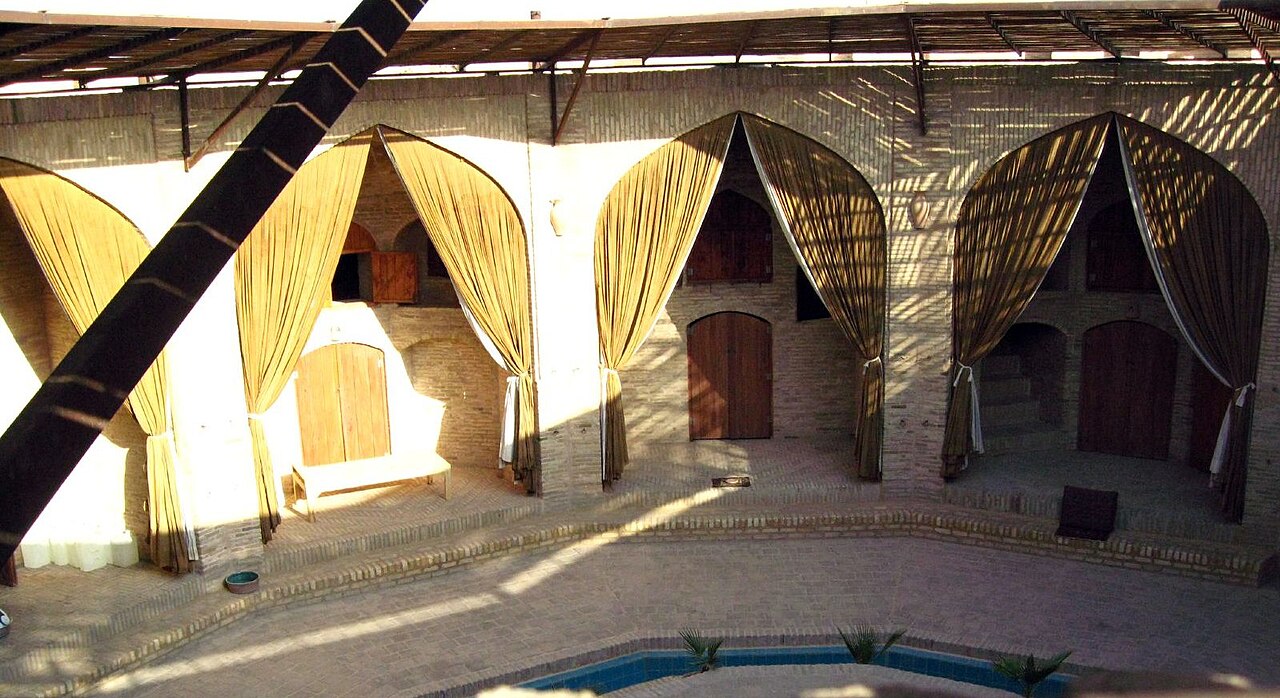
Around the courtyard ran rows of small rooms raised on a platform, each opening onto a shallow arched niche where travellers cooked and sat. Behind or beneath them were long vaulted stables for the animals. Most Iranian caravanserais follow the four-iwan plan familiar from Iranian mosques and madrasas: a tall arched hall, the iwan (ایوان), in the middle of each side of the court. Corner towers, a bath, a small prayer room and a keeper’s lodge were added in the bigger ones.
The plan was adapted to the land. On the central deserts walls are thick mud brick or fired brick, built to hold off heat and raiders. In the cold north-west some caravanserais are entirely roofed, with the courtyard replaced by a covered hall to keep out snow. Along the hot Persian Gulf coast and in the Zagros, builders used local stone and gave rooms deep shade. UNESCO’s description stresses exactly this range of climates and materials across “thousands of kilometres”.
From Seljuk ribats to Shah Abbas
Roadside stations go back to the Achaemenid Royal Road, whose staging posts Herodotus describes, and the Sasanians kept a network of their own. The oldest caravanserais that still stand, though, date from the Islamic centuries. The great model is Ribat-i Sharaf on the road between Nishapur and Merv, built around 1114–15 under the Seljuks and refurbished in 1154. Its two courtyards and fine carved brick and stucco show how grand a roadside building could be. It is discussed alongside other Seljuk buildings in Seljuk Architecture: Tomb Towers and Caravanserais.
The busiest period of building came under the Safavids. Shah Abbas I wanted trade, especially in silk, to flow through his territory and his new capital Isfahan, and he and his officials put up inns along the main routes. Popular tradition says he built 999 caravanserais; the number is a legend, but many surviving inns do date to his reign, and “Shah Abbasi caravanserai” became a general name for any old inn. The Qajars kept building in the 19th century, including grand urban caravanserais that were really merchants’ offices and warehouses inside the bazaars.
The coming of motor roads and railways in the 20th century ended the system. Many inns fell into ruin; others were used as army posts, storehouses or village stables. For the trade that the caravanserais served, see Iran and the Silk Road.
The 2023 UNESCO listing
Iran submitted the nomination in 2021 as a single serial property, and the World Heritage Committee inscribed it in September 2023. The 54 chosen caravanserais are only a small share of the inns ever built; they were picked to show different periods, plans and building traditions. They include:
- Deyr-e Gachin, in the Kavir National Park south-east of Tehran, sometimes called the “mother of Iranian caravanserais” because of its age and size.
- Ribat-i Sharaf in Razavi Khorasan, the Seljuk masterpiece.
- Zein-o-din in Yazd province, one of only two known Safavid caravanserais with a round plan and circular towers.
- Maranjab on the edge of the desert near Kashan, built in 1603 (see Maranjab Desert and Caravanserai).
- Ganjali Khan in Kerman, part of the Safavid square and bazaar complex (see Ganjali Khan Complex).
- Qasr-e Bahram in Semnan province, a stone caravanserai deep in the Dasht-e Kavir.
- Bisotun in Kermanshah, beside the famous rock inscription on the road to Baghdad.
- Sa’d al-Saltaneh in Qazvin, a large Qajar complex in the city centre.
- Smaller inns such as Titi in Gilan, Borazjan in Bushehr and Bastak in Hormozgan, which show how the type changed in wet forests and on the hot coast.
For all of Iran’s inscribed sites, see UNESCO World Heritage Sites in Iran.
Visiting a caravanserai today
Caravanserais are among the easiest historic buildings in Iran to experience from the inside, because several have been restored as hotels, guesthouses or restaurants. Zein-o-din has operated as an inn since its restoration, and others on the desert routes near Kashan, Yazd and Kerman take overnight guests. Sleeping in a room off the courtyard, under the same vaults that housed merchants four centuries ago, is a memorable way to see one.
Urban caravanserais are a different experience. In Kerman, Qazvin, Isfahan and Tabriz the old inns of the bazaar are busy with shops, carpet dealers, tea houses and craft workshops, and you can simply walk in. Remote ones such as Qasr-e Bahram or Deyr-e Gachin need a car and, ideally, a local driver who knows the desert tracks.
What to look for
- The gateway: often the only decorated part, with brickwork, a tiled panel or an inscription naming the builder and date.
- The raised platforms and niches in front of each room, where travellers lived in the open air.
- The stables behind the rooms, sometimes larger than the courtyard itself.
- Cisterns (آبانبار, âb-anbâr) and qanat channels outside the walls, which decided where an inn could be built at all.
Practical notes and safety
- Opening times and entry arrangements vary widely, and many rural caravanserais are unstaffed; check locally before making a long detour.
- Desert caravanserais are hot in summer and cold at night in winter. Carry water if you travel off the main roads.
- Ruined walls and roofs can be unstable. Stay out of cordoned areas.
- For security conditions, follow your own government’s current travel advice for Iran. General tips are in Practical Tips for Travelling to Iran.
Persian words from this page
| کاروانسرا | kârvânsarâ | caravanserai (“caravan house”) |
| کاروان | kârvân | caravan |
| رباط | robât | fortified roadside inn |
| ایوان | eyvân | iwan, a vaulted hall open on one side |
| آبانبار | âb-anbâr | cistern, water store |
| بازار | bâzâr | bazaar, market |
Sources and further reading
- UNESCO World Heritage Centre, The Persian Caravanserai (inscribed 2023), description and maps of the 54 components.
- Encyclopaedia Iranica, “Caravansary”.
- Maxime Siroux, Caravansérails d’Iran et petites constructions routières (Cairo, 1949).
- Robert Hillenbrand, Islamic Architecture: Form, Function and Meaning (Edinburgh University Press, 1994), chapter on the caravanserai.
- Herodotus, Histories, Book 5, on the royal road and its stations.
Want to learn Persian? Get the free Starter Pack
Get the 14-page printable Starter Pack (all 32 letters, a 7-day reading plan, 100 core words and 20 survival phrases) and a short 5-email course. Free.
More in Top Places to Visit in Iran
- Naqsh-e Jahan Square
- Shah (Imam) Mosque, Isfahan
- Sheikh Lotfollah Mosque
- Ali Qapu Palace
- Jameh Mosque of Isfahan
- Si-o-se Pol and Khaju Bridge
- Vank Cathedral
- Hasht Behesht Palace
- Naqsh-e Rostam
- Eram Garden, Shiraz
- Nasir al-Molk (Pink) Mosque
- Tomb of Hafez (Hafezieh)
- Tomb of Saadi (Saadieh)
- Shah Cheragh Shrine
- Arg of Karim Khan
- Fin Garden, Kashan
- Historic Houses of Kashan
- Jameh Mosque of Yazd
- Yazd Fire Temple and Towers of Silence
- Dowlatabad Garden and Windcatcher
- Amir Chakhmaq Complex
- Golestan Palace
- National Museum of Iran
- Treasury of National Jewels
- Tehran Grand Bazaar
- Milad Tower
- Imam Reza Shrine, Mashhad
- Tomb of Ferdowsi, Tus
- Tomb of Omar Khayyam, Neyshabur
- Tomb of Avicenna, Hamadan
- Ganjnameh Inscriptions, Hamadan
- Behistun (Bisotun): Visiting the Site
- Taq-e Bostan: Visiting the Site
- Tabriz Historic Bazaar
- Takht-e Soleyman
- Armenian Monastic Ensembles of Iran
- Sheikh Safi al-Din Shrine, Ardabil
- Dome of Soltaniyeh
- Alamut Castle
- Falak-ol-Aflak Castle
- Shushtar Historical Hydraulic System
- Chogha Zanbil: Visiting the Ziggurat
- Susa Archaeological Site
- Arg-e Bam
- Ganjali Khan Complex, Kerman
- Shazdeh Garden, Mahan
- Rayen Castle
- Dasht-e Lut (Lut Desert)
- Maranjab Desert and Caravanserai
- Varzaneh Desert
- Mount Damavand
- Hyrcanian Forests
- Lake Urmia
- Badab-e Surt Springs
- Ali Sadr Cave
- The Kaluts of Shahdad
- Qeshm Geopark
- Hormuz Island Colours
- Visiting Persepolis: A Day Trip from Shiraz
- Visiting Pasargadae
- Persian Caravanserais
- The Qanat of Gonabad
- Meymand Village
- Sasanian Sites of Fars: Firuzabad, Bishapur and Sarvestan
- Gonbad-e Qabus: Visiting the Tower
- Zayandeh Rud and Isfahan’s Bridges
- Tochal and Darband: Hiking Above Tehran
- Mount Sabalan
- Skiing in Iran: Dizin and Shemshak
- Golestan National Park