Tahirih, born Fatemeh Baraghani in Qazvin around 1814–1817, was a poet and religious scholar who became one of the leading figures of the Babi movement in the 1840s. She is remembered above all for appearing unveiled before an assembly of men at Badasht in 1848, a moment historians see as the Babis’ public break with Islamic law, and she was executed in Tehran in August 1852.
| Birth name | Fatemeh Baraghani |
|---|---|
| Born | Qazvin, c. 1814–1817 (sources differ; 1814 and 1817 are the most cited years) |
| Died | Tehran, August 1852 |
| Names | Qurrat al-Ayn (Persian قرةالعین, “solace of the eyes”) and Tahirih (طاهره, “the pure”) |
| Known for | Scholarship, poetry, leadership among the Babis, the unveiling at Badasht |
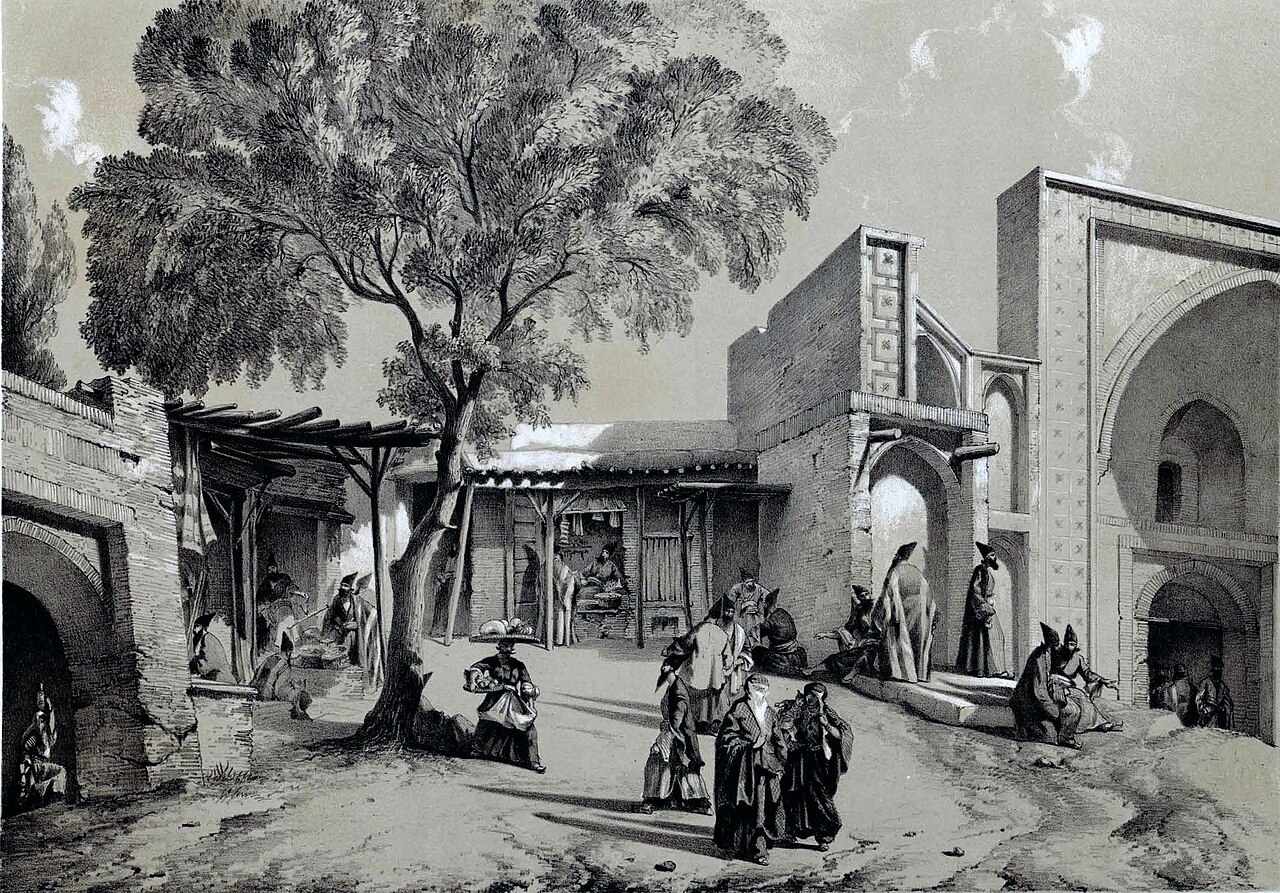

A family of clerics in Qazvin
Fatemeh grew up in one of the most prominent clerical families of Qazvin. Her father, Molla Mohammad Saleh Baraghani, was a senior mujtahid who founded a madrasa in the city, and her uncle Molla Mohammad Taqi Baraghani was among the most powerful clerics in Iran. Unusually for a girl, she was taught by her father, studied Arabic, the Qur’an and Shi’i law, and according to later family accounts listened to his lessons from behind a curtain. She was married young to her cousin, Mohammad Taqi’s son, and had children, but the marriage was unhappy and later ended.
The family was divided by religious argument. Her uncle was a fierce opponent of the Shaykhi school, a mystical current in Shi’ism founded by Shaykh Ahmad Ahsa’i, while Fatemeh was drawn to it through Shaykhi books. She corresponded with the Shaykhi leader Sayyed Kazem Rashti in Karbala, who is said to have given her the name Qurrat al-Ayn.
Karbala and the Babi movement
In 1843 she travelled to Karbala to study with Sayyed Kazem, but he died before she arrived. When Sayyed Ali Mohammad of Shiraz announced in 1844 that he was the bab, the gate to the Hidden Imam, she accepted his claim through letters, without ever meeting him. Babi tradition counts her among the eighteen first disciples, the Letters of the Living, and the only woman among them. The movement itself is described on the page on the Bab and the Babi movement.
In Karbala she taught and preached, and her bold interpretation of the new teachings divided even the Babis there. Local clerics complained to the Ottoman authorities. She was moved to Baghdad, where she was held for a time in the house of the city’s mufti, Shaykh Mahmud al-Alusi, and in 1847 she was sent back across the border to Iran.
The murder of her uncle
Back in Qazvin in 1847, she refused to return to her husband. Later that year her uncle Mohammad Taqi, who had denounced the Shaykhis and the Babis from the pulpit, was stabbed in his mosque and died of his wounds. The killer is usually described as a Shaykhi who sympathised with the Babis; Tahirih denied any part in the crime, but her husband’s family held her responsible. Several Babis were killed in reprisal, and she left Qazvin secretly, reaching Tehran and then Mazandaran. To his descendants and to many Shi’i writers, Mohammad Taqi became a martyr; to the Babis, the reprisals were the first of many persecutions.
Badasht, 1848
In the summer of 1848, while the Bab was imprisoned in Azerbaijan, leading Babis met at the hamlet of بدشت (Badasht), near Shahrud. Accounts agree that Tahirih appeared before the men without a veil, an act that shocked the gathering, and that the meeting proclaimed that the old religious law had been superseded. Babi and later Baha’i sources say it was at Badasht that she took the name Tahirih. Some participants left the movement in protest, and enemies of the Babis spread charges of immorality against her, which her supporters rejected.
Historians read the event in different ways. Abbas Amanat treats Badasht as the moment the Babis declared a new religious dispensation, with Tahirih as its most radical voice. Feminist scholars such as Farzaneh Milani see her unveiling as the first public challenge by an Iranian woman to the rules of seclusion. Writers hostile to the movement saw it as proof of heresy.
Arrest and execution
After Badasht she was arrested in Mazandaran and, by about 1850, brought to Tehran, where she was held under house arrest in the home of Mahmud Khan, the kalantar (mayor and police chief) of the city. Baha’i accounts describe clerics debating with her and attempts to make her recant, which she refused. In August 1852 a small group of Babis tried to assassinate Naser al-Din Shah. In the wave of executions that followed, Tahirih was put to death in secret. According to most accounts she was strangled in a garden in Tehran and her body was thrown into a well. The Austrian physician Jakob Polak, who was in Tehran at the time, wrote that he witnessed her death and that she bore it with great courage.
Poet and symbol
Only a small body of poems in Persian and Arabic is attributed to her, mostly mystical verse about longing and religious renewal. Some were collected by the Cambridge orientalist Edward Granville Browne in the 1880s and 1890s. The authorship of several famous pieces is disputed, and scholars are still sorting authentic poems from those ascribed to her later.
Her reputation has grown in different directions. In the Baha’i Faith, which grew out of the Babi movement, she is honoured as a heroine and martyr (see the Baha’i Faith in Iran). Iranian and Western writers on women’s history have claimed her as a forerunner of women’s emancipation, while others caution against reading modern ideas back into a figure whose concerns were above all religious. Within Shi’i tradition she has generally been viewed as a heretic. Her place among other women of Iranian history is discussed in women in Iranian history.
Persian words from this page
| طاهره | Tâhereh | Tahirih, “the pure” |
| قرةالعین | Qorrat al-Eyn | “solace of the eyes” |
| قزوین | Qazvin | Qazvin |
| بدشت | Badasht | Badasht |
| باب | bâb | gate |
| شیخیه | Sheykhiyeh | the Shaykhi school |
Sources and further reading
- Abbas Amanat, Resurrection and Renewal: The Making of the Babi Movement in Iran, 1844–1850 (Cornell University Press, 1989)
- Farzaneh Milani, Veils and Words: The Emerging Voices of Iranian Women Writers (Syracuse University Press, 1992)
- Moojan Momen, “Usuli, Akhbari, Shaykhi, Babi: The Tribulations of a Qazvin Family”, Iranian Studies 36 (2003)
- Edward Granville Browne, A Year Amongst the Persians (1893)
- Jakob Eduard Polak, Persien: Das Land und seine Bewohner (1865)
Want to learn Persian? Get the free Starter Pack
Get the 14-page printable Starter Pack (all 32 letters, a 7-day reading plan, 100 core words and 20 survival phrases) and a short 5-email course. Free.
More in The Qajar Dynasty (1789–1925)
- Agha Mohammad Khan Qajar
- The Battle of Krtsanisi and Sack of Tiflis (1795)
- Fath-Ali Shah Qajar
- The Qajar Court and Harem
- The Russo-Persian War of 1804–1813
- The Battle of Aslanduz (1812)
- The Treaty of Golestan (1813)
- Abbas Mirza and the First Reforms
- The Russo-Persian War of 1826–1828
- The Treaty of Turkmenchay (1828)
- The Death of Griboyedov (1829)
- Mohammad Shah and the Siege of Herat
- The Bab and the Babi Movement
- Tahirih (Qurrat al-Ayn)
- Naser al-Din Shah Qajar
- Amir Kabir
- Dar al-Funun: Iran’s First Modern School
- The Anglo-Persian War (1856–1857)
- How Iran Lost Herat
- The Great Persian Famine of 1870–1872
- The Reuter Concession (1872)
- Naser al-Din Shah’s Journeys to Europe
- The Tobacco Protest (1891–1892)
- Mirza Malkam Khan and Early Reformers
- The Assassination of Naser al-Din Shah (1896)
- Photography in Qajar Iran
- Mozaffar ad-Din Shah
- Taj al-Saltaneh
- The D’Arcy Concession and the Discovery of Oil (1908)
- The Persian Constitutional Revolution (1905–1911)
- The First Majlis and the Constitution of 1906
- The Anglo-Russian Convention of 1907
- Mohammad Ali Shah and the Bombardment of the Majlis
- The Siege of Tabriz and Sattar Khan
- The Constitutionalists Take Tehran (1909)
- The Bakhtiari and the Revolution
- Morgan Shuster and the Russian Ultimatum (1911)
- Women in the Constitutional Revolution
- Iran in the First World War
- The Persian Famine of 1917–1919
- Mirza Kuchik Khan and the Jangali Movement
- The Anglo-Persian Agreement of 1919
- The 1921 Coup: Reza Khan and Seyyed Zia
- The End of the Qajar Dynasty (1925)
- Qajar Art, Photography and Society