The coup of February 1921 was a military takeover of Tehran by a few thousand men of the Persian Cossack Brigade under Reza Khan, acting with the journalist Sayyed Zia al-Din Tabatabai. The Cossacks entered the capital in the early hours of 21 February 1921, a date remembered in Iran as 3 Esfand 1299 (کودتای ۳ اسفند). Sayyed Zia became prime minister for three months; Reza Khan, commander of the army, emerged as the real power and within five years made himself shah.
| Date | Night of 20–21 February 1921 (3 Esfand 1299) |
|---|---|
| Military leader | Reza Khan, commander of the Cossack Brigade |
| Political leader | Sayyed Zia al-Din Tabatabai, editor of the newspaper Ra’d |
| Force | About 2,500–4,000 Cossacks, by different accounts, from the camp at Aqa Baba near Qazvin |
| Shah | Ahmad Shah, who accepted the new government |
| Outcome | Sayyed Zia prime minister until 25 May 1921; Reza Khan minister of war from April 1921 |
Iran in the winter of 1920–1921
By late 1920 the Qajar state barely functioned. The Anglo-Persian Agreement of 1919 had been suspended but not abandoned, the treasury was empty, and governments in Tehran rose and fell within months. In Gilan the Soviet-backed republic of 1920 held Rasht (see the Jangali movement), and Azerbaijan and Khorasan were restless. Britain, its finances strained after the war, planned to withdraw its troops of Norperforce from northern Iran in the spring of 1921, and British officers feared a Bolshevik advance on Tehran when they left.
Reza Khan and the Cossacks
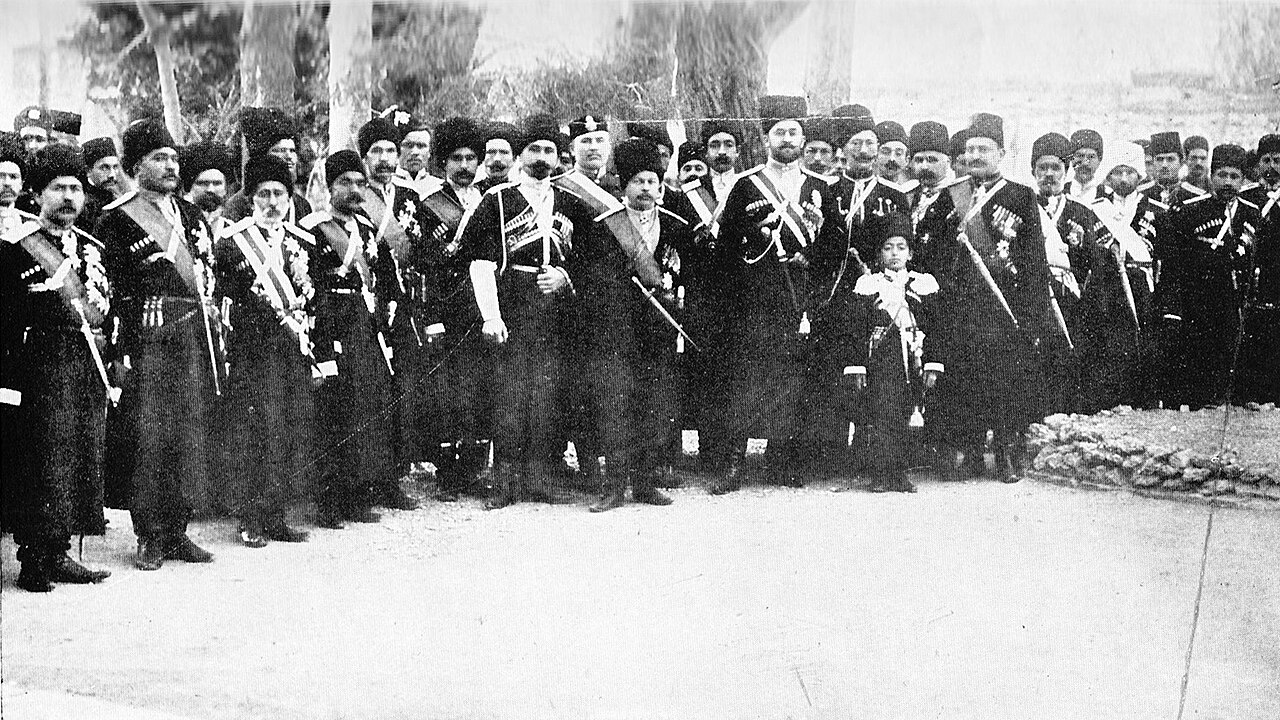
The Cossack Brigade, founded in 1879, had been the shah’s most effective unit, with Russian officers. After the Russian revolution its Russian commanders lost their government but kept their posts. In the autumn of 1920 the brigade was defeated in Gilan. The British minister in Tehran, Herman Norman, and General Edmund Ironside, commander of Norperforce, pressed Ahmad Shah to dismiss the Russian commander, Colonel Starosselsky, and the remaining Russian officers, which he did. The brigade was placed under Iranian officers with British supervision and paid with British money.
Reza Khan was a career soldier from Alasht in Mazandaran, born in 1878, who had joined the brigade as a young man and risen through the ranks to colonel. Ironside met him and judged him the strongest of the Iranian officers. In January 1921 Reza Khan was given command of the Cossacks at their camp near Qazvin. Ironside’s diary, published in 1972, records that he thought a strong military government would serve Britain’s interests and that he would not stand in the way of a move on Tehran. He left Iran shortly before the coup.

The march on Tehran
In mid-February the Cossacks set out from Qazvin, a march of about 150 kilometres. Envoys from the government and the shah met them on the road to ask their intentions and to turn them back, without success. On the night of 20–21 February they entered Tehran almost without resistance; the gendarmerie and the police did not fight. The prime minister, Fathollah Akbar Sepahdar, resigned, and the Cossacks took control of the government buildings.
The next day Reza Khan issued a proclamation to the people of Tehran, which began with the words “I command” (حکم میکنم, hokm mikonam). It declared martial law, closed newspapers and theatres and banned public gatherings. Ahmad Shah, with little choice, appointed Sayyed Zia prime minister and gave Reza Khan the title Sardar Sepah, commander of the army.
Sayyed Zia’s hundred days
Sayyed Zia, born around 1889, was a journalist known for his newspaper Ra’d (Thunder) and for his links to the British legation. He announced a programme of radical reform: land distribution, new schools, an end to corruption, a national army and the end of foreign privileges. He arrested several hundred politicians, princes and landowners, including members of the old aristocracy, and demanded money from them for the treasury. He formally annulled the 1919 agreement and, on 26 February 1921, his government signed the Soviet-Iranian treaty under which Moscow gave up tsarist concessions and debts.
His government was short-lived. The arrested notables had friends at court, the shah disliked him, and Reza Khan, now minister of war from April 1921, did not need him. On 25 May 1921 the shah dismissed him and he left the country. Many of those arrested were freed, and one of them, Ahmad Qavam, became prime minister. Sayyed Zia did not return to Iran until 1943.
- Autumn 1920 Russian officers of the Cossack Brigade dismissed
- Jan 1921 Reza Khan given command of the Cossacks at Qazvin
- Mid-Feb 1921 March on Tehran begins
- 21 Feb 1921 Cossacks take Tehran; “I command” proclamation
- 26 Feb 1921 Soviet-Iranian treaty signed
- Apr 1921 Reza Khan becomes minister of war
- 25 May 1921 Sayyed Zia dismissed and exiled
Did Britain plan the coup?
The British role has been argued about ever since. Iranian opponents of the Pahlavis long held that the coup was a British operation and Reza Khan a British instrument. The documents show a more complicated picture. Ironside and some British officers on the spot encouraged the Cossacks and gave them money and freedom of movement; the British minister, Norman, knew of the plans and favoured a strong government; but the Foreign Office in London under Curzon was not informed in advance and still hoped to save the 1919 agreement. Historians such as Cyrus Ghani, Homa Katouzian and Michael Zirinsky conclude that British officers in Iran helped bring about the coup, while differing on how far it was planned and how much Reza Khan was acting on his own account.
What is not disputed is the result. Within months the coup government had built a new army from the Cossacks and the gendarmerie, and Reza Khan used it to defeat the rebels in Gilan, Azerbaijan and Khorasan. His path from minister of war to prime minister and finally to the throne is followed on the page on the end of the Qajar dynasty, and his reign on the page on Reza Shah Pahlavi.
Persian words from this page
| کودتا | kudetâ | coup d’état |
| رضاخان | Rezâ Khân | Reza Khan |
| سردار سپه | sardâr-e sepah | commander of the army |
| حکم میکنم | hokm mikonam | I command |
| قزوین | Qazvin | Qazvin |
| اسفند | Esfand | Esfand, the twelfth month |
Sources and further reading
- Edmund Ironside, High Road to Command: The Diaries of Major-General Sir Edmund Ironside, 1920–1922 (London, 1972).
- Cyrus Ghani, Iran and the Rise of Reza Shah: From Qajar Collapse to Pahlavi Power (I.B. Tauris, 1998).
- Michael P. Zirinsky, “Imperial Power and Dictatorship: Britain and the Rise of Reza Shah, 1921–1926”, International Journal of Middle East Studies 24 (1992).
- Homa Katouzian, State and Society in Iran: The Eclipse of the Qajars and the Emergence of the Pahlavis (I.B. Tauris, 2000).
- Encyclopaedia Iranica, “Coup d’état of 1299/1921”.
Want to learn Persian? Get the free Starter Pack
Get the 14-page printable Starter Pack (all 32 letters, a 7-day reading plan, 100 core words and 20 survival phrases) and a short 5-email course. Free.
More in The Qajar Dynasty (1789–1925)
- Agha Mohammad Khan Qajar
- The Battle of Krtsanisi and Sack of Tiflis (1795)
- Fath-Ali Shah Qajar
- The Qajar Court and Harem
- The Russo-Persian War of 1804–1813
- The Battle of Aslanduz (1812)
- The Treaty of Golestan (1813)
- Abbas Mirza and the First Reforms
- The Russo-Persian War of 1826–1828
- The Treaty of Turkmenchay (1828)
- The Death of Griboyedov (1829)
- Mohammad Shah and the Siege of Herat
- The Bab and the Babi Movement
- Tahirih (Qurrat al-Ayn)
- Naser al-Din Shah Qajar
- Amir Kabir
- Dar al-Funun: Iran’s First Modern School
- The Anglo-Persian War (1856–1857)
- How Iran Lost Herat
- The Great Persian Famine of 1870–1872
- The Reuter Concession (1872)
- Naser al-Din Shah’s Journeys to Europe
- The Tobacco Protest (1891–1892)
- Mirza Malkam Khan and Early Reformers
- The Assassination of Naser al-Din Shah (1896)
- Photography in Qajar Iran
- Mozaffar ad-Din Shah
- Taj al-Saltaneh
- The D’Arcy Concession and the Discovery of Oil (1908)
- The Persian Constitutional Revolution (1905–1911)
- The First Majlis and the Constitution of 1906
- The Anglo-Russian Convention of 1907
- Mohammad Ali Shah and the Bombardment of the Majlis
- The Siege of Tabriz and Sattar Khan
- The Constitutionalists Take Tehran (1909)
- The Bakhtiari and the Revolution
- Morgan Shuster and the Russian Ultimatum (1911)
- Women in the Constitutional Revolution
- Iran in the First World War
- The Persian Famine of 1917–1919
- Mirza Kuchik Khan and the Jangali Movement
- The Anglo-Persian Agreement of 1919
- The 1921 Coup: Reza Khan and Seyyed Zia
- The End of the Qajar Dynasty (1925)
- Qajar Art, Photography and Society