Kermanshah is the largest city of western Iran, the capital of Kermanshah province, with about 950,000 people in a broad valley of the Zagros mountains. It sits on the ancient road from the Iranian plateau down to Mesopotamia, which is why two of Iran’s most important monuments are on its edge: the Sasanian rock arches of Taq-e Bostan, inside the city, and the inscription of Darius the Great at Behistun, about 30 km to the east.
| Persian name | کرمانشاه (Kermânshâh) |
|---|---|
| Province | Kermanshah (capital) |
| Population | 946,651 (city, 2016 census, Statistical Centre of Iran) |
| Elevation | About 1,350 m |
| Climate | Hot, dry summers; cold winters with snow |
| Languages heard | Southern Kurdish dialects, Laki and Persian |
| UNESCO site nearby | Bisotun (2006) |
| Distance | About 520 km west of Tehran; about 180 km west of Hamadan |

A city on the road to Mesopotamia
The great road that ran from Ecbatana (Hamadan) to Babylon, and later from Khorasan to Baghdad, crosses the Zagros through the Kermanshah valley. Armies, merchants and pilgrims used it for over two thousand years, and the kings who controlled it left their mark on the cliffs beside it. That road, rather than any single founder, explains the city.
Tradition links the name to the Sasanian king Bahram IV (ruled 388 to 399 CE), who held the title Kermanshah, “king of Kerman”, before he took the throne, and he is often credited with founding a town here. Early Arab geographers knew it as Qarmisin, an Arabic form of the same name. It was a stopping place on the Baghdad road through the Abbasid and Seljuk centuries, though the major town of the area was often elsewhere in the valley.
Frontier capital of the Qajars
Kermanshah’s modern importance came when the Safavids and then the Qajars faced the Ottoman empire across the Zagros. Its governors guarded the western frontier. The best known was Mohammad Ali Mirza Dowlatshah, the eldest son of Fath-Ali Shah, who governed from Kermanshah in the early nineteenth century, built up the city, raised a modern army and fought the Ottomans until his death on campaign in 1821.
In the nineteenth century the city was also the last major Iranian stop for Shi’a pilgrims on their way to the shrines of Karbala and Najaf in Iraq, and its caravanserais, bazaar and religious buildings grew with that traffic. Kermanshah also had a long-established Jewish community, which Encyclopaedia Iranica covers in a separate article.
Takyeh Moaven ol-Molk
The most striking Qajar building in the city is the Takyeh Moaven ol-Molk, a hall for Muharram mourning ceremonies built around the turn of the twentieth century. Its walls are covered in painted tiles: scenes of the battle of Karbala sit beside portraits of pre-Islamic kings, episodes from the Shahnameh and views of Qajar life, a mix that makes it one of the most interesting tile programmes in Iran. A small ethnographic museum is attached.
Taq-e Bostan, inside the city
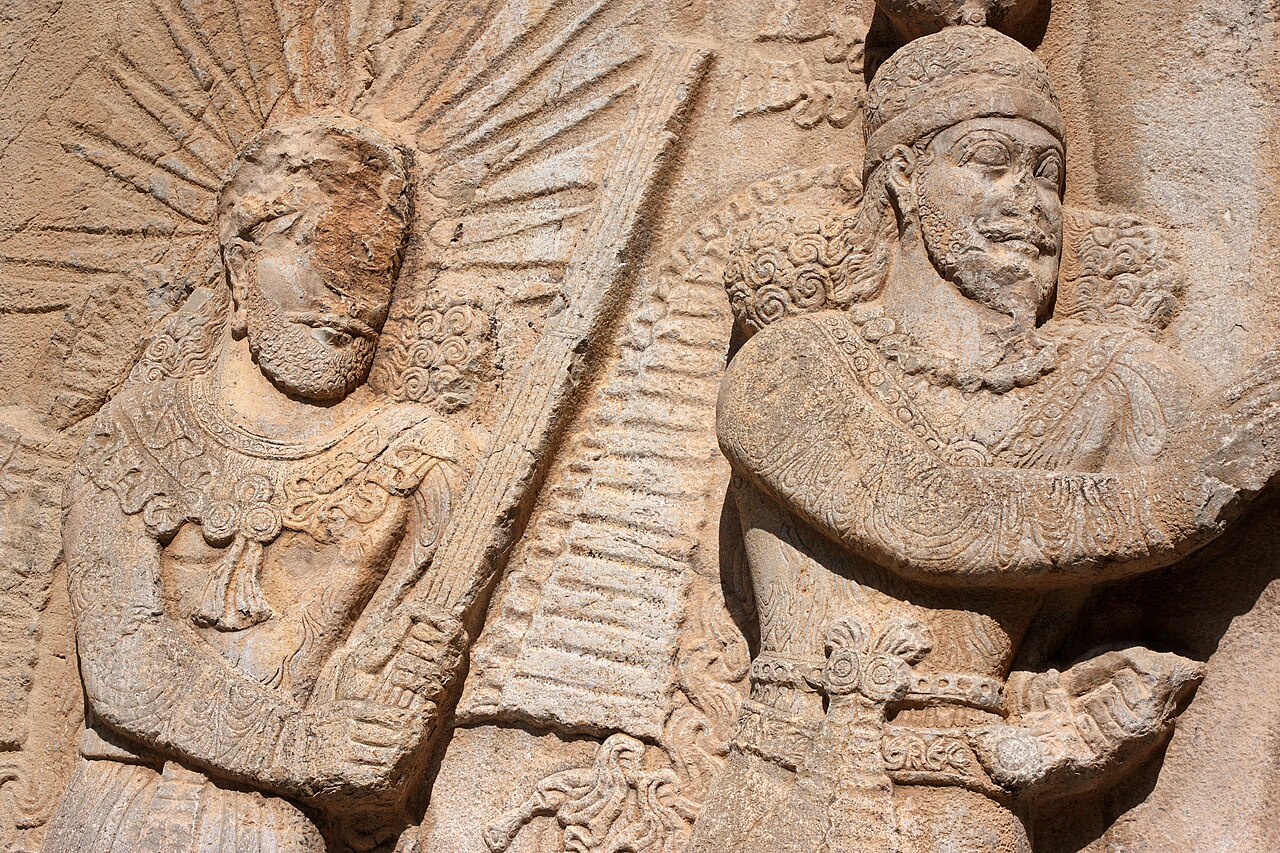
On the north-eastern edge of Kermanshah, where a spring rises at the foot of the mountain into a large pool, Sasanian kings carved a series of reliefs and two arched grottoes into the rock. طاق بستان (Tâgh-e Bostân) means “arch of the garden”.
- The oldest relief shows the investiture of Ardashir II (ruled 379 to 383) with the god Mithra standing on a lotus.
- The small arch has inscriptions naming Shapur II and Shapur III.
- The large arch, generally dated to Khosrow II (ruled 590 to 628), shows a royal investiture above an armoured horseman, with huge boar and deer hunting scenes on the side walls.
The site is described for visitors on the Taq-e Bostan visitor page, and the reliefs themselves are discussed on the history page about Taq-e Bostan and the hunting scenes of Khosrow II.
Behistun and the road east
About 30 km east of the city, at Bisotun, Darius I had his account of his seizure of power carved high on the cliff around 520 BCE, in Old Persian, Elamite and Babylonian, with a relief of the king standing over the rebels he defeated. Copied by Henry Rawlinson in the 1830s and 1840s, it became the key to reading cuneiform, and UNESCO listed the site in 2006. Below it are a Parthian relief, a Hellenistic carving of Herakles, a Safavid caravanserai and other remains. See visiting Behistun and the Behistun inscription.
Further east on the same road, at Kangavar, are the remains of a large stone platform long described as a temple of Anahita, though archaeologists disagree about its date and purpose.
Kurdish Kermanshah
Most people in Kermanshah speak dialects of Southern Kurdish, such as Kalhori, or the related Laki, and many also speak Persian; the city’s own speech mixes the two. Unlike most Kurds in Iran, who are Sunni, the majority here are Shi’a. The province is also a centre of the Yarsan (Ahl-e Haqq) religion, especially around Guran and the Dalahu mountains. For the wider picture, see the Kurds in Iranian history.
Kermanshah is known across Iran for two foods: nan berenji (نان برنجی), crumbly rice-flour cookies flavoured with cardamom and rosewater, and roghan-e Kermanshahi, a rich clarified butter from the sheep of the Zagros, used for rice.
Earthquake and war
As a frontier province, Kermanshah was bombed and fought over in the Iran–Iraq War of 1980 to 1988, and towns near the border such as Qasr-e Shirin and Sarpol-e Zahab were badly damaged. On 12 November 2017, a magnitude 7.3 earthquake centred near Sarpol-e Zahab killed more than 600 people in the province, the deadliest earthquake worldwide that year.
Getting there
Kermanshah has an airport with flights from Tehran and is linked by road to Hamadan, Sanandaj and Khorramabad. Taq-e Bostan is a short taxi ride from the centre, and Bisotun is an easy half-day trip. Many travellers combine Kermanshah with Hamadan. For opening hours, tickets and safety advice, check current official information and your own government’s travel advice.
Persian words from this page
| کرمانشاه | Kermânshâh | Kermanshah |
| طاق | tâgh | arch, vault |
| بستان | bostân | garden |
| بیستون | Bisotun | Behistun |
| کرد | Kord | Kurd |
| تکیه | takyeh | hall for Muharram ceremonies |
| نان برنجی | nân berenji | rice-flour cookies |
Sources and further reading
- Encyclopaedia Iranica, “Kermanshah” (iranicaonline.org), especially “iv. History to 1953” and “vii. Languages and Dialects”.
- Encyclopaedia Iranica, “Kermanshah viii. The Jewish Community” (iranicaonline.org).
- Encyclopaedia Iranica, “Ṭāq-e Bostān”.
- UNESCO World Heritage List, Bisotun (whc.unesco.org/en/list/1222).
- Statistical Centre of Iran, General Population and Housing Census 2016 (1395).
Want to learn Persian? Get the free Starter Pack
Get the 14-page printable Starter Pack (all 32 letters, a 7-day reading plan, 100 core words and 20 survival phrases) and a short 5-email course. Free.
More in Cities of Iran
- Tehran: Iran’s Capital
- Mashhad
- Isfahan
- Shiraz
- Tabriz
- Yazd
- Kashan
- Kerman
- Hamadan
- Qom
- Ahvaz
- Rasht
- Kermanshah
- Urmia
- Ardabil
- Zanjan
- Qazvin
- Sanandaj
- Khorramabad
- Bandar Abbas
- Bushehr
- Zahedan
- Birjand
- Gorgan
- Sari
- Semnan
- Arak
- Ilam
- Yasuj
- Shahr-e Kord
- Bojnurd
- Karaj
- Abadan and Khorramshahr
- Kish Island
- Qeshm Island
- Hormuz Island
- Masuleh
- Abyaneh
- Kandovan
- Bam
- Neyshabur (Nishapur)
- Shush (Susa) Today