The Sasanians began as a local family of priests and minor rulers in Istakhr, a town in Fars (Persis) a few kilometres north of Persepolis. Around 205 CE Papak, a member of the family linked to the temple of Anahita there, seized power from his overlord, and within twenty years his son Ardashir had overthrown the Parthian king of kings. The dynasty took its name from an ancestor called Sasan, whose real identity is still argued over.
| Home region | Fars (Persis), south-west Iran |
|---|---|
| Family seat | Istakhr, near Persepolis |
| Key figures | Sasan (eponymous ancestor), Papak (ruled Istakhr c. 205/206 to 207–210), Shapur son of Papak (d. c. 211/212), Ardashir I |
| Religious link | Temple of Anahita (Anahid) at Istakhr |
| Overlords | The Bazrangid kings of Fars, vassals of the Parthian Arsacids |
| Outcome | Ardashir defeats Artabanus IV in 224 CE and founds the Sasanian Empire |
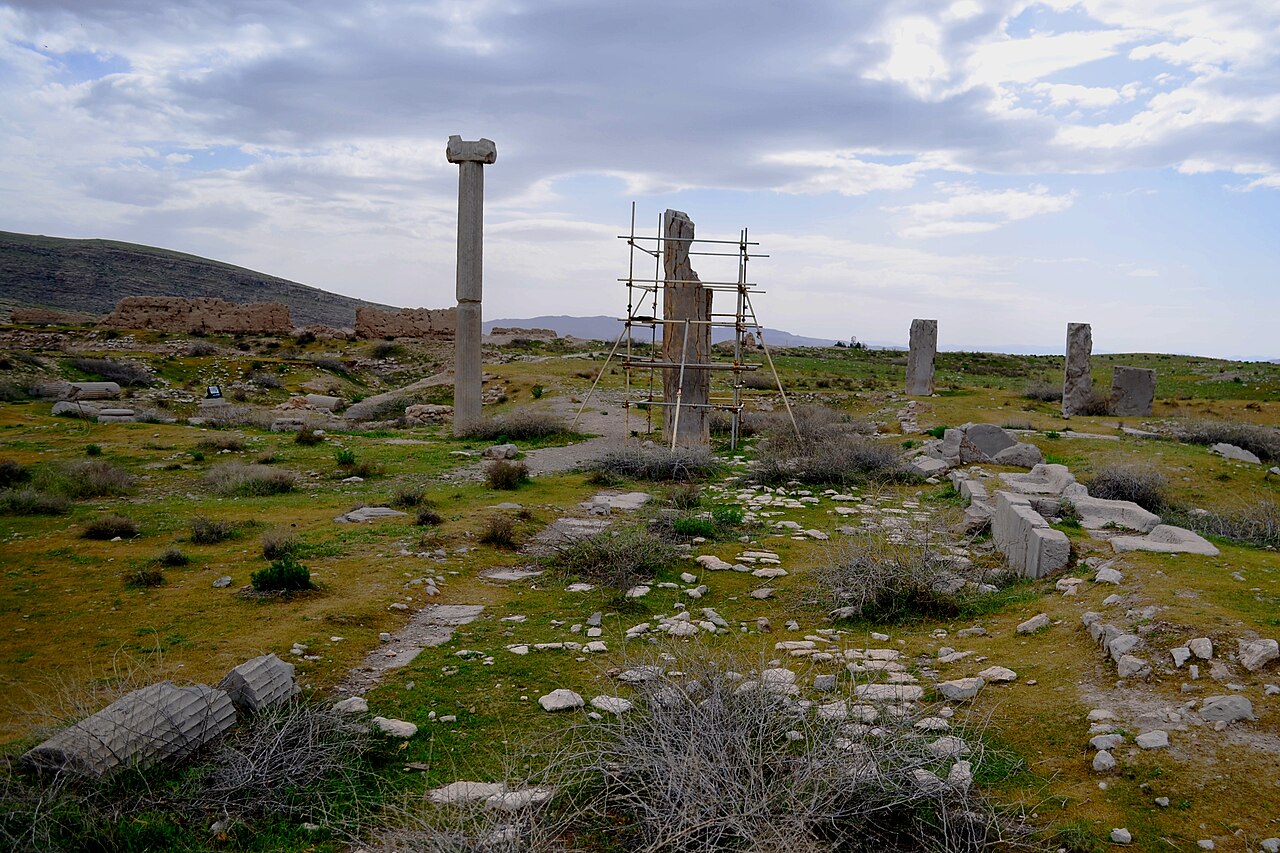

Fars under the Parthians
By the early third century CE, the Parthian (Arsacid) dynasty had ruled Iran for more than four hundred years, but its empire was loose. Regional kings governed their lands with wide freedom and owed the king of kings tribute and soldiers. Fars, the old homeland of the Achaemenids, was one of these sub-kingdoms. Its rulers, known to historians as the kings of Persis, struck their own coins with Aramaic-derived legends and kept up a memory of the Persian past, helped by the ruins of Persepolis and Pasargadae that stood in their territory.
At the start of the third century Fars itself was split among local lords. The most important at Istakhr was a king called Gochihr, of the Bazrangid family, according to the later Arab historian al-Tabari. The Parthian court was distracted by a war between two brothers, Vologases VI and Artabanus IV, and by repeated Roman invasions of Mesopotamia. That gave ambitious men in the provinces room to act.
Who was Sasan
The dynasty is named after Sasan, but the sources do not agree on who he was or how he was related to Ardashir, the founder of the empire. There are three main versions.
Al-Tabari’s account
Al-Tabari, writing in Baghdad around 900 CE and drawing on Sasanian court traditions, says Sasan was the keeper of the fire temple of Anahid (Anahita) at Istakhr and married a woman of the Bazrangid royal house. Their son was Papak, and Papak’s son was Ardashir. This is the official family tree in its tidiest form.
The Book of Deeds of Ardashir
The Middle Persian romance known as the Karnamag-i Ardashir-i Papakan (The Book of Deeds of Ardashir son of Papak) tells a folk-tale version. Sasan is a shepherd working for Papak, but in truth a descendant of the Achaemenid king Dara (Darius). Papak sees in a dream that Sasan’s line is destined to rule, gives him his daughter in marriage, and Ardashir is born of their union. The story links the new dynasty directly to the old Persian kings, which was exactly the claim the Sasanians wanted to make.
Roman and Byzantine writers
The sixth-century Byzantine historian Agathias reports a less flattering tale: Sasan was a wandering soldier who lodged with Papak, a humble man, and Papak’s wife bore Sasan’s son, Ardashir. In this version Sasan is the real father and Papak only the stepfather. Agathias may have been passing on hostile gossip, but his account shows that Ardashir’s parentage was already uncertain in antiquity.
What modern historians think
Most historians accept that Papak was a real ruler and that Ardashir was his son, as Ardashir’s own inscriptions say. Sasan is harder to pin down. Shapur I’s great inscription at the Ka’ba-ye Zartosht names “Sasan the lord” among the family members honoured with offerings, so he was a real person remembered at court. A coin from the Indo-Parthian east bearing the name Sasan has led some scholars, including Touraj Daryaee, to suggest that the family had an eastern ancestor, but this remains a hypothesis.
The temple of Anahita at Istakhr
Whatever Sasan’s origins, the family’s power was rooted in Istakhr and in its temple to Anahita, the Iranian goddess of the waters, fertility and victory. A temple of this kind was more than a place of worship. It held treasure, drew pilgrims and gave its priests standing among the soldiers and landowners of the district. Papak himself is described as holding a priestly role there.
The link lasted. The Sasanian kings continued to honour the fire of Anahid at Istakhr long after they moved their capital to Ctesiphon in Mesopotamia. Al-Tabari says Ardashir sent the heads of defeated enemies to this temple. Later in the third century, the priest Kartir lists the Anahid fire of Istakhr among the offices he held, a sign of how important the shrine remained to the state church. You can read more about him on our page on Kartir and the Zoroastrian church.
Papak’s revolt
According to al-Tabari, Papak overthrew Gochihr and took Istakhr around 205 or 206 CE, encouraged by his son Ardashir, who had been serving as commander (argbed) of the fortress of Darabgerd in eastern Fars. Modern historians are cautious about the detail that Ardashir drove the revolt, since the story may have been written to make the founder the hero from the start.
Papak asked the Parthian king to recognise his eldest son, Shapur, as his heir. The request was refused, but Papak acted anyway. Coins from these years show the portrait of Papak on one side and of Shapur on the other, with Middle Persian legends calling both of them king. These coins are among the best evidence we have for the family’s early claims.
Shapur’s death and Ardashir’s rise
Papak died between about 207 and 210, and his son Shapur succeeded him at Istakhr. Ardashir refused to accept his brother’s rule. Before the conflict came to open war, Shapur died in around 211 or 212. Al-Tabari says a building collapsed on him while he was on campaign, an accident that some modern scholars find rather convenient for Ardashir. With his brother gone, Ardashir took control of Istakhr, killed or removed rival lords in Fars, and began the campaign of conquest described on our page on Ardashir I.
- Early 3rd century Fars is divided among local kings under Parthian overlordship
- c. 205/206 Papak overthrows Gochihr and takes Istakhr
- 207–210 Papak dies; his son Shapur succeeds him
- c. 211/212 Shapur dies; Ardashir takes power in Fars
- 224 Ardashir defeats and kills Artabanus IV at the battle of Hormozgan
Why the origins mattered
The Sasanians were newcomers who replaced a dynasty with four centuries of legitimacy. They answered the problem in several ways. They stressed their roots in Fars, the land of the Achaemenids, and built their early monuments near Persepolis, at Naqsh-e Rostam and Naqsh-e Rajab. They presented themselves as devout worshippers of Ahura Mazda with a priestly family background. And, at least in later court tradition, they claimed descent from the legendary Kayanian kings and from Dara. How much they actually knew about the Achaemenids is debated: the Sasanian picture of the past came largely through Zoroastrian and epic tradition, not through the Old Persian inscriptions, which nobody could read by then.
The story of the family’s rise was retold many times, and the version that reached Ferdowsi’s Shahnameh follows the Karnamag closely, with Sasan as a shepherd of royal blood. For how myth and history mix in the epic, see Myth and History in the Shahnameh. For the Parthian side of the story, see The Fall of the Parthian Empire.
Persian words from this page
| ساسان | Sâsân | Sasan, ancestor of the dynasty |
| بابک | Bâbak | Papak (modern Persian form) |
| اردشیر | Ardeshir | Ardashir |
| استخر | Estakhr | Istakhr |
| آناهیتا | Ânâhitâ | Anahita, goddess of the waters |
| فارس | Fârs | Fars, the province |
Sources and further reading
- Al-Tabari, The History of al-Tabari, vol. 5: The Sasanids, the Byzantines, the Lakhmids, and Yemen, trans. C. E. Bosworth (SUNY Press, 1999).
- Agathias, The Histories, Book 2, trans. J. D. Frendo (de Gruyter, 1975).
- Karnamag-i Ardashir-i Papakan (The Book of Deeds of Ardashir), Middle Persian text.
- Encyclopaedia Iranica, “Sasanian Dynasty” by A. Sh. Shahbazi.
- Touraj Daryaee, Sasanian Persia: The Rise and Fall of an Empire (I.B. Tauris, 2009).
- Ehsan Yarshater (ed.), The Cambridge History of Iran, vol. 3: The Seleucid, Parthian and Sasanian Periods (1983).
Want to learn Persian? Get the free Starter Pack
Get the 14-page printable Starter Pack (all 32 letters, a 7-day reading plan, 100 core words and 20 survival phrases) and a short 5-email course. Free.
More in The Sasanian Empire (224–651 CE)
- The Origins of the Sasanian Family
- Ardashir I, Founder of the Sasanian Empire
- Firuzabad: Ardashir’s Round City
- Shapur I, King of Kings of Iran and Non-Iran
- Bishapur: Shapur’s City
- The Battle of Edessa and the Capture of Valerian
- The Ka’ba-ye Zartosht Inscription of Shapur I
- Mani and Manichaeism
- Hormizd I and Bahram I
- Kartir and the Zoroastrian Church
- Bahram II
- Narseh and the Peace of Nisibis
- Shapur II the Great
- Julian’s Invasion of Persia (363)
- Christians in the Sasanian Empire
- Shapur III and the Partition of Armenia
- Yazdegerd I
- Bahram V Gur
- Yazdegerd II
- The Battle of Avarayr (451)
- The Hephthalites and Iran’s Eastern Frontier
- Peroz I and the Hephthalite Disaster
- Kavad I
- Zamasp and Kavad’s Return
- Mazdak and the Mazdakite Movement
- Khosrow I Anushirvan the Just
- The Sasanian–Byzantine Wars of the 6th Century
- The Battle of Dara (530)
- Khosrow I Sacks Antioch (540)
- The Lazic War (541–562)
- The Reforms of Khosrow I
- The Academy of Gondishapur: History and Legend
- Borzuya, Chess and Kalila wa Dimna
- Taq Kasra: The Arch of Ctesiphon
- The Sasanian Conquest of Yemen
- The Sasanians and the Western Turks
- Hormizd IV
- Bahram Chobin’s Rebellion
- Khosrow II Parviz
- The Last Great War: Byzantium and Persia, 602–628
- The Siege of Constantinople (626)
- Heraclius Strikes Back
- Shirin: Queen and Legend
- Shahrbaraz, the General Who Became King
- Civil War and the Queens Boran and Azarmidokht
- Yazdegerd III, the Last Sasanian King
- The Sasanian Army
- Sasanian Society and the Class System
- Zoroastrianism under the Sasanians
- Sasanian Art: Silver, Reliefs and Silk
- The Sasanian Reliefs of Naqsh-e Rostam
- Taq-e Bostan
- Sasanian Cities, Palaces and Bridges
- Middle Persian (Pahlavi) Language and Literature
- Sasanian Coins and Silverwork
- Women in the Sasanian Empire
- Polo, Hunting and Games at the Sasanian Court
- The Sasanian Legacy