The inscription of Shapur I on the Ka’ba-ye Zartosht at Naqsh-e Rostam, known to scholars as ŠKZ or the Res Gestae Divi Saporis, is the longest and most important surviving text from the early Sasanian Empire. Carved around 262 CE in Middle Persian, Parthian and Greek, it records Shapur’s lands, his three victories over Rome, the fires he founded and the names of the men and women of his court.
| Date | Shortly after 260 CE, usually dated c. 262 |
|---|---|
| Place | Ka’ba-ye Zartosht, Naqsh-e Rostam, near Persepolis, Fars |
| Languages | Middle Persian (35 lines), Parthian (30 lines), Greek (70 lines) |
| Discovered | 1936 and 1939, by Erich Schmidt’s Oriental Institute (University of Chicago) expedition |
| Scholarly names | ŠKZ; Res Gestae Divi Saporis (“the deeds of the divine Shapur”) |
| Later addition | Inscription of the priest Kartir (KKZ), carved below the Middle Persian text |
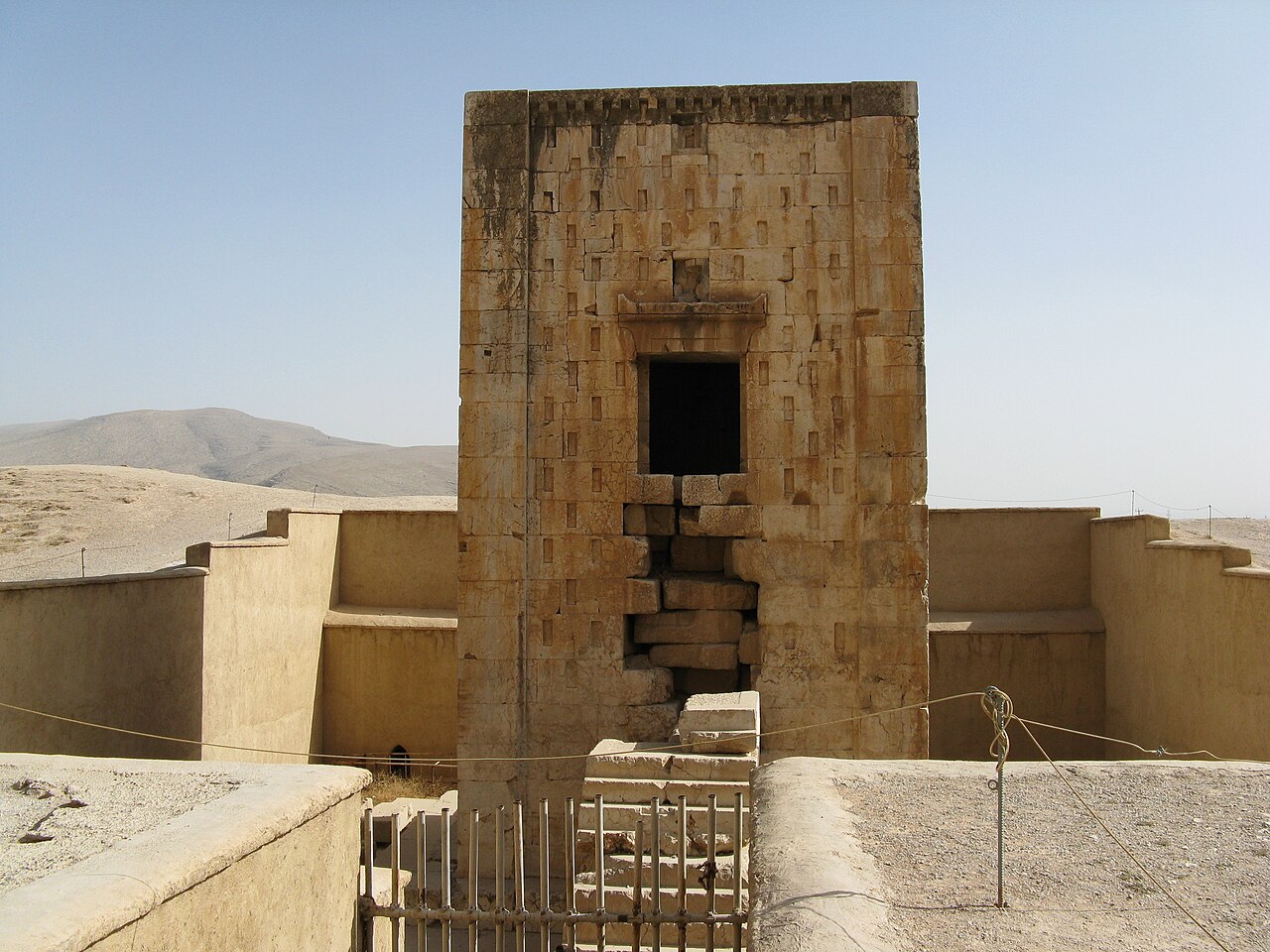

An old building with a new text
The Ka’ba-ye Zartosht (“Cube of Zoroaster”) is much older than the inscription. It is a square stone tower about 12 m high, built in the Achaemenid period, probably in the fifth century BCE, facing the rock-cut tombs of Darius I and his successors. A single room inside is reached by a stone staircase. Its original purpose is still argued over: suggestions include a fire temple, a tomb, a store for royal regalia or sacred texts, and a place for coronation rites. The Persian name is a much later popular label and has no historical link with Zoroaster.
Shapur chose this building in the holiest royal landscape of Fars, among the tombs of the Achaemenid kings and close to the rock reliefs of his own dynasty. By carving his record on its walls he placed his deeds alongside those of the ancient kings, as if adding a new chapter to their story.
How it was found
For centuries the lower part of the building was buried by soil and debris. Excavations by the Oriental Institute of the University of Chicago, led by Erich Schmidt, cleared it in the 1930s. The three versions came to light in two seasons, in 1936 and 1939. The first full English translation was published by Martin Sprengling in 1953 under the title Third Century Iran: Sapor and Kartir. The French scholar André Maricq named the Greek version the Res Gestae Divi Saporis in 1958, by analogy with the Res Gestae Divi Augusti, the record of the emperor Augustus’s achievements. The standard modern edition, with all three versions side by side, is by Philip Huyse (1999).
Three languages, three audiences
Each version was meant for a different readership. Middle Persian was the language of Fars and the new court. Parthian was still spoken and written by the great noble families who had served the Arsacids. Greek was the language of administration and culture in the eastern Roman world, and of many of the Roman captives now living in Iran. The three texts are close but not identical; where the Middle Persian is damaged, scholars reconstruct it from the Parthian and Greek.
What the inscription says
Titles and lineage
The text opens with Shapur’s name and titles: the Mazda-worshipping lord, king of kings of Iran and non-Iran, whose lineage is from the gods, son of Ardashir and grandson of Papak. It is one of the earliest texts to use the word Eranshahr, “the realm of the Iranians”, as the name of the state.
The lands of the empire
Next comes a list of provinces, running from Fars, Parthia, Khuzestan and Mesopotamia through Armenia, Georgia and Albania in the Caucasus, to Media, Gurgan, Merv, Herat, Kerman, Sistan, Makran and the Kushan lands “up to Peshawar”, Sogdiana and Chach (Tashkent). Some of these regions were ruled directly, some by vassals, and some may represent claims rather than control. Historians use the list as a map of how the king saw his realm.
Three wars with Rome
The core of the text describes Shapur’s three campaigns: the defeat of Gordian III at Misiche in 244 and the peace with Philip the Arab, who paid 500,000 denarii; the victory at Barbalissos over a Roman force of 60,000 and the capture of Antioch and dozens of other cities; and the battle beyond Carrhae and Edessa in 260 in which Valerian was taken prisoner. Each campaign ends with a list of the cities captured. For the last campaign, see The Battle of Edessa and the Capture of Valerian.
The inscription also gives a reason for Shapur’s settlement policy: he says he brought people from the Roman lands and settled them in Persis, Parthia, Khuzestan and Mesopotamia.
Fires and offerings
Shapur then lists the sacred fires he founded in thanks for his victories, each named for the soul of a family member: for himself, his daughter Adur-Anahid, whom he calls “queen of queens”, and his sons Hormizd-Ardashir, Narseh and Shapur. He sets out the daily offerings of lambs, bread and wine at these fires. The passage is valuable evidence for royal Zoroastrian practice in the third century.
The court
The last section names the members of three royal courts, those of Papak, Ardashir and Shapur, with their titles. Here we find the queens and princes, the heads of the great noble houses such as the Karen and the Suren, satraps and officials. Among the names is a young priest called Kartir, listed with the simple title herbed. It is the first appearance of the man who would later dominate the Zoroastrian church.
Kartir’s addition
A generation later, under Bahram II, Kartir had his own inscription carved on the same building, directly below the Middle Persian version of Shapur’s text. In it he tells of his rise through the reigns of Shapur’s sons and of his campaign against other religions. Placing his words beneath the king’s was a statement of how far a priest had come. His career is told on Kartir and the Zoroastrian Church.
Why historians value it
Before the inscription was found, the Roman wars of the third century were known almost only from Roman authors, who wrote decades or centuries later and played down their defeats. ŠKZ gives the Persian side in the king’s own words. It is propaganda, of course, and some details are disputed, such as Shapur’s claim that Gordian III died in battle. But it allows historians to compare two hostile accounts of the same events, a rare luxury in ancient history.
It also tells us things no Roman would have recorded: the names of provinces, the structure of the court, the family of the king and the religious duties of royalty. Together with the reliefs of Naqsh-e Rostam, it makes this one cliff and the plain in front of it the best single source for the early Sasanian state. For the language itself, see Middle Persian (Pahlavi) Language and Literature, and for the king, Shapur I.
Persian words from this page
| کعبه زرتشت | Ka’be-ye Zartosht | Cube of Zoroaster |
| سنگنبشته | sang-neveshte | stone inscription |
| پهلوی | Pahlavi | Middle Persian (in its written form) |
| پارتی | Pârti | Parthian (language) |
| یونانی | Yunâni | Greek |
| ایرانشهر | Irânshahr | Eranshahr, the realm of Iran |
| هیربد | hirbad | herbed, a Zoroastrian priestly title |
Sources and further reading
- Philip Huyse, Die dreisprachige Inschrift Šābuhrs I. an der Ka’ba-i Zardušt (ŠKZ), Corpus Inscriptionum Iranicarum III.1.1, 2 vols. (London, 1999).
- Martin Sprengling, Third Century Iran: Sapor and Kartir (Oriental Institute, University of Chicago, 1953).
- André Maricq, “Res Gestae Divi Saporis”, Syria 35 (1958).
- Encyclopaedia Iranica, “Ka’ba-ye Zardošt”.
- Michael H. Dodgeon and Samuel N. C. Lieu, The Roman Eastern Frontier and the Persian Wars, AD 226–363 (Routledge, 1991), with English translation of the Greek text.
Want to learn Persian? Get the free Starter Pack
Get the 14-page printable Starter Pack (all 32 letters, a 7-day reading plan, 100 core words and 20 survival phrases) and a short 5-email course. Free.
More in The Sasanian Empire (224–651 CE)
- The Origins of the Sasanian Family
- Ardashir I, Founder of the Sasanian Empire
- Firuzabad: Ardashir’s Round City
- Shapur I, King of Kings of Iran and Non-Iran
- Bishapur: Shapur’s City
- The Battle of Edessa and the Capture of Valerian
- The Ka’ba-ye Zartosht Inscription of Shapur I
- Mani and Manichaeism
- Hormizd I and Bahram I
- Kartir and the Zoroastrian Church
- Bahram II
- Narseh and the Peace of Nisibis
- Shapur II the Great
- Julian’s Invasion of Persia (363)
- Christians in the Sasanian Empire
- Shapur III and the Partition of Armenia
- Yazdegerd I
- Bahram V Gur
- Yazdegerd II
- The Battle of Avarayr (451)
- The Hephthalites and Iran’s Eastern Frontier
- Peroz I and the Hephthalite Disaster
- Kavad I
- Zamasp and Kavad’s Return
- Mazdak and the Mazdakite Movement
- Khosrow I Anushirvan the Just
- The Sasanian–Byzantine Wars of the 6th Century
- The Battle of Dara (530)
- Khosrow I Sacks Antioch (540)
- The Lazic War (541–562)
- The Reforms of Khosrow I
- The Academy of Gondishapur: History and Legend
- Borzuya, Chess and Kalila wa Dimna
- Taq Kasra: The Arch of Ctesiphon
- The Sasanian Conquest of Yemen
- The Sasanians and the Western Turks
- Hormizd IV
- Bahram Chobin’s Rebellion
- Khosrow II Parviz
- The Last Great War: Byzantium and Persia, 602–628
- The Siege of Constantinople (626)
- Heraclius Strikes Back
- Shirin: Queen and Legend
- Shahrbaraz, the General Who Became King
- Civil War and the Queens Boran and Azarmidokht
- Yazdegerd III, the Last Sasanian King
- The Sasanian Army
- Sasanian Society and the Class System
- Zoroastrianism under the Sasanians
- Sasanian Art: Silver, Reliefs and Silk
- The Sasanian Reliefs of Naqsh-e Rostam
- Taq-e Bostan
- Sasanian Cities, Palaces and Bridges
- Middle Persian (Pahlavi) Language and Literature
- Sasanian Coins and Silverwork
- Women in the Sasanian Empire
- Polo, Hunting and Games at the Sasanian Court
- The Sasanian Legacy