Sasanian art is the court art of Iran from 224 to 651 CE: rock reliefs carved on cliffs, silver plates and ewers gilded with royal hunts, patterned silks, stucco wall panels and cut glass. Almost all of it served one idea, the glory of the king of kings, and its motifs travelled along trade routes from Byzantium to China and lived on in the art of the Islamic world.
| Period | 224–651 CE, with a long afterlife |
|---|---|
| Main media | Rock reliefs, silver vessels, silk textiles, stucco, glass, seals, coins |
| Typical themes | Investiture by gods, victory, the royal hunt, the banquet, winged creatures, pearl roundels |
| Key sites | Naqsh-e Rostam, Bishapur, Taq-e Bostan, Ctesiphon |
| Major collections | National Museum of Iran, Hermitage (St Petersburg), British Museum, Louvre, Metropolitan Museum |
An art of kingship
Sasanian kings presented themselves as “Mazda-worshipping” rulers of divine descent, and their art says the same thing again and again. The king appears larger than other figures, wearing his personal crown, with ribbons flowing from his diadem and shoulders. He receives his kingship from a god, defeats his enemies, hunts lions and boars, and feasts. Because each king had his own crown, and the crowns are known from coins, historians can often tell which ruler a relief or plate shows. Even where art was made for nobles, it borrowed royal images.
Rock reliefs: the early centuries
About forty Sasanian rock reliefs are known, most in Fars, the dynasty’s homeland, and almost all from the first century of the dynasty. They were cut on cliffs at places with older royal associations or water: beneath the Achaemenid tombs at Naqsh-e Rostam, in the gorge at Bishapur, near Firuzabad. The early reliefs show investiture and triumph; under Bahram II the king’s family and court appear; jousting scenes stress the valour of the armoured horseman. After the 4th century the habit almost stopped, until the great grotto of Taq-e Bostan in the 7th century. See the Sasanian reliefs of Naqsh-e Rostam, Bishapur and Taq-e Bostan.

Silver: the king on a plate
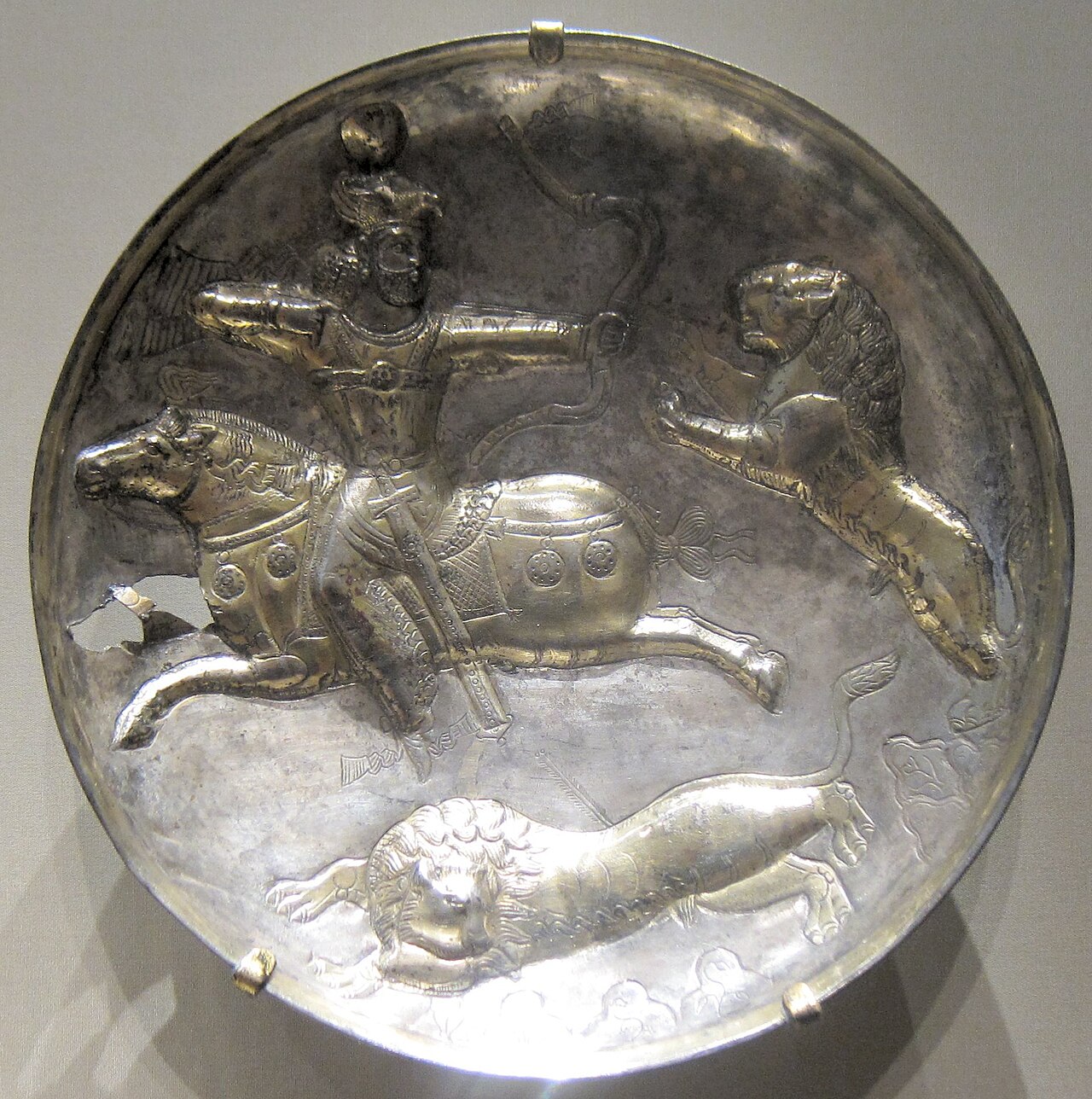
The best-known Sasanian objects are silver plates showing a king hunting. He rides at full gallop or stands on foot, shooting arrows or striking with a sword, while lions, boars, rams or deer fall around him. The plates were not tableware in the everyday sense. They seem to have been made in royal workshops as gifts to nobles, allies and foreign rulers, carrying the king’s image across and beyond the empire.
How they were made
Craftsmen hammered and cast the plates, then built up the figures in relief. On many pieces the main parts of the design were made separately and fitted into the plate, so that they stand out from the surface. Selected areas were gilded with a mixture of gold and mercury, the mercury burned off, leaving gold on silver. The result is a glittering two-colour image.
Where they were found
Many of the finest plates were not found in Iran at all but in the Perm and Ural region of Russia, where they had travelled north through the fur trade and were kept for centuries by local peoples. That is why the Hermitage in St Petersburg has one of the largest collections. Besides royal hunts, Sasanian silver includes bowls with banquet scenes, ewers decorated with dancing women holding vessels and birds, and boat-shaped cups. Some later pieces were made after the fall of the empire, in Sasanian style, which makes dating difficult. The specialised story of coins and silverwork is told on the page on Sasanian coins and silverwork.
Silk and pattern
Sasanian textiles survive mostly in small pieces, but their designs are well known from the clothes carved at Taq-e Bostan and from silks preserved in church treasuries and tombs far from Iran. Typical patterns place animals or birds, often in pairs, inside circles framed by small round “pearls”: winged horses, rams, ducks, boars’ heads, and the senmurv, a fabulous creature with a dog’s head, wings and a peacock’s tail, which Persian later called the Simorgh. Silk was one of the luxuries over which Byzantium and Persia competed, and the Sasanians controlled much of the trade from China to the west. Silks in “Sasanian style” were woven in Sogdiana, Byzantium and China as well, so not every such piece was made in Iran.
Stucco, glass and gems
Palaces and houses were decorated with moulded and carved stucco: panels with vine scrolls, rosettes, animals, busts of kings and hunting scenes. Important groups come from Ctesiphon, Kish in Iraq and Chal Tarkhan near Rey. Sasanian glass-makers produced heavy bowls decorated with rows of circular cut facets; one such bowl was preserved in the Shosoin treasury at Nara in Japan, having travelled the Silk Road. Engraved seals of semi-precious stone carry portraits of officials, animals, symbols and Middle Persian names, and are a major source for administration and personal names.
Where it came from
Sasanian artists drew on several traditions. Achaemenid art left the idea of royal monuments in stone and some motifs, such as bull-headed capitals. Parthian art supplied frontal figures and the costume of riders. Roman and later Byzantine art, known through war, captives and diplomacy, contributed mosaics at Bishapur and the winged Victories at Taq-e Bostan. What emerged was not a copy of any of these, but a recognisable court style.
What came after
Sasanian forms outlived the dynasty by centuries. Early Islamic palaces in Syria and Iraq used Sasanian stucco motifs and royal imagery; Islamic metalwork took over the hunting king and the banquet; pearl roundels and paired animals appear on silks from Spain to Japan; the Simorgh became a bird of Persian poetry and painting. The page on the Sasanian legacy follows these threads further.
Persian words from this page
| نقره | noqre | silver |
| ابریشم | abrisham | silk |
| سیمرغ | Simorgh | the Simorgh (senmurv) |
| گچبری | gachbori | carved stucco |
| شکار | shekâr | hunt |
| تاج | tâj | crown |
Sources and further reading
- Prudence O. Harper, The Royal Hunter: Art of the Sasanian Empire (1978)
- Prudence O. Harper and Pieter Meyers, Silver Vessels of the Sasanian Period, Volume One: Royal Imagery (1981)
- Georgina Herrmann, The Iranian Revival (1977)
- Encyclopaedia Iranica, “Art in Iran” (Sasanian section) (iranicaonline.org)
- Matthew P. Canepa, The Two Eyes of the Earth (2009)
Want to learn Persian? Get the free Starter Pack
Get the 14-page printable Starter Pack (all 32 letters, a 7-day reading plan, 100 core words and 20 survival phrases) and a short 5-email course. Free.
More in The Sasanian Empire (224–651 CE)
- The Origins of the Sasanian Family
- Ardashir I, Founder of the Sasanian Empire
- Firuzabad: Ardashir’s Round City
- Shapur I, King of Kings of Iran and Non-Iran
- Bishapur: Shapur’s City
- The Battle of Edessa and the Capture of Valerian
- The Ka’ba-ye Zartosht Inscription of Shapur I
- Mani and Manichaeism
- Hormizd I and Bahram I
- Kartir and the Zoroastrian Church
- Bahram II
- Narseh and the Peace of Nisibis
- Shapur II the Great
- Julian’s Invasion of Persia (363)
- Christians in the Sasanian Empire
- Shapur III and the Partition of Armenia
- Yazdegerd I
- Bahram V Gur
- Yazdegerd II
- The Battle of Avarayr (451)
- The Hephthalites and Iran’s Eastern Frontier
- Peroz I and the Hephthalite Disaster
- Kavad I
- Zamasp and Kavad’s Return
- Mazdak and the Mazdakite Movement
- Khosrow I Anushirvan the Just
- The Sasanian–Byzantine Wars of the 6th Century
- The Battle of Dara (530)
- Khosrow I Sacks Antioch (540)
- The Lazic War (541–562)
- The Reforms of Khosrow I
- The Academy of Gondishapur: History and Legend
- Borzuya, Chess and Kalila wa Dimna
- Taq Kasra: The Arch of Ctesiphon
- The Sasanian Conquest of Yemen
- The Sasanians and the Western Turks
- Hormizd IV
- Bahram Chobin’s Rebellion
- Khosrow II Parviz
- The Last Great War: Byzantium and Persia, 602–628
- The Siege of Constantinople (626)
- Heraclius Strikes Back
- Shirin: Queen and Legend
- Shahrbaraz, the General Who Became King
- Civil War and the Queens Boran and Azarmidokht
- Yazdegerd III, the Last Sasanian King
- The Sasanian Army
- Sasanian Society and the Class System
- Zoroastrianism under the Sasanians
- Sasanian Art: Silver, Reliefs and Silk
- The Sasanian Reliefs of Naqsh-e Rostam
- Taq-e Bostan
- Sasanian Cities, Palaces and Bridges
- Middle Persian (Pahlavi) Language and Literature
- Sasanian Coins and Silverwork
- Women in the Sasanian Empire
- Polo, Hunting and Games at the Sasanian Court
- The Sasanian Legacy