Bahram Chobin was a Sasanian general of the Mihran family who defeated a Turkish invasion in 588–589, rebelled against Hormizd IV and in 590 seized the throne as Bahram VI, the only man outside the house of Sasan to rule Iran between 224 and the 630s. Khosrow II won back the crown in 591 with a Byzantine army, and Bahram died in exile among the Turks. His story lived on as a Middle Persian romance and one of the great episodes of Ferdowsi’s Shahnameh.
| Family | House of Mihran, one of the great Parthian-descended families, based at Rey |
|---|---|
| Father | Bahram Gushnasp, a military officer |
| Nickname | Chobin (Middle Persian Chobēn), usually explained as “like a wooden shaft” or “javelin-like”, for his tall, lean figure |
| Victory | Over the Western Turks near Herat, 588; Balkh and beyond the Oxus, 589 |
| Rebellion | 589–590 |
| Reign | As Bahram VI, 590–591 |
| Defeat | Battle of Blarathon, near Ganzak in Azerbaijan, 591 |
| Death | Murdered in exile among the Turks, 591 or soon after |
A general from Rey
Bahram came from one of the seven great families of the Sasanian Empire, the Mihran, whose power base was Rey near modern Tehran and who claimed descent from the Parthian nobility. His father and grandfather had served the crown as officers and governors. By the 580s Bahram himself was a senior commander with experience on the western front, where he had fought in the long war with Byzantium.
The Shahnameh describes him as tall, dark and spare, with black curling hair, a warrior of few words. The physical description may come from the Middle Persian romance about him, which is lost but was known to Arabic and Persian writers.

The war against the Turks
In 588 a large army of the Western Turks invaded Khorasan. The Persian sources name its leader Saba or Shaba; he was probably a Turkic ruler subordinate to the great khagan. At the same time, other enemies pressed on the Caucasus and the Arab frontier. Hormizd IV gave the eastern command to Bahram.
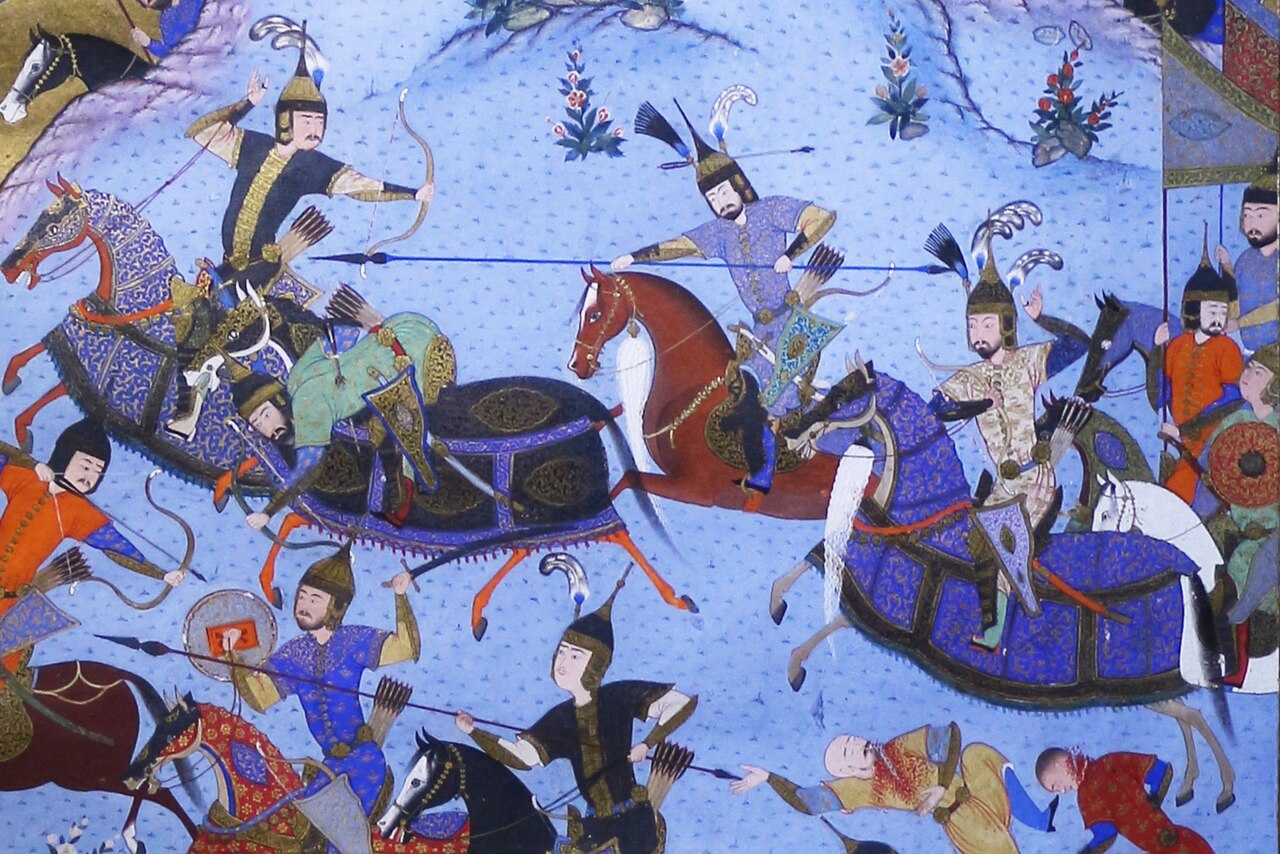
The sources say Bahram chose a small army of experienced horsemen, often given as 12,000, rather than a large levy. He met the Turks in the mountains near Herat, where a narrow position reduced the advantage of their numbers. Persian tradition makes much of the battle: Bahram is said to have killed the Turkish leader with an arrow. In 589 he followed up by taking Balkh and crossing the Oxus, capturing the Turkish ruler’s son and a vast treasure. The sources describe hundreds of camel-loads of booty sent to Ctesiphon.
The victory made Bahram the most famous man in the empire, which proved dangerous. For the wider story of these wars see the Sasanians and the Western Turks.
From loyal general to rival king
Sent west to fight the Byzantines in the Caucasus, Bahram was beaten near the Araxes river in 589. Hormizd, already listening to courtiers who accused Bahram of keeping booty for himself, removed him from command. The sources agree that the king added an insult, most often described as a woman’s dress and a distaff, the tool for spinning wool.
Bahram’s army refused to accept the dismissal. The revolt began as a soldiers’ protest against a king who had treated their general badly, and it might have ended with Hormizd’s fall. In early 590 nobles at court deposed and blinded Hormizd and crowned his son Khosrow II, as told on the Hormizd IV page. But Bahram did not submit to the new king. He marched on Ctesiphon, defeated Khosrow’s forces near the Nahrawan canal, and entered the capital. Khosrow fled west across the desert and asked the Byzantine emperor Maurice for help.
In the summer of 590 Bahram took the crown as Bahram VI. This was a radical step. Since Ardashir I, only members of the Sasanian family had been accepted as kings of kings. Bahram justified himself by claiming to restore the rule of the Arsacids, the Parthian dynasty that the Sasanians had overthrown in 224, and from whom the Mihran claimed descent. He issued silver drachms in his own name, which survive from the first and second years of his reign.
Defeat at Blarathon
Much of the nobility and the priesthood would not accept a king who was not a Sasanian. Maurice, seeing a chance to end the long war on good terms, supported Khosrow with a Byzantine army, in return for the cession of most of Persian Armenia and part of Iberia and the return of Dara and Martyropolis. Khosrow’s uncle Vindoe raised troops in Azerbaijan, and Armenian nobles joined the coalition.
In 591 the allied army met Bahram near Ganzak in Azerbaijan, on the river Blarathon. Bahram’s forces were outnumbered and many of his men deserted. He lost the battle and fled east with a few thousand followers to the Turks, the people he had defeated three years before. They received him well. Within a short time he was murdered there, most sources say at Khosrow’s instigation, through bribes paid to members of the Turkish royal family.
His sister Gordiya and the later revolts
Bahram’s family did not disappear. His sister Gordiya, who is said to have fought alongside him, later married Vistahm, Khosrow’s uncle, when he too rebelled against the king in the 590s. Ferdowsi gives Gordiya her own episodes as a warrior woman. The Mihran family remained powerful in the north for decades.
Several centuries later, the Samanid rulers of Bukhara claimed Bahram Chobin as their ancestor. For a Persian dynasty in the Islamic period, descent from a hero who had defied the Sasanians while upholding Iranian kingship was a useful pedigree. See the Samanid Empire.
Bahram in legend
A Middle Persian book about him, the Bahram Chobin-namag, was translated into Arabic in the 8th century and used by the historians al-Dinawari, al-Tabari and Bal’ami, and by Ferdowsi. In the Shahnameh, the reigns of Hormizd IV and Khosrow II are told largely through Bahram’s story. He appears as a heroic but proud figure who is warned by omens and by his own sister against claiming a throne that is not his by birth.
Historians use this material with care, because it is a romance written to entertain and, in parts, to justify the Sasanian line. But the outline of events is confirmed by the Byzantine historian Theophylact Simocatta and by the Armenian history attributed to Sebeos, who give the war and the Byzantine intervention from the other side. Read more about the poem in Ferdowsi and the Shahnameh, or on the site’s guide to the Shahnameh.
Persian words from this page
| بهرام چوبین | Bahrâm Chubin | Bahram Chobin |
| چوب | chub | wood, stick |
| ری | Rey | Rey, near Tehran |
| گردیه | Gordiye | Gordiya, Bahram’s sister |
| سپهبد | sepahbod | army commander |
| شاهنامه | Shâhnâme | Book of Kings |
Sources and further reading
- Ferdowsi, Shahnameh, reigns of Hormozd and Khosrow Parviz; English translation by Dick Davis, Shahnameh: The Persian Book of Kings (Penguin, 2006).
- Theophylact Simocatta, History, books 3–5, trans. Michael and Mary Whitby (Oxford, 1986).
- The Armenian History attributed to Sebeos, trans. R. W. Thomson (Liverpool University Press, 1999).
- A. Shapur Shahbazi, “Bahram VI Chobin”, Encyclopaedia Iranica.
- Parvaneh Pourshariati, Decline and Fall of the Sasanian Empire (I.B. Tauris, 2008).
Want to learn Persian? Get the free Starter Pack
Get the 14-page printable Starter Pack (all 32 letters, a 7-day reading plan, 100 core words and 20 survival phrases) and a short 5-email course. Free.
More in The Sasanian Empire (224–651 CE)
- The Origins of the Sasanian Family
- Ardashir I, Founder of the Sasanian Empire
- Firuzabad: Ardashir’s Round City
- Shapur I, King of Kings of Iran and Non-Iran
- Bishapur: Shapur’s City
- The Battle of Edessa and the Capture of Valerian
- The Ka’ba-ye Zartosht Inscription of Shapur I
- Mani and Manichaeism
- Hormizd I and Bahram I
- Kartir and the Zoroastrian Church
- Bahram II
- Narseh and the Peace of Nisibis
- Shapur II the Great
- Julian’s Invasion of Persia (363)
- Christians in the Sasanian Empire
- Shapur III and the Partition of Armenia
- Yazdegerd I
- Bahram V Gur
- Yazdegerd II
- The Battle of Avarayr (451)
- The Hephthalites and Iran’s Eastern Frontier
- Peroz I and the Hephthalite Disaster
- Kavad I
- Zamasp and Kavad’s Return
- Mazdak and the Mazdakite Movement
- Khosrow I Anushirvan the Just
- The Sasanian–Byzantine Wars of the 6th Century
- The Battle of Dara (530)
- Khosrow I Sacks Antioch (540)
- The Lazic War (541–562)
- The Reforms of Khosrow I
- The Academy of Gondishapur: History and Legend
- Borzuya, Chess and Kalila wa Dimna
- Taq Kasra: The Arch of Ctesiphon
- The Sasanian Conquest of Yemen
- The Sasanians and the Western Turks
- Hormizd IV
- Bahram Chobin’s Rebellion
- Khosrow II Parviz
- The Last Great War: Byzantium and Persia, 602–628
- The Siege of Constantinople (626)
- Heraclius Strikes Back
- Shirin: Queen and Legend
- Shahrbaraz, the General Who Became King
- Civil War and the Queens Boran and Azarmidokht
- Yazdegerd III, the Last Sasanian King
- The Sasanian Army
- Sasanian Society and the Class System
- Zoroastrianism under the Sasanians
- Sasanian Art: Silver, Reliefs and Silk
- The Sasanian Reliefs of Naqsh-e Rostam
- Taq-e Bostan
- Sasanian Cities, Palaces and Bridges
- Middle Persian (Pahlavi) Language and Literature
- Sasanian Coins and Silverwork
- Women in the Sasanian Empire
- Polo, Hunting and Games at the Sasanian Court
- The Sasanian Legacy