The Sasanian Empire fell to the Arab conquest between 636 and 651 CE, but much of what it built outlived it. Its methods of government, its court ceremony and its ideal of the just king passed to the caliphs of Baghdad; its royal history became the backbone of Ferdowsi’s Shahnameh; its architecture shaped the mosques and palaces of Islamic Iran; and Iranians today still give their children Sasanian names.
| End of the dynasty | Death of Yazdegerd III at Merv, 651 CE |
|---|---|
| Government | Diwan offices, tax registers, coin designs taken over by the caliphate |
| Ideas of kingship | Ardashir’s Testament, Khosrow I as the model of justice, “mirrors for princes” |
| Literature | The Book of Lords, the source behind the Shahnameh; Kalila wa Dimna; wisdom literature |
| Architecture | Iwan, dome on squinches, four-iwan courtyard |
| Living traces | Zoroastrian communities in Iran and India; names such as Ardeshir, Shapur, Bahram, Khosrow, Shirin |
An empire that ended, a culture that did not
When the last king, Yazdegerd III, was killed near Merv in 651, the empire that had ruled Iran for more than four centuries came to an end. The reasons for the collapse, from the exhausting war of 602–628 to plague and civil war, are discussed on the page on why the Sasanian Empire fell. Yet the conquerors inherited a vast, working administration and a population many times their own number, and they needed the people who ran it. The result was a long process in which Sasanian traditions entered the new Islamic civilisation, often through Iranians who had converted.
Running an empire
Offices and taxes
The early caliphs governed Iraq and Iran through the existing tax offices, staffed by Persian secretaries who kept their records in Middle Persian until the reform of the Umayyad governor al-Hajjaj in the 690s. The land tax built on the assessments introduced by Khosrow I’s reforms. The word divan (دیوان), for a government office or register, is usually traced to Middle Persian, and passed from Arabic into Turkish and many other languages, and even into English as “divan”.
Coins
For decades after the conquest, the mints of the eastern caliphate went on striking silver drachms in Sasanian style, with the bust of Khosrow II and a fire altar, adding short Arabic phrases in the margin. Only at the end of the 7th century did a purely Islamic coinage, with inscriptions and no images, replace them.
Secretaries and viziers
Under the Abbasids, who came to power in 750 with support from Khorasan, Persian influence at court grew stronger. The family of the Barmakids from Balkh ran the government of Harun al-Rashid. Whether the office of vizier itself was Sasanian in origin is debated, but Abbasid secretaries saw themselves as heirs of the Sasanian scribes and read Sasanian books on statecraft in Arabic translation.

The ideal of the just king
Middle Persian literature handed on a theory of monarchy: that religion and kingship are twin brothers, that the king must protect each class of society in its place, and that justice brings prosperity, which brings taxes, which pay the army that protects justice. These ideas appear in the Testament of Ardashir and in sayings attributed to Khosrow I Anushirvan, who became for Muslim writers the very model of the just ruler. They run through the “mirrors for princes” of Islamic Iran, from Ibn al-Muqaffa’s Arabic works to Nizam al-Mulk’s Siyasatnama in the 11th century.
Court life
The Abbasid caliphs adopted much of the ceremonial of the Sasanian court: the ruler hidden behind a curtain, elaborate rules of precedence, and festivals such as Nowruz and Mehregan celebrated with gifts. Chess and backgammon, which Persian tradition connects with the court of Khosrow I, spread across the Islamic world. So did polo, the hunting park and the garden as royal settings. The ideal court musician remained Barbad, Khosrow II’s legendary singer.
Memory in poetry and history
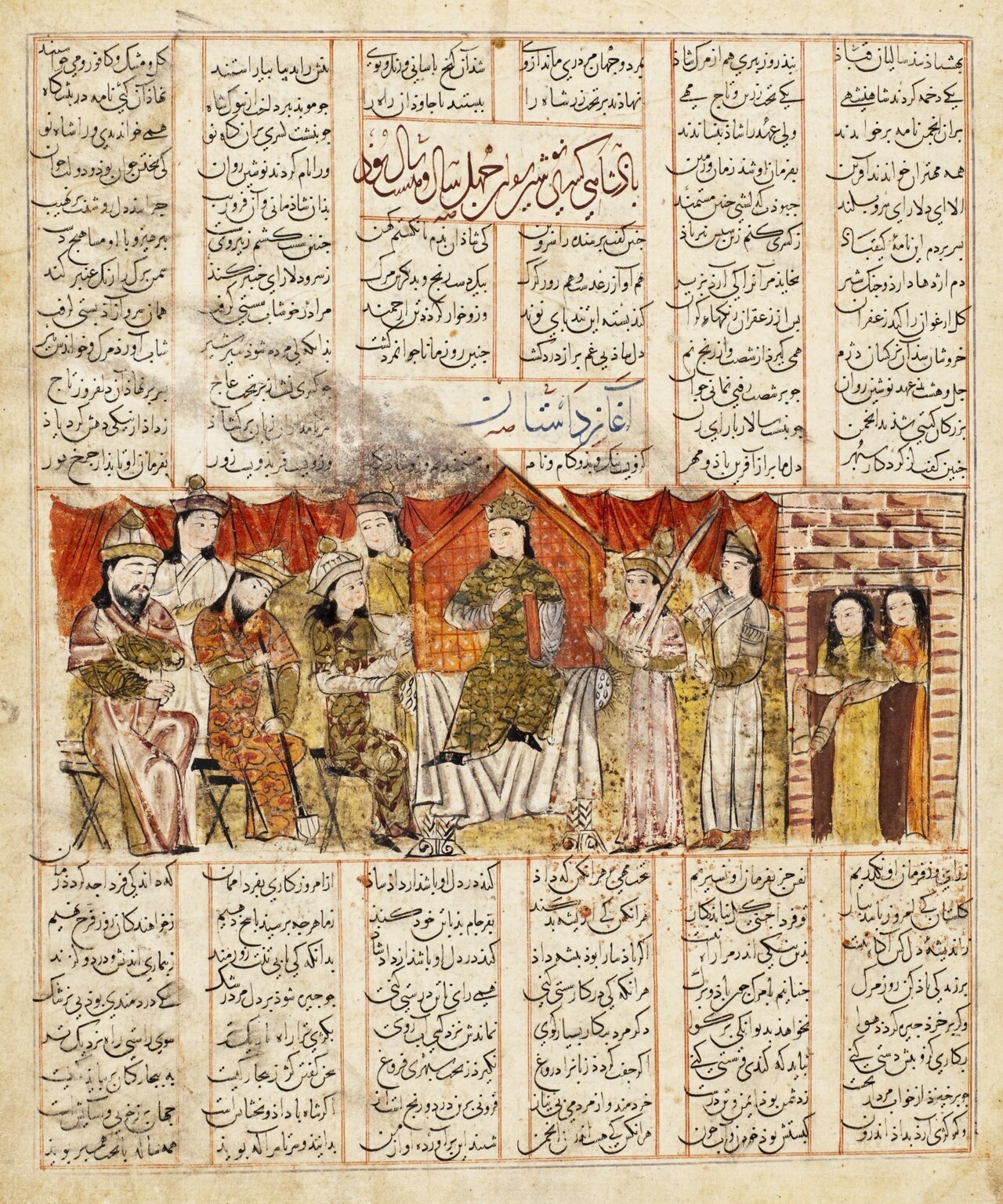
The late Sasanian Khwaday-namag, the “Book of Lords”, was translated into Arabic and rewritten in Persian prose, and these versions became the basis of the historical part of Ferdowsi’s Shahnameh, completed around 1010. The final part of the poem tells the story of the Sasanian kings, from Ardashir to Yazdegerd III, and fixed figures such as Bahram Gur, Anushirvan, Khosrow Parviz and Shirin in Persian memory. The language of that memory was itself a Sasanian legacy: New Persian grew directly out of Middle Persian.
The ruined Taq Kasra at Ctesiphon became a symbol of vanished greatness. The Arabic poet al-Buhturi wrote a famous ode on it in the 9th century, and the Persian poet Khaqani wrote another, on “the palace of Mada’in”, in the 12th, a meditation on the ruin and the passing of power.
Claiming Sasanian descent
The new Iranian dynasties of the 9th and 10th centuries reached back to the Sasanians for legitimacy. The Samanids of Bukhara claimed descent from the general Bahram Chobin; the Buyids, who took Baghdad in 945, had genealogies linking them to Bahram Gur and revived the title shahanshah. Arabs and Persians argued over cultural precedence in the movement known as the Shu’ubiyya (see the Mawali and the Shu’ubiyya).
Buildings and art
The iwan opening onto a courtyard and the dome raised on squinches, both developed by Sasanian builders, became basic forms of Iranian Islamic architecture, combined in the four-iwan mosques of Isfahan and elsewhere. Sasanian motifs, the hunting king, paired animals in roundels, the winged senmurv that became the Simorgh, entered Islamic metalwork, textiles and painting (see Sasanian art and Sasanian cities, palaces and bridges).
Religion
Zoroastrianism, the Sasanian state religion, became a minority faith over the following centuries, but it survived, in Yazd and Kerman and among the Parsis of India, who descend from Zoroastrians who left Iran. Zoroastrians still count years in an era that begins with the accession of Yazdegerd III in 632. Their story continues on the page on Zoroastrians after the Arab conquest.
Beyond Iran
The Sasanian world reached far. The Church of the East, organised under the Sasanians, carried Syriac Christianity to Central Asia and China. A son of Yazdegerd III, Peroz, took refuge at the Tang court in China. Sasanian silks and silver were treasured from Byzantium to Japan.
In modern Iran
Iranians today often name children after Sasanian kings and queens, such as Ardeshir, Shapur, Bahram, Khosrow, Anushirvan and Shirin, and Sasanian monuments are among the country’s best-known heritage sites. The 20th-century Pahlavi dynasty took its name from the Middle Persian language and used Sasanian imagery to link itself to pre-Islamic Iran. How the Sasanian past is valued has changed with Iran’s politics, but its presence in the language, literature and landscape has not.
Persian words from this page
| دیوان | divân | government office; also a poetry collection |
| شاهنامه | Shâhnâme | Book of Kings |
| انوشیروان | Anushirvân | Khosrow I |
| ایوان مدائن | Eyvân-e Madâen | the palace of Ctesiphon |
| مهرگان | Mehregân | autumn festival |
| شطرنج | shatranj | chess |
Sources and further reading
- Ferdowsi, Shahnameh, Sasanian section, trans. Dick Davis (2006)
- Touraj Daryaee, Sasanian Persia: The Rise and Fall of an Empire (2009)
- Michael Axworthy, Iran: Empire of the Mind (2008)
- Ehsan Yarshater (ed.), The Cambridge History of Iran, vol. 3: The Seleucid, Parthian and Sasanian Periods (1983)
- Dimitri Gutas, Greek Thought, Arabic Culture (1998), on Abbasid translation and Sasanian ideology
Want to learn Persian? Get the free Starter Pack
Get the 14-page printable Starter Pack (all 32 letters, a 7-day reading plan, 100 core words and 20 survival phrases) and a short 5-email course. Free.
More in The Sasanian Empire (224–651 CE)
- The Origins of the Sasanian Family
- Ardashir I, Founder of the Sasanian Empire
- Firuzabad: Ardashir’s Round City
- Shapur I, King of Kings of Iran and Non-Iran
- Bishapur: Shapur’s City
- The Battle of Edessa and the Capture of Valerian
- The Ka’ba-ye Zartosht Inscription of Shapur I
- Mani and Manichaeism
- Hormizd I and Bahram I
- Kartir and the Zoroastrian Church
- Bahram II
- Narseh and the Peace of Nisibis
- Shapur II the Great
- Julian’s Invasion of Persia (363)
- Christians in the Sasanian Empire
- Shapur III and the Partition of Armenia
- Yazdegerd I
- Bahram V Gur
- Yazdegerd II
- The Battle of Avarayr (451)
- The Hephthalites and Iran’s Eastern Frontier
- Peroz I and the Hephthalite Disaster
- Kavad I
- Zamasp and Kavad’s Return
- Mazdak and the Mazdakite Movement
- Khosrow I Anushirvan the Just
- The Sasanian–Byzantine Wars of the 6th Century
- The Battle of Dara (530)
- Khosrow I Sacks Antioch (540)
- The Lazic War (541–562)
- The Reforms of Khosrow I
- The Academy of Gondishapur: History and Legend
- Borzuya, Chess and Kalila wa Dimna
- Taq Kasra: The Arch of Ctesiphon
- The Sasanian Conquest of Yemen
- The Sasanians and the Western Turks
- Hormizd IV
- Bahram Chobin’s Rebellion
- Khosrow II Parviz
- The Last Great War: Byzantium and Persia, 602–628
- The Siege of Constantinople (626)
- Heraclius Strikes Back
- Shirin: Queen and Legend
- Shahrbaraz, the General Who Became King
- Civil War and the Queens Boran and Azarmidokht
- Yazdegerd III, the Last Sasanian King
- The Sasanian Army
- Sasanian Society and the Class System
- Zoroastrianism under the Sasanians
- Sasanian Art: Silver, Reliefs and Silk
- The Sasanian Reliefs of Naqsh-e Rostam
- Taq-e Bostan
- Sasanian Cities, Palaces and Bridges
- Middle Persian (Pahlavi) Language and Literature
- Sasanian Coins and Silverwork
- Women in the Sasanian Empire
- Polo, Hunting and Games at the Sasanian Court
- The Sasanian Legacy