Mani (216 to c. 274/277 CE) was a prophet from Sasanian Mesopotamia who founded Manichaeism, a religion that taught a cosmic struggle between Light and Darkness. Protected for a time by Shapur I, he was imprisoned and died under Bahram I, but his faith spread from North Africa to China and survived in places for more than a thousand years.
| Born | 14 April 216 CE, near Ctesiphon in Babylonia (Asoristan) |
|---|---|
| Father | Pattig (Patik), a man of Iranian, probably Parthian, descent |
| Upbringing | A Jewish-Christian baptist community, the Elchasaites |
| Public mission | From 240 CE |
| Royal patron | Shapur I |
| Died | In prison at Gondishapur (Bet Lapat), c. 274 or 276/277, under Bahram I |
| Languages of his writings | Syriac (Aramaic); one book in Middle Persian |
A childhood among the baptists
Mani was born in southern Mesopotamia, then the richest province of the young Sasanian Empire, home to Jews, Christians, pagans, Mandaeans and Zoroastrians living side by side. According to Manichaean tradition his father, Pattig, joined a community of “baptists” when Mani was a small child and took his son with him. Thanks to the Cologne Mani Codex, a tiny Greek parchment book found in Egypt and published in the 1970s, we know this group were followers of Elchasai, a Jewish-Christian teacher who stressed ritual washing of the body and food.
The same codex says Mani received his first revelation at the age of twelve, from a heavenly “Twin” (Syzygos), and a second at twenty-four, in 240. The Twin told him to leave the baptists and preach a new message. He argued with the community about their washing rites, insisting that true purity came from knowledge, not water, and was expelled.
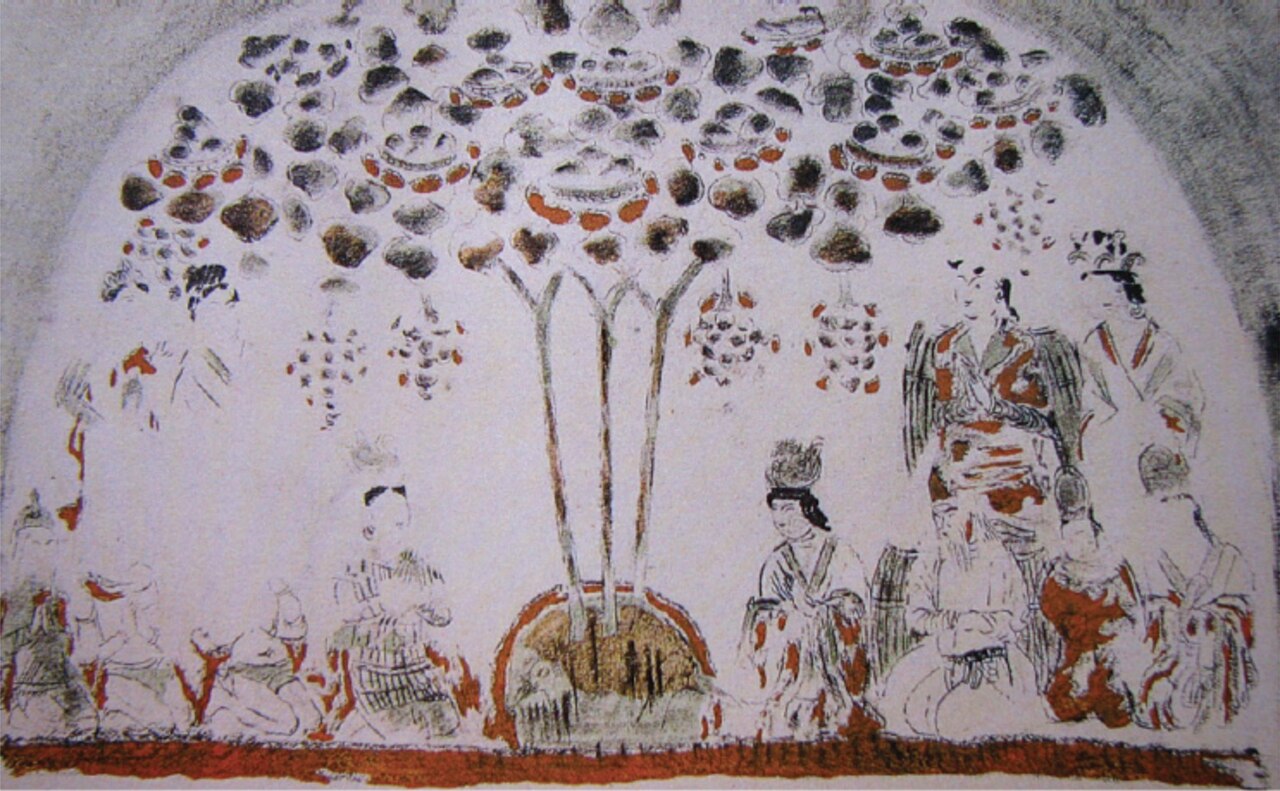

What Mani taught
Mani saw himself as the last in a line of messengers sent to humanity: Zoroaster in Iran, the Buddha in India and Jesus in the West. Each had brought the truth to one region, but their followers had corrupted it and their teachings had not been written down by the prophets themselves. Mani would write his own scriptures and preach to the whole world. He called himself “the apostle of Jesus Christ” and, later, was known as the “seal of the prophets”.
Two principles and three times
At the heart of the teaching were two principles, Light and Darkness, good and evil, spirit and matter, eternally separate in origin. In the “former time” they were apart. In the “middle time”, the present, Darkness has attacked Light and particles of Light are trapped in matter, including in human bodies and in plants. In the “final time” the Light will be freed and the two will be separated again for ever. Salvation meant knowing this truth and helping to release the Light.
Elect and hearers
The community had two ranks. The Elect lived strictly: celibate, vegetarian, without property or wine, and forbidden even to harvest plants, since that harmed the Light within them. The Hearers, ordinary believers, could marry and work, and supported the Elect by bringing them food. By eating it the Elect were thought to free the Light it contained. A Hearer might hope to be reborn as one of the Elect.
Books and pictures
Mani wrote a canon of books, mostly in Syriac, including the Living Gospel, the Treasure of Life and his Epistles. For Shapur I he wrote the Shabuhragan in Middle Persian, a summary of his teaching for an Iranian reader. He also made a book of paintings to illustrate his ideas, known in Middle Persian as the Ardahang. This is the root of his later fame in Persian culture as a master painter: in classical Persian poetry, “Mani” is the name of the ideal artist, and the Arzhang is his legendary picture book.
At the court of Shapur I
After leaving the baptists, Mani travelled by sea to the Indus region (Turan and Sindh), where he preached and, according to tradition, converted a local king. When he returned to Iran around 242, he gained an audience with the new king of kings, Shapur I. Manichaean texts say Shapur granted him letters of protection allowing him to preach throughout the empire, and that Mani travelled with the royal court for years.
Shapur never became a Manichaean. Historians usually explain his support as practical: a universal religion that embraced Zoroaster, Jesus and the Buddha might help bind together an empire of many faiths. Mani also converted members of the royal family and nobility, including, according to his followers, two of Shapur’s brothers, Mihrshah and Peroz. Missionaries were sent west to the Roman Empire and Egypt, and east to Parthia and Central Asia.
Arrest and death
The situation changed after Shapur’s death in about 270. His son Hormizd I reigned only a year. The next king, Bahram I, was influenced by the Zoroastrian priest Kartir, who saw Mani as a dangerous rival. Mani was summoned to the court at Gondishapur (Bet Lapat in Syriac), accused of turning people away from the Zoroastrian religion and put in chains. After 26 days in prison, according to Manichaean accounts, he died. His followers called his death the “crucifixion”, using the language of Jesus’s passion, and remembered it each year at the festival of the Bema.
The year is uncertain: scholars argue for 274 or 276/277. Later Persian and Arabic stories say his body was flayed and the skin stuffed with straw and hung at a city gate, but this is not in the earliest Manichaean accounts. Kartir himself, in his inscriptions, lists the zandik (Manichaeans) among the groups that were “struck” in the empire. For the political background, see Hormizd I and Bahram I and Kartir and the Zoroastrian Church.
A world religion
Persecution in Iran and, from around 302, in the Roman Empire under Diocletian did not stop the spread of Mani’s church.
- In the West, Manichaeism reached Egypt, North Africa, Italy and Gaul. The young Augustine of Hippo was a Hearer for about nine years before becoming a Christian and the faith’s most famous critic. Manichaean books in Coptic were found at Medinet Madi and Kellis in Egypt.
- In Iran, Manichaeans survived despite repeated persecution, and the word zandik (Arabic zindiq) later became a general term for heretics in the Islamic world.
- In Central Asia, Sogdian merchants carried the religion along the Silk Road. In 762 or 763 the ruler of the Uyghur Khaganate adopted it, making Manichaeism a state religion for the only time in its history. Texts in Middle Persian, Parthian, Sogdian and Old Uyghur found at Turfan in the early twentieth century transformed modern knowledge of Mani’s church, and of the Parthian language.
- In China, Manichaeism lasted longest, blending with Buddhism and Daoism. A small temple at Cao’an near Quanzhou in Fujian, with a statue of Mani as the “Buddha of Light”, survives from the fourteenth century.
How historians see Mani
For centuries Mani was known almost only through his enemies: Christian church fathers, Zoroastrian priests and Muslim scholars. The discoveries at Turfan, in Egypt and in the Cologne Codex now let scholars read Manichaean texts in their own words. They show a religion that was neither a Christian heresy nor a Zoroastrian offshoot but a new, deliberately universal faith, born in the cosmopolitan world of Sasanian Mesopotamia. For the wider religious picture, see Zoroastrianism under the Sasanians.
Persian words from this page
| مانی | Mâni | Mani |
| مانوی | Mânavi | Manichaean |
| ارژنگ | Arzhang | Mani’s picture book |
| زندیق | zendiq | heretic (originally a Manichaean) |
| نور | nur | light |
| تاریکی | târiki | darkness |
| پیامبر | payâmbar | prophet |
Sources and further reading
- Encyclopaedia Iranica, “Manicheism” (series of articles), by W. Sundermann and others.
- Ron Cameron and Arthur J. Dewey (trans.), The Cologne Mani Codex: “Concerning the Origin of His Body” (Scholars Press, 1979).
- Iain Gardner and Samuel N. C. Lieu, Manichaean Texts from the Roman Empire (Cambridge University Press, 2004).
- Samuel N. C. Lieu, Manichaeism in the Later Roman Empire and Medieval China (2nd ed., Mohr Siebeck, 1992).
- Hans-Joachim Klimkeit, Gnosis on the Silk Road: Gnostic Texts from Central Asia (HarperCollins, 1993).
Want to learn Persian? Get the free Starter Pack
Get the 14-page printable Starter Pack (all 32 letters, a 7-day reading plan, 100 core words and 20 survival phrases) and a short 5-email course. Free.
More in The Sasanian Empire (224–651 CE)
- The Origins of the Sasanian Family
- Ardashir I, Founder of the Sasanian Empire
- Firuzabad: Ardashir’s Round City
- Shapur I, King of Kings of Iran and Non-Iran
- Bishapur: Shapur’s City
- The Battle of Edessa and the Capture of Valerian
- The Ka’ba-ye Zartosht Inscription of Shapur I
- Mani and Manichaeism
- Hormizd I and Bahram I
- Kartir and the Zoroastrian Church
- Bahram II
- Narseh and the Peace of Nisibis
- Shapur II the Great
- Julian’s Invasion of Persia (363)
- Christians in the Sasanian Empire
- Shapur III and the Partition of Armenia
- Yazdegerd I
- Bahram V Gur
- Yazdegerd II
- The Battle of Avarayr (451)
- The Hephthalites and Iran’s Eastern Frontier
- Peroz I and the Hephthalite Disaster
- Kavad I
- Zamasp and Kavad’s Return
- Mazdak and the Mazdakite Movement
- Khosrow I Anushirvan the Just
- The Sasanian–Byzantine Wars of the 6th Century
- The Battle of Dara (530)
- Khosrow I Sacks Antioch (540)
- The Lazic War (541–562)
- The Reforms of Khosrow I
- The Academy of Gondishapur: History and Legend
- Borzuya, Chess and Kalila wa Dimna
- Taq Kasra: The Arch of Ctesiphon
- The Sasanian Conquest of Yemen
- The Sasanians and the Western Turks
- Hormizd IV
- Bahram Chobin’s Rebellion
- Khosrow II Parviz
- The Last Great War: Byzantium and Persia, 602–628
- The Siege of Constantinople (626)
- Heraclius Strikes Back
- Shirin: Queen and Legend
- Shahrbaraz, the General Who Became King
- Civil War and the Queens Boran and Azarmidokht
- Yazdegerd III, the Last Sasanian King
- The Sasanian Army
- Sasanian Society and the Class System
- Zoroastrianism under the Sasanians
- Sasanian Art: Silver, Reliefs and Silk
- The Sasanian Reliefs of Naqsh-e Rostam
- Taq-e Bostan
- Sasanian Cities, Palaces and Bridges
- Middle Persian (Pahlavi) Language and Literature
- Sasanian Coins and Silverwork
- Women in the Sasanian Empire
- Polo, Hunting and Games at the Sasanian Court
- The Sasanian Legacy