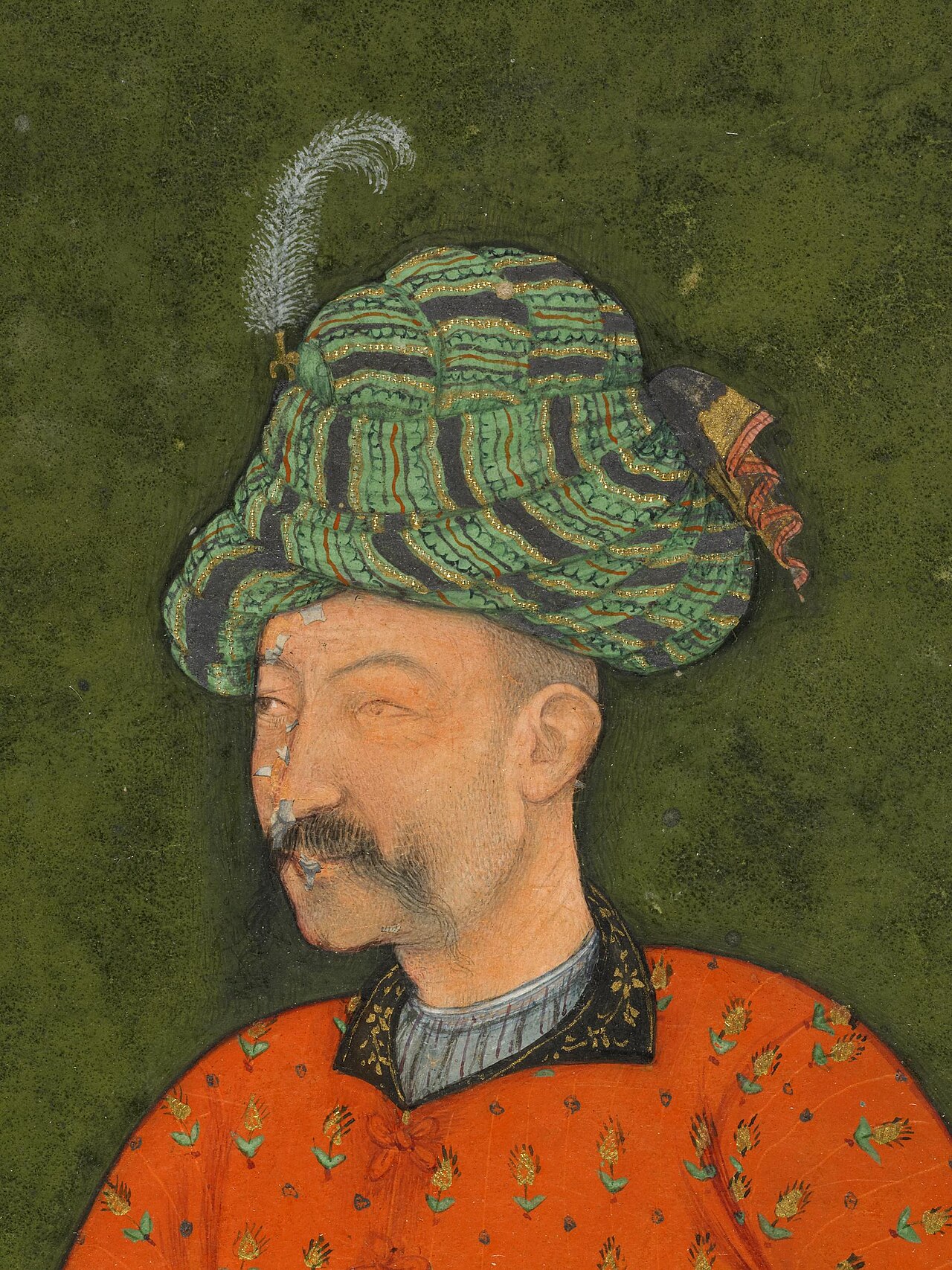
Shah Abbas I, known as Abbas the Great (1571–1629, reigned 1587–1629), was the most powerful of the Safavid kings. He took the throne in the middle of civil war and foreign invasion, broke the power of the Qizilbash chiefs, won back the provinces lost to the Ottomans and Uzbeks, and made Isfahan one of the great cities of the world. He was also suspicious and cruel, and his treatment of his own sons weakened the dynasty after him.
| Born | 27 January 1571, Herat |
|---|---|
| Reigned | October 1587 – 19 January 1629 |
| Father | Mohammad Khodabanda |
| Capitals | Qazvin, then Isfahan (from 1598) |
| Main victories | Herat 1598; Tabriz 1603; Sufiyan 1605; Hormuz and Kandahar 1622; Baghdad 1624 |
| Died | 19 January 1629, Farahabad, Mazandaran; buried in Kashan |
| Successor | His grandson Safi |
A prince in the hands of the tribes
Abbas grew up in Herat as a pawn of the Qizilbash chiefs. His father, Mohammad Khodabanda, was half-blind and weak; his mother, Khayr al-Nisa Begum, was murdered by Qizilbash chiefs when he was eight. In 1581 his guardian Ali Qoli Khan Shamlu proclaimed him shah in Khorasan in defiance of his father. In 1587 Morshed Qoli Khan Ustajlu, who had taken charge of the boy, brought him to Qazvin, and Khodabanda gave up the throne. Abbas was sixteen. Within two years he had Morshed Qoli Khan killed. The lesson of his childhood was that the shah must depend on no tribal chief.
Buying time: the peace of 1590
Abbas faced two invasions at once. The Ottomans held Tabriz, Shirvan and much of the Caucasus, and the Uzbeks under Abdullah Khan held Herat and Mashhad. He could not fight both, so in 1590 he made peace with Istanbul on humiliating terms, giving up Azerbaijan, Tabriz and other western provinces and sending a nephew as a hostage. The peace freed him to rebuild his army and deal with the east. When Abdullah Khan died in 1598, Abbas marched into Khorasan, defeated the Uzbeks near Herat and recovered Herat and Mashhad.

A new army and a new state
The centre of Abbas’s reforms was a standing army paid by the crown: slave soldiers, or gholams, drawn from Georgian, Circassian and Armenian converts, alongside new corps of musketeers and artillerymen. To pay them he took provinces away from Qizilbash governors and placed them under direct royal administration. The Qizilbash remained part of the army, but no longer controlled it. The details, and the role of the English Sherley brothers, are on the page about Shah Abbas’s military reforms and the ghulams.
Winning back the west
With the new army ready, Abbas turned on the Ottomans. He retook Tabriz in 1603 and Yerevan in 1604, and on 6 November 1605 he defeated a large Ottoman army at Sufiyan, near Tabriz. Fighting went on until 1618, and in January 1624, after a siege begun in 1623, he took Baghdad. In 1622, with the help of English East India Company ships, he drove the Portuguese from the island of Hormuz, and in the same year he took Kandahar from the Mughals. These campaigns are told in Shah Abbas retakes the west and the capture of Hormuz.
The wars were brutal for civilians. In 1604–1605, as an Ottoman army advanced, Abbas laid waste to Armenia and forced a large part of its population to move into Iran. Many died on the way. Merchants from Julfa on the Aras river were resettled in a new suburb of Isfahan, where they became the shah’s partners in the silk trade; see New Julfa and the Armenian merchants. In Georgia he crushed revolts with great violence, and the Georgian queen Ketevan, held hostage in Shiraz, was tortured to death in 1624 for refusing to convert.
Isfahan, trade and faith
In 1598 Abbas made Isfahan his capital and began rebuilding it around a vast new square, a royal avenue and a bridge across the Zayandeh Rud. The plan is described in Isfahan, “Half the World”. He made silk a royal monopoly and sent embassies to Europe seeking allies against the Ottomans and buyers for Persian silk. Roads and caravanserais were built or repaired across the empire.
Abbas was a committed Twelver Shi’a and used religion to bind his subjects to the throne. In 1601 he walked from Isfahan to Mashhad, a journey of several weeks, to visit the shrine of Imam Reza, and he spent heavily on the shrine. Pilgrimage to Mashhad, inside Iran, was a useful alternative to the shrines of Iraq, then in Ottoman hands. He also endowed his personal property to the Fourteen Innocents, the Prophet, Fatima and the twelve Imams.
The man
European visitors left vivid portraits. The Italian Pietro della Valle was struck by the shah’s curiosity about Christianity and Europe; the Spanish ambassador García de Silva y Figueroa heard him speak Georgian. Abbas liked to walk the bazaars of Isfahan incognito, ate with foreign guests and chatted with craftsmen. His chronicler, Eskandar Beg Monshi, praises his justice and his close attention to the details of government. Roger Savory singled out his prudence; Michael Axworthy calls him a gifted administrator and a ruthless autocrat.
A father’s fear
The darker side was his fear of plots. In 1615 he had his eldest son, Mohammad Baqer Mirza, known as Safi Mirza, killed at Rasht on suspicion of conspiracy, and later regretted it bitterly. He blinded two other sons, which made them unable to rule. To keep princes from becoming rivals, they were raised inside the harem with no experience of government. Many historians see this practice as one cause of the weak rulers who followed him.
Death and legacy
Abbas died at his palace of Farahabad on the Caspian coast on 19 January 1629, aged fifty-seven, and was buried in Kashan. His grandson Safi succeeded him; see Shah Safi and the Treaty of Zuhab. In Iranian memory Abbas is the builder-king, the shah of Isfahan’s squares and bridges, and countless buildings, caravanserais and stories are credited to him, more than he could ever have built. Historians agree that under him the Safavid state reached its greatest power and prosperity, and that the system he created kept the dynasty going for a century after his death.
Persian words from this page
| شاه عباس بزرگ | Shâh Abbâs-e Bozorg | Shah Abbas the Great |
| اصفهان | Esfahân | Isfahan |
| مشهد | Mashhad | Mashhad |
| کاروانسرا | kârvânsarâ | caravanserai |
| ابریشم | abrisham | silk |
| زیارت | ziyârat | pilgrimage |
| کاشان | Kâshân | Kashan |
Sources and further reading
- Eskandar Beg Monshi, Tarikh-e Alam-ara-ye Abbasi, trans. Roger Savory as History of Shah ‘Abbas the Great (Westview, 1978)
- David Blow, Shah Abbas: The Ruthless King Who Became an Iranian Legend (I.B. Tauris, 2009)
- Roger Savory, Iran under the Safavids (Cambridge University Press, 1980)
- Michael Axworthy, Iran: Empire of the Mind (Penguin, 2008)
- Sheila R. Canby (ed.), Shah ‘Abbas: The Remaking of Iran (British Museum Press, 2009)
Want to learn Persian? Get the free Starter Pack
Get the 14-page printable Starter Pack (all 32 letters, a 7-day reading plan, 100 core words and 20 survival phrases) and a short 5-email course. Free.
More in The Safavid Empire (1501–1736)
- Shah Ismail I
- The Qizilbash
- Twelver Shi’ism Becomes Iran’s State Religion
- The Battle of Marv and the Uzbeks
- The Battle of Chaldiran (1514)
- Shah Tahmasp I
- The Ottoman–Safavid War and the Peace of Amasya
- Humayun’s Exile in Persia
- Qazvin: The Second Safavid Capital
- Ismail II and Mohammad Khodabanda
- Shah Abbas the Great
- Shah Abbas’s Military Reforms and the Ghulams
- The Sherley Brothers in Persia
- Isfahan: “Half the World”
- The Building of Naqsh-e Jahan Square
- Shah Abbas Retakes the West: The Ottoman Wars of 1603–1618
- The Capture of Hormuz from the Portuguese (1622)
- New Julfa and the Armenian Merchants
- The Safavid Silk Trade and Europe
- Sheikh Baha’i
- Reza Abbasi
- Shah Safi and the Treaty of Zuhab
- Shah Abbas II
- The Fight for Kandahar
- Chehel Sotoun Palace and Its War Paintings
- Shah Suleiman
- European Travellers in Safavid Persia
- Shah Soltan Hoseyn
- Safavid Art: Carpets, Miniatures and Tiles
- Mulla Sadra and the School of Isfahan
- The Afghan Revolt and the Battle of Gulnabad
- The Siege and Fall of Isfahan (1722)
- Peter the Great’s Persian Campaign (1722–1723)
- Tahmasp II and Hotaki Rule (1722–1732)
- Women of the Safavid Court
- The Safavid Legacy