Between 1603 and 1618 Shah Abbas I fought two wars against the Ottoman Empire and won back Tabriz, Yerevan, Shirvan and the rest of the north-west that Iran had surrendered in 1590. The peace treaties of 1612 and 1618 restored the old frontier of 1555, and in 1624 Abbas went further and took Baghdad. It was the most successful Iranian campaign against the Ottomans of the whole Safavid period.
| Dates | 1603–1612 and 1616–1618, with Baghdad taken in January 1624 |
|---|---|
| Iranian ruler | Shah Abbas I |
| Ottoman sultans | Mehmed III, Ahmed I, Mustafa I, Osman II |
| Main events | Tabriz retaken (1603), Yerevan (1604), battle of Sufiyan (1605), Shirvan (1607) |
| Treaties | Nasuh Pasha (Istanbul), November 1612; Serav (Sarab), September 1618 |
| Result | Safavid recovery of the lands lost in 1590; frontier of the Peace of Amasya restored |
What Iran had lost
Abbas came to the throne in 1587 in the middle of an Ottoman invasion. During the civil wars that followed the death of Tahmasp I, Ottoman armies had taken Tabriz in 1585 and spread across Azerbaijan, Shirvan, Georgia and the western provinces. With Uzbeks raiding Khorasan at the same time, the young shah chose to buy peace in the west. The Treaty of Constantinople of 1590 left the Ottomans in possession of Tabriz and most of the north-west. It was a humiliating settlement, accepted to gain time, as described in Shah Abbas the Great.
Abbas used the next twelve years to deal with the Uzbeks and to build a new standing army of gholâm soldiers, musketeers and artillery that answered to him rather than to the Qizilbash tribal chiefs. That army, described in Shah Abbas’s military reforms and the ghulams, was the tool he now turned against the Ottomans. The timing was good. The Ottomans were tied down in a long war with the Habsburgs in Hungary (1593–1606), and Anatolia was shaken by the Jelali revolts.
The first war, 1603–1612
Tabriz and Yerevan
In the autumn of 1603 Abbas left Isfahan with little warning and marched fast to the north-west. He reached Tabriz before the Ottoman governor could organise a defence, and the city, under Ottoman rule since 1585, fell to him; the garrison in the citadel soon followed. Nakhchivan fell soon after, and Abbas laid siege to the strong fortress of Yerevan, which surrendered in June 1604 after a winter siege.

Scorched earth in Armenia
The Ottomans answered by sending a large army under Cigalazade Sinan Pasha. Abbas did not want to fight it on ground of its choosing. In 1604 he ordered the country between Kars and the Aras river laid waste and moved its people south into Iran, so that the invaders would find no food. The deportation of Armenians, including the merchants of Julfa on the Aras, was carried out in winter and with great suffering; many died crossing the river. The survivors’ later history in Isfahan is told in New Julfa and the Armenian merchants.
The battle of Sufiyan, 1605
On 6 November 1605 the two armies met at Sufiyan, north-west of Tabriz. An Ottoman commander, Köse Sefer Pasha, attacked before the main army was ready; Abbas drew the Ottoman cavalry out of position with a feint and then threw in his reserves. The Ottomans were routed. Modern accounts give very large figures, around 100,000 Ottomans against 60,000 Iranians and some 20,000 Ottoman dead, but these numbers go back to chroniclers on each side and should be treated as rough indications. What is not in doubt is the result: Sinan Pasha retreated, and died soon afterwards.
After Sufiyan the Ottoman position in the Caucasus collapsed. Ganja was taken in 1606, and by 1607 Abbas held Shamakhi and the rest of Shirvan, as well as Derbent on the Caspian. The lands lost in 1590 had been recovered within four campaigning seasons.
The Treaty of Nasuh Pasha
Peace was signed in Istanbul on 20 November 1612 and is named after the Ottoman grand vizier Nasuh Pasha. The Ottomans accepted the frontier set by the Peace of Amasya in 1555. In return Iran agreed to send 200 loads of raw silk every year, and Iranian pilgrims to Mecca were to travel through Syria rather than Iraq. The silk clause mattered: silk was Iran’s most valuable export, as explained in the Safavid silk trade and Europe, and Abbas soon stopped sending it.
The second war, 1616–1618
The unpaid silk gave Sultan Ahmed I’s government its reason to fight again. In 1616 a large Ottoman army under the grand vizier Öküz Mehmed Pasha besieged Yerevan. Abbas did not try to relieve it by battle. He harried the Ottoman supply lines, and after 44 days, with winter coming, the grand vizier gave up and retreated, losing many men to the cold. He was dismissed.
In 1618 his successor, Damat Halil Pasha, invaded again with Crimean Tatar allies and pushed towards Ardabil, the Safavids’ ancestral shrine town. Abbas’s commander-in-chief Qarachaqay Khan followed the same tactics: burn the countryside, strike at foraging parties, avoid a pitched battle until the enemy was hungry and cold. The Ottomans, unable to force a decision, accepted terms. The Treaty of Serav, signed at Sarab near Tabriz on 26 September 1618, confirmed the 1612 frontier with small changes and cut the silk payment to 100 loads a year.
The capture of Baghdad
The 1618 peace did not last long. In 1621 an Ottoman officer in Baghdad, Bakr Subashi, seized control of the city and, threatened by the sultan’s forces, appealed to Abbas. The shah sent an army, and Safavid troops broke into the city in January 1624, ending a siege that had begun the previous year. Baghdad and the Shi’i shrine cities of Karbala and Najaf were in Iranian hands again for the first time since 1534. An Ottoman army tried to retake Baghdad in 1625–1626 and failed. The city stayed Safavid until 1638, when Sultan Murad IV took it back; the final settlement is told in Shah Safi and the Treaty of Zuhab.
- 1590 Treaty of Constantinople: Iran cedes Tabriz and the north-west
- 1603 Abbas retakes Tabriz and Nakhchivan
- June 1604 Yerevan surrenders after a winter siege
- 1604–1605 Scorched earth and deportations in Armenia
- 6 Nov 1605 Ottoman defeat at Sufiyan
- 1606–1607 Ganja, Shirvan and Derbent recovered
- 20 Nov 1612 Treaty of Nasuh Pasha
- 1616 Ottoman siege of Yerevan fails
- 26 Sep 1618 Treaty of Serav
- Jan 1624 Safavid capture of Baghdad
How historians judge the wars
Roger Savory called Abbas a general of consummate ability, and the wars are usually seen as the proof that his military reforms worked: for the first time since Chaldiran in 1514, a Safavid army beat the Ottomans in the field. Historians also stress how much he owed to timing, since the Ottomans were fighting on two fronts and facing rebellion at home. The price was paid by the people of the borderlands. The deportations from Armenia, and Abbas’s campaigns in Georgia in 1614–1616, in which tens of thousands of Georgians were killed or carried off according to Georgian and Persian sources, are remembered in those countries as catastrophes. Iranian historians, by contrast, have tended to remember the wars as the moment when the losses of the sixteenth century, beginning with Chaldiran, were finally reversed.
For Tabriz itself and its later history, see the Tabriz city guide.
Persian words from this page
| تبریز | Tabriz | Tabriz |
| ایروان | Iravân | Yerevan |
| بغداد | Baghdâd | Baghdad |
| صلح | solh | peace |
| ابریشم | abrisham | silk |
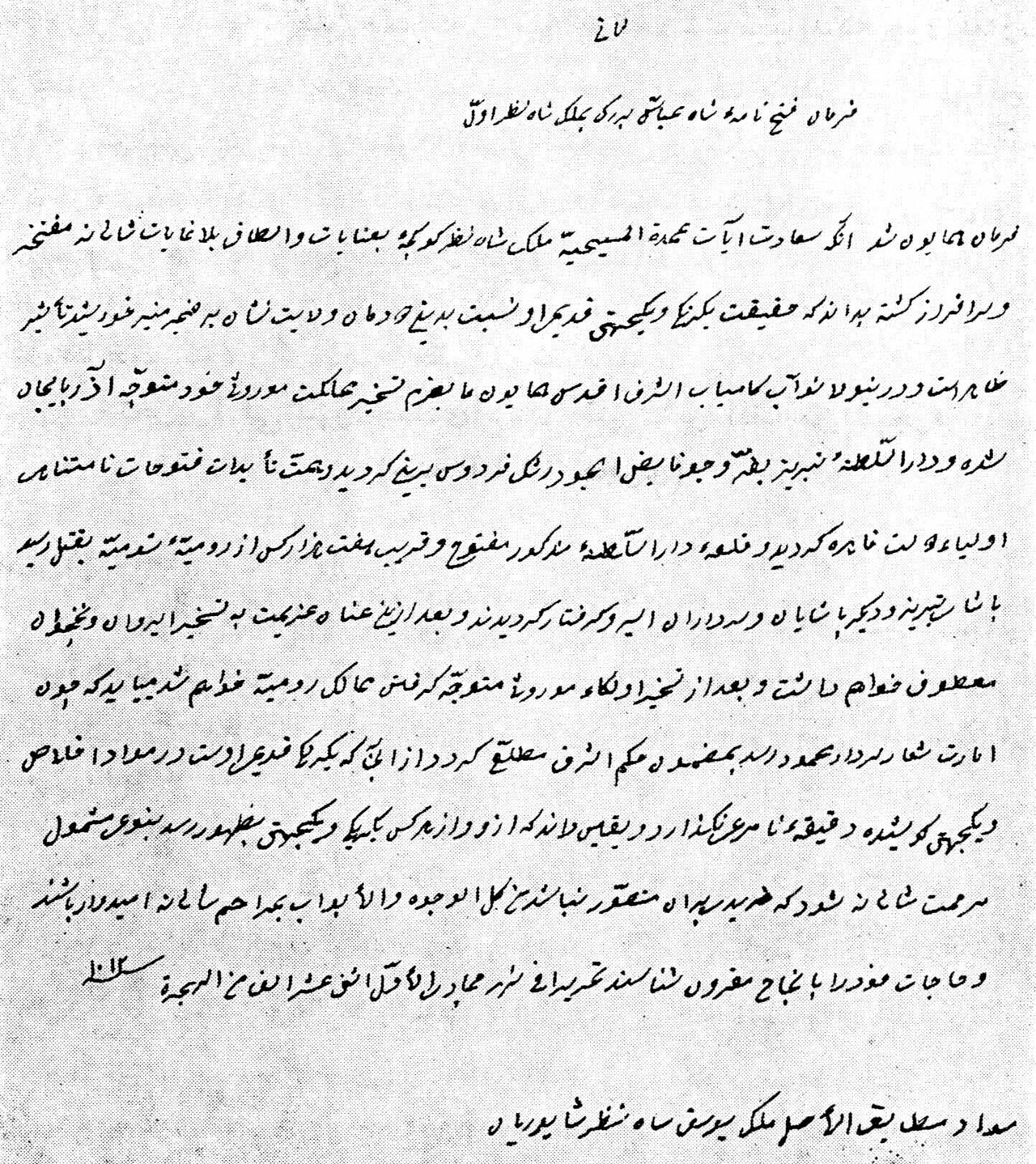
| فتحنامه | fath-nâme | letter announcing a victory |
| غلام | gholâm | royal slave soldier |
Sources and further reading
- Eskandar Beg Monshi, History of Shah ‘Abbas the Great, translated by Roger Savory, 1978.
- Roger Savory, Iran under the Safavids, Cambridge University Press, 1980.
- Encyclopaedia Iranica, “‘Abbas I”.
- The Cambridge History of Iran, vol. 6: The Timurid and Safavid Periods, 1986.
- David Blow, Shah Abbas: The Ruthless King Who Became an Iranian Legend, I.B. Tauris, 2009.
Want to learn Persian? Get the free Starter Pack
Get the 14-page printable Starter Pack (all 32 letters, a 7-day reading plan, 100 core words and 20 survival phrases) and a short 5-email course. Free.
More in The Safavid Empire (1501–1736)
- Shah Ismail I
- The Qizilbash
- Twelver Shi’ism Becomes Iran’s State Religion
- The Battle of Marv and the Uzbeks
- The Battle of Chaldiran (1514)
- Shah Tahmasp I
- The Ottoman–Safavid War and the Peace of Amasya
- Humayun’s Exile in Persia
- Qazvin: The Second Safavid Capital
- Ismail II and Mohammad Khodabanda
- Shah Abbas the Great
- Shah Abbas’s Military Reforms and the Ghulams
- The Sherley Brothers in Persia
- Isfahan: “Half the World”
- The Building of Naqsh-e Jahan Square
- Shah Abbas Retakes the West: The Ottoman Wars of 1603–1618
- The Capture of Hormuz from the Portuguese (1622)
- New Julfa and the Armenian Merchants
- The Safavid Silk Trade and Europe
- Sheikh Baha’i
- Reza Abbasi
- Shah Safi and the Treaty of Zuhab
- Shah Abbas II
- The Fight for Kandahar
- Chehel Sotoun Palace and Its War Paintings
- Shah Suleiman
- European Travellers in Safavid Persia
- Shah Soltan Hoseyn
- Safavid Art: Carpets, Miniatures and Tiles
- Mulla Sadra and the School of Isfahan
- The Afghan Revolt and the Battle of Gulnabad
- The Siege and Fall of Isfahan (1722)
- Peter the Great’s Persian Campaign (1722–1723)
- Tahmasp II and Hotaki Rule (1722–1732)
- Women of the Safavid Court
- The Safavid Legacy