New Julfa is the Armenian quarter of Isfahan, founded around 1605 by Shah Abbas I for Armenians he had forcibly moved from Julfa on the Aras river during his war with the Ottomans. Its merchants became the shah’s partners in exporting Iranian silk and, during the seventeenth century, built one of the most far-reaching trade networks of the early modern world, from Amsterdam to Manila.
| Persian name | جلفای نو (Jolfâ-ye Now), today usually just جلفا (Jolfâ) |
|---|---|
| Founded | c. 1605, on the south bank of the Zayandeh Rud |
| Founder | Shah Abbas I |
| Origin of settlers | Old Julfa, a merchant town on the Aras (in today’s Nakhchivan), and other Armenian districts |
| Main church | Holy Saviour (Vank) Cathedral, rebuilt 1655–1664 |
| Height of the trade network | c. 1620s–1720s |
The deportation of 1604–1605
Old Julfa was a prosperous town of stone houses on the north bank of the Aras, whose Armenian merchants already traded silk to Aleppo, Venice and beyond. It lay on the path of the Ottoman army that marched east in 1604 to undo Abbas’s conquests, told in Shah Abbas retakes the west. To leave the enemy nothing, Abbas ordered the region emptied. The town was destroyed and its people were driven south across the river with tens of thousands of other Armenians from the plain of Ararat and Nakhchivan.
The fullest account is by the Armenian churchman Arakel of Tabriz, who wrote his history in the 1660s from the memories of survivors. He describes soldiers forcing families into the swollen river, many drowning, and people dying of cold and hunger on the road. Historians accept that the loss of life was very great, though no reliable total exists. Most deportees were settled as farmers in Gilan, Mazandaran and around Isfahan. The Julfa merchants were treated differently.
A merchant suburb for the capital
Abbas gave the Julfans land across the Zayandeh Rud from his new capital, a short walk from the palace precinct described in Isfahan: “Half the World”. The terms were unusually generous for a Muslim state of the time. The Armenians could build churches and ring bells, kept their own courts for internal matters, and chose their own kalântar, or mayor, who answered directly to the crown. Abbas’s founding decree is still shown in the museum of Vank Cathedral. Muslims were not allowed to settle in the quarter.
The shah’s motives were practical. He wanted Iranian silk, the country’s most valuable export, to earn silver for his treasury, and the Julfans had the contacts, languages and capital to sell it. Leading merchants such as Khwaja Nazar, the kalantar in Abbas’s later years, received open signs of royal favour, and the shah is reported to have visited their houses and attended their feasts. In 1619, when Abbas made the export of silk a royal monopoly, it was the Julfan merchants who won the contract to carry the crown’s silk west, in competition with the English East India Company. The wider story of that trade is on the Safavid silk trade and Europe.

A network across Eurasia
From their base in Isfahan, Julfan families sent agents along every major route. The historian Sebouh Aslanian, who has studied thousands of their letters and contracts, describes a network with outposts in Venice, Livorno, Marseille, Amsterdam and London; in Moscow and Astrakhan; in Surat, Madras and Bengal; and as far as Lhasa, Canton and Manila. Much of his evidence comes from merchant letters on board the ship Santa Catarina, seized by a British vessel in 1748, which ended up in the National Archives in London.
How it worked
The system rested on the commenda, a contract in which a senior merchant at home entrusted goods or capital to a travelling agent, who took a share of the profit. Agents were usually young Julfans, bound by family ties, church and reputation. Disputes were settled by Julfan assemblies abroad that answered to the merchants’ council at home. Couriers carried letters in a distinctive Julfan dialect of Armenian. In 1667 the merchants reached an agreement with Tsar Alexis of Russia that opened a route for Iranian silk up the Volga, avoiding Ottoman territory.
Churches, books and a printing press
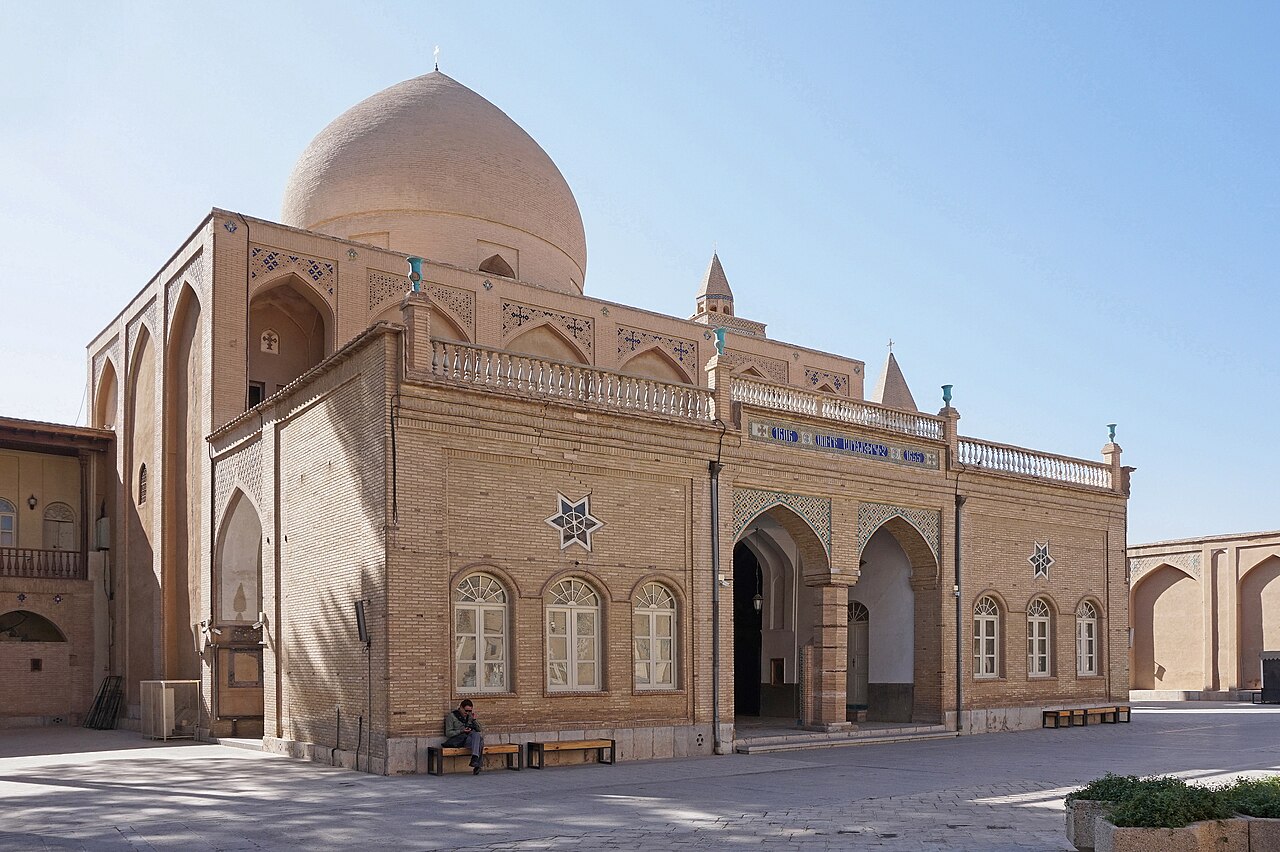
Wealth went into building. Julfa had more than twenty churches by the late seventeenth century, among them Bethlehem Church, paid for by a merchant, and the cathedral of the Holy Saviour, known as Vank (from the Armenian for monastery). A first church on the site dates from about 1606; the present building was raised in 1655–1664 under Archbishop David. Its walls combine Persian-style tile dados and gilded domes with large painted scenes from the Bible in a manner learned from European prints. The cathedral itself is described on the Vank Cathedral page.
In the 1630s a monk of the cathedral, Khachatur Kesaratsi, built a printing press with locally made type. In 1638 it produced a Psalter, the first book printed in Iran.
Pressure and decline
The quarter’s position depended on the goodwill of each shah. Abbas I’s successors gave up the royal silk monopoly, and the Julfans then traded on their own account. Under Abbas II, Armenians still living inside Isfahan were moved across the river to Julfa in the 1650s. In the reigns of Shah Suleiman and especially Shah Soltan Hoseyn, the influence of the clergy brought heavier taxes and restrictions on non-Muslims, described on the Shah Soltan Hoseyn page.
The real break came with the Afghan siege of Isfahan in 1722, when Julfa surrendered early to the besiegers and was made to pay huge sums, and with the heavy demands of Nader Shah in the 1730s and 1740s. Many merchant families moved to India, Russia or Europe. The Armenian community of Isfahan survived, and still keeps its churches, school and cathedral museum, but Julfa never again sat at the centre of a world trade network. Armenians as one of Iran’s peoples are covered in The people of Iran.
- 1604–1605 Deportation of the people of Old Julfa
- c. 1605 New Julfa founded across the Zayandeh Rud
- 1619 Julfans win the contract to export the shah’s silk
- 1638 First book printed in Iran, at Vank
- 1655–1664 Present Vank Cathedral built
- 1667 Trade agreement with Russia
- 1722 Afghan siege of Isfahan; Julfa pays heavy ransom
Persian words from this page
| جلفا | Jolfâ | Julfa |
| ارمنی | armani | Armenian |
| کلیسا | kelisâ | church |
| کلانتر | kalântar | mayor, head of a district |
| بازرگان | bâzargân | merchant |
| ابریشم | abrisham | silk |
| زایندهرود | Zâyande-rud | Zayandeh river |
Sources and further reading
- Arakel of Tabriz, Book of History (1669), translated by George Bournoutian, Mazda, 2010.
- Sebouh David Aslanian, From the Indian Ocean to the Mediterranean: The Global Trade Networks of Armenian Merchants from New Julfa, University of California Press, 2011.
- Ina Baghdiantz McCabe, The Shah’s Silk for Europe’s Silver: The Eurasian Trade of the Julfa Armenians in Safavid Iran and India (1530–1750), Scholars Press, 1999.
- Rudi Matthee, The Politics of Trade in Safavid Iran: Silk for Silver, 1600–1730, Cambridge University Press, 1999.
- John Carswell, New Julfa: The Armenian Churches and Other Buildings, Clarendon Press, 1968.
Want to learn Persian? Get the free Starter Pack
Get the 14-page printable Starter Pack (all 32 letters, a 7-day reading plan, 100 core words and 20 survival phrases) and a short 5-email course. Free.
More in The Safavid Empire (1501–1736)
- Shah Ismail I
- The Qizilbash
- Twelver Shi’ism Becomes Iran’s State Religion
- The Battle of Marv and the Uzbeks
- The Battle of Chaldiran (1514)
- Shah Tahmasp I
- The Ottoman–Safavid War and the Peace of Amasya
- Humayun’s Exile in Persia
- Qazvin: The Second Safavid Capital
- Ismail II and Mohammad Khodabanda
- Shah Abbas the Great
- Shah Abbas’s Military Reforms and the Ghulams
- The Sherley Brothers in Persia
- Isfahan: “Half the World”
- The Building of Naqsh-e Jahan Square
- Shah Abbas Retakes the West: The Ottoman Wars of 1603–1618
- The Capture of Hormuz from the Portuguese (1622)
- New Julfa and the Armenian Merchants
- The Safavid Silk Trade and Europe
- Sheikh Baha’i
- Reza Abbasi
- Shah Safi and the Treaty of Zuhab
- Shah Abbas II
- The Fight for Kandahar
- Chehel Sotoun Palace and Its War Paintings
- Shah Suleiman
- European Travellers in Safavid Persia
- Shah Soltan Hoseyn
- Safavid Art: Carpets, Miniatures and Tiles
- Mulla Sadra and the School of Isfahan
- The Afghan Revolt and the Battle of Gulnabad
- The Siege and Fall of Isfahan (1722)
- Peter the Great’s Persian Campaign (1722–1723)
- Tahmasp II and Hotaki Rule (1722–1732)
- Women of the Safavid Court
- The Safavid Legacy