Sheikh Baha’i (Baha al-Din Mohammad al-Ameli, 1547–1621) was the leading religious scholar of Shah Abbas I’s Isfahan, its shaykh al-islam, and a writer on law, mathematics, astronomy and mystical poetry. Iranians also remember him as an engineer and architect of almost magical skill, but most of those stories cannot be traced to sources from his lifetime.
| Full name | Baha al-Din Mohammad ibn Hoseyn al-Ameli |
|---|---|
| Born | 1547, near Baalbek (in today’s Lebanon); dates vary in the sources |
| Died | 1621, Isfahan; buried in Mashhad |
| Office | Shaykh al-islam of Isfahan under Abbas I |
| Main works | Jâme’-e Abbâsi, Kholâsat al-hesâb, Kashkul, the poems Nân o halvâ and Shir o shekar |
| Persian name | شیخ بهایی Sheykh Bahâ’i |
His pen name, Baha’i, comes from his title Baha al-Din, “splendour of the faith”. It has no connection with the Baha’i religion, which arose more than two centuries later.
From Jabal Amil to Qazvin
Sheikh Baha’i belonged to the Arab Shi’a scholarly families of Jabal Amil, in what is now southern Lebanon. After the Ottomans executed the prominent Shi’a jurist known as al-Shahid al-Thani, the “Second Martyr”, in 1558, Baha’i’s father, Hoseyn ibn Abd al-Samad, one of the martyr’s students, left Ottoman lands with his family for Safavid Iran. He served Shah Tahmasp I as shaykh al-islam in Qazvin and later in other cities. Scholars like him were invited to Iran to teach the new state religion, a story told in Twelver Shi’ism becomes Iran’s state religion.
The boy grew up in Qazvin, then the Safavid capital, and studied religious sciences, mathematics and medicine. As a young man he travelled widely, including a pilgrimage to Mecca and journeys through Iraq, Syria and Egypt, where he met Sunni as well as Shi’a scholars.
Shaykh al-islam of Isfahan
Under Shah Abbas I he became shaykh al-islam of Isfahan, the senior religious judge of the new capital, after the death of the previous holder. He was close to the shah, accompanied him on journeys and taught a generation of scholars. His students included Mulla Sadra, the philosopher, and Mohammad Taqi Majlesi, father of the influential later cleric Mohammad Baqer Majlesi. With his friend Mir Damad he stands at the start of the intellectual world described in Mulla Sadra and the School of Isfahan.
A scholar who wrote for everyone
Sheikh Baha’i wrote more than a hundred works, in Arabic and Persian. Several were meant for a wide audience.
- Jâme’-e Abbâsi, written in Persian at the shah’s request, explained Shi’a religious law for ordinary believers who did not read Arabic. It was unfinished at his death and completed by a student, and it was used for centuries.
- Kholâsat al-hesâb, “the essence of arithmetic”, a short Arabic textbook on arithmetic, measurement and algebra, was taught in schools across the Muslim world and was translated into German in 1843 and French in 1854.
- Works on astronomy, including the Tashrih al-aflâk, and on instruments such as the astrolabe.
- Kashkul, named after the begging bowl of a dervish, a large miscellany of stories, verses, anecdotes and sayings in Arabic and Persian.

The poet
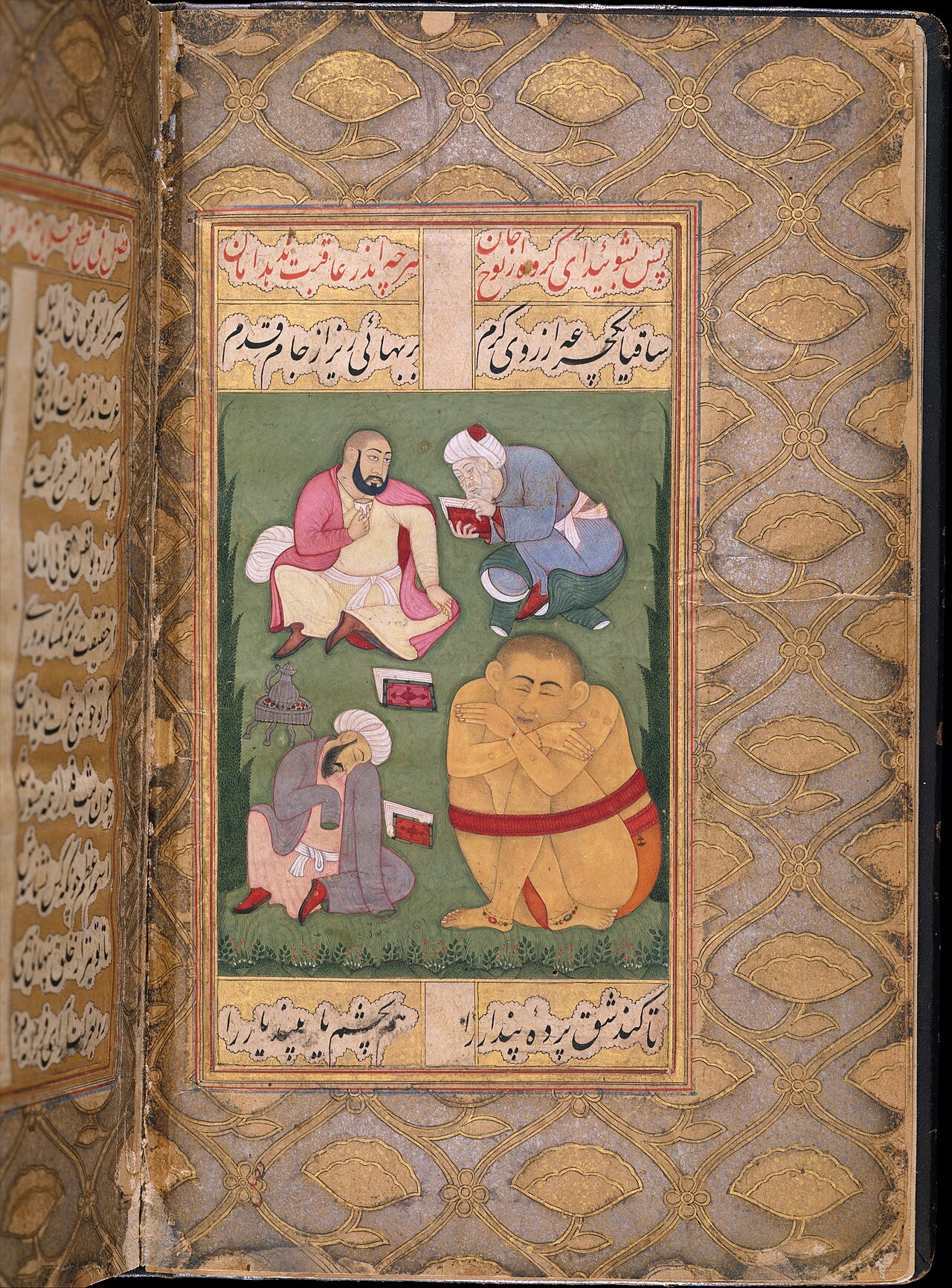
In Persian verse he wrote mystical masnavis, the best known being Nân o halvâ (Bread and Sweets) and Shir o shekar (Milk and Sugar). They use homely images to criticise scholars who learn texts by heart without inner understanding. That a senior jurist wrote Sufi-flavoured poetry shows how open the intellectual life of Abbas I’s court still was, before later clerics turned against Sufism.
The legends
Popular memory has made Sheikh Baha’i into a kind of Persian Leonardo. He is credited with:
- A public bath in Isfahan, the Hammam-e Sheikh Baha’i, whose water was said to be heated for years by a single candle.
- The tumâr, the scroll that divides the water of the Zayandeh Rud among the villages and districts of the Isfahan region.
- The layout of canals and parts of the plan of Isfahan, including works around Naqsh-e Jahan Square.
None of these attributions can be confirmed from sources of his own time. The candle bath is a legend. The water-sharing scroll in its surviving form is later, and historians doubt that he wrote it, though he may have been consulted on water questions. Some of his writings on mathematics and measurement show that practical problems interested him, and that is probably the root of the legends. They tell us more about how Iranians came to see him, as the ideal scholar of a golden age, than about what he built.
Death and tomb
Sheikh Baha’i died in Isfahan in 1621; the dates on his tomb and in the chronicles differ by a year or so. As he had asked, his body was carried to Mashhad and buried near the shrine of Imam Reza, in the house where he had taught. The site is now part of the shrine complex as the Sheikh Baha’i portico, described in our guide to the Imam Reza Shrine. Today streets, schools and a science park in Isfahan carry his name.
Persian words from this page
| شیخ بهایی | Sheykh Bahâ’i | Sheikh Baha’i |
| شیخالاسلام | sheykh-ol-eslâm | chief religious judge |
| جامع عباسی | Jâme’-e Abbâsi | his law manual |
| نان و حلوا | nân o halvâ | bread and sweets |
| کشکول | kashkul | dervish’s bowl; miscellany |
| حمام | hammâm | bath house |
Sources and further reading
- Encyclopaedia Iranica, “Bahāʾ-al-Dīn ʿĀmelī” (Etan Kohlberg).
- Eskandar Beg Monshi, History of Shah Abbas the Great, trans. Roger Savory (Boulder, 1978).
- Devin J. Stewart, “Taqiyyah as Performance: The Travels of Bahāʾ al-Dīn al-ʿĀmilī in the Ottoman Empire”, Princeton Papers in Near Eastern Studies 4 (1996).
- Rula Jurdi Abisaab, Converting Persia: Religion and Power in the Safavid Empire (London, 2004).
- Biographical Encyclopedia of Astronomers, “ʿĀmilī: Bahāʾ al-Dīn al-ʿĀmilī”.
Want to learn Persian? Get the free Starter Pack
Get the 14-page printable Starter Pack (all 32 letters, a 7-day reading plan, 100 core words and 20 survival phrases) and a short 5-email course. Free.
More in The Safavid Empire (1501–1736)
- Shah Ismail I
- The Qizilbash
- Twelver Shi’ism Becomes Iran’s State Religion
- The Battle of Marv and the Uzbeks
- The Battle of Chaldiran (1514)
- Shah Tahmasp I
- The Ottoman–Safavid War and the Peace of Amasya
- Humayun’s Exile in Persia
- Qazvin: The Second Safavid Capital
- Ismail II and Mohammad Khodabanda
- Shah Abbas the Great
- Shah Abbas’s Military Reforms and the Ghulams
- The Sherley Brothers in Persia
- Isfahan: “Half the World”
- The Building of Naqsh-e Jahan Square
- Shah Abbas Retakes the West: The Ottoman Wars of 1603–1618
- The Capture of Hormuz from the Portuguese (1622)
- New Julfa and the Armenian Merchants
- The Safavid Silk Trade and Europe
- Sheikh Baha’i
- Reza Abbasi
- Shah Safi and the Treaty of Zuhab
- Shah Abbas II
- The Fight for Kandahar
- Chehel Sotoun Palace and Its War Paintings
- Shah Suleiman
- European Travellers in Safavid Persia
- Shah Soltan Hoseyn
- Safavid Art: Carpets, Miniatures and Tiles
- Mulla Sadra and the School of Isfahan
- The Afghan Revolt and the Battle of Gulnabad
- The Siege and Fall of Isfahan (1722)
- Peter the Great’s Persian Campaign (1722–1723)
- Tahmasp II and Hotaki Rule (1722–1732)
- Women of the Safavid Court
- The Safavid Legacy