Shah Soltan Hoseyn (1668–1727) was the last Safavid shah to rule from Isfahan with real authority, from 1694 until he surrendered his capital and his crown to the Afghan leader Mahmud Hotak in October 1722. A pious, gentle and indecisive man, he let leading clerics and court factions shape policy, and his reign ended in the collapse of the Safavid state.
| Born | 1668, in the royal harem, Isfahan |
|---|---|
| Reign | 7 August 1694 to 23 October 1722 |
| Father | Shah Suleiman |
| Religious leaders | Mohammad Baqer Majlesi (d. 1699); later the mollabashi of the Khatunabadi family |
| Buildings | Chahar Bagh madrasa (Madrese-ye Mâdar-e Shâh), Farahabad palace |
| End of reign | Abdicated to Mahmud Hotak after the siege of Isfahan, 1722 |
| Died | Killed on Ashraf Hotak’s orders, 1727 |
A coronation and a decree
When Suleiman died in July 1694, the court officials and eunuchs chose his son Hoseyn, a quiet, devout young man brought up in the harem. At the coronation the girding of the new shah with his sword was carried out not by a Sufi master, as Safavid custom had been, but by Mohammad Baqer Majlesi, the most powerful cleric in Isfahan. In return Majlesi asked the shah to rule by the sacred law.
Within days a decree was issued against what it called unislamic conduct: drinking, gambling, music in public, and the mixing of men and women at festivals. According to European witnesses, thousands of bottles from the royal cellars were broken in the great square. The ban did not last. Within a few years, according to the same witnesses, the shah himself had begun drinking again, persuaded by his great-aunt, Maryam Begum.

Clerics at court
Majlesi, author of the vast hadith collection Bihar al-Anwar, was hostile to Sufism, to philosophy of the kind taught by Mulla Sadra, and to Sunni Islam. Under his influence the Sufi lodges of Isfahan were closed. Pressure on non-Muslims grew. Zoroastrians were pressed to convert and their temple in Isfahan was made into a mosque; Jews and Christians were made to pay the poll tax, the jezye, more strictly. Sunnis, who were a majority in many frontier regions, from Kurdistan and Dagestan to Baluchistan and the Afghan lands around Kandahar, felt increasingly alienated.
Majlesi died in 1699, but clerical influence did not end with him. Around 1712 Soltan Hoseyn created a new office, mollâbâshi, “chief mullah”, for a member of the Khatunabadi family, which made a cleric one of the shah’s closest advisers. Contemporaries mocked the shah as “Molla Hoseyn”. A later story, often repeated, has him answering every proposal put to him with the Turkish words yakhshi dir, “it is good”.
Building and court life
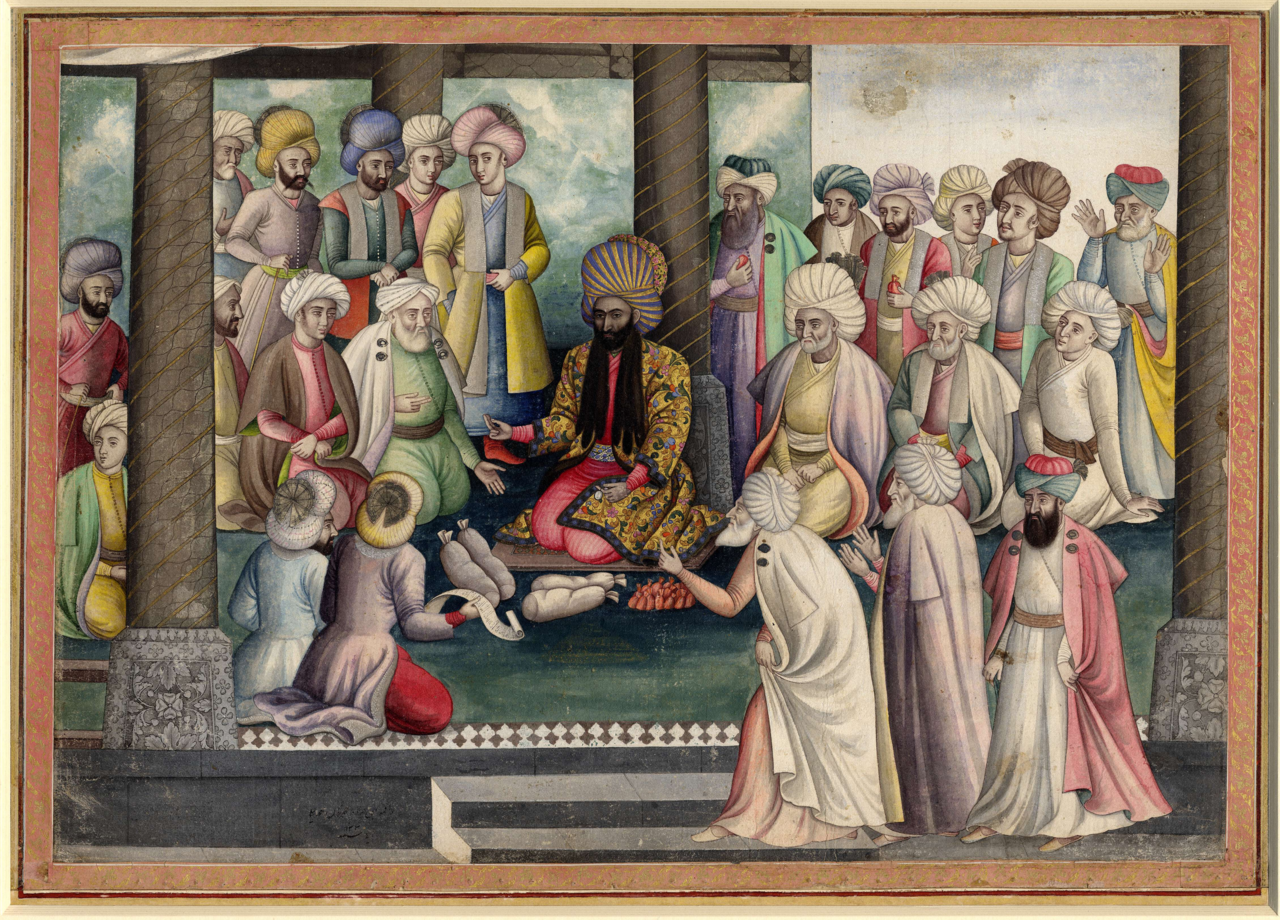
The reign was not barren. Soltan Hoseyn’s largest project, the madrasa on the Chahar Bagh avenue of Isfahan, built in about 1704–1714 and named after the shah’s mother, is one of the last great Safavid buildings, with a tiled dome and a garden courtyard lined with students’ rooms. South of the city he laid out the Farahabad palace and gardens, where he spent much of his time. Court painting continued too: the work of Mohammad Ali, son of the painter Mohammad Zaman, shows the shah at ceremonies such as the giving of presents at Nowruz.
Europeans still came. The Dutch artist Cornelis de Bruijn, who was in Isfahan in 1703–1704, drew the shah. In 1715 the Persian envoy Mohammad Reza Beg reached Paris and was received by Louis XIV. In 1717 Peter the Great’s envoy Artemy Volynsky came to Isfahan, and his reports to the tsar described a weak court and an army that could be defeated.
The provinces slip away
The crisis came from the edges of the empire. In the south-east, Baluch tribes raided Kerman. Arabs from Oman attacked the Persian Gulf coast and in 1717 took Bahrain. In the north, Lezgi tribesmen from Dagestan raided Shirvan and in 1721 sacked its capital, Shamakhi. In the east, the Ghilzai Afghans of Kandahar, led by Mir Ways Hotak, rose in 1709 and killed the Safavid governor, the Georgian prince Gurgin Khan; Safavid attempts to recover the city failed. The Abdali Afghans of Herat followed in 1716–1717.
At court, rival factions blocked action. In 1720 the grand vizier Fath Ali Khan Daghestani was accused of plotting, blinded and dismissed, and his relative Lotf Ali Khan, who commanded the troops in the south, was recalled. When Mir Ways’s son Mahmud marched on Isfahan in 1722, the Safavid army that met him was divided and badly led. The battle and its aftermath are told in the Afghan revolt and the Battle of Gulnabad.
- 1694 Soltan Hoseyn crowned; decree against wine
- 1699 Death of Mohammad Baqer Majlesi
- 1709 Mir Ways Hotak takes Kandahar
- c. 1712 Office of mollabashi created
- 1715 Persian embassy received by Louis XIV
- 1717 Volynsky’s embassy; Bahrain lost to Oman
- 1720 Grand vizier Fath Ali Khan Daghestani blinded
- 1721 Lezgis sack Shamakhi
- 8 March 1722 Safavid defeat at Gulnabad
- 23 Oct 1722 Soltan Hoseyn abdicates to Mahmud Hotak
- 1727 Killed on Ashraf Hotak’s orders
Abdication and death
After a siege of seven months, told in the siege and fall of Isfahan, Soltan Hoseyn rode out to the Afghan camp at Farahabad in October 1722 and placed the royal plume on Mahmud’s turban. He lived on as a prisoner in Isfahan. In 1727 Mahmud’s successor, Ashraf Hotak, had him beheaded, in reply to an Ottoman commander’s letter that threatened to restore him. His son Tahmasp, who had escaped the siege, carried on the claim of the dynasty, as told in Tahmasp II and Hotaki rule.
A weak shah or a deeper crisis
Older histories, drawing on the Polish Jesuit Tadeusz Krusinski, who lived in Isfahan through the siege, blamed the fall on the shah’s weakness and the influence of clerics and eunuchs. Modern historians give a wider explanation. Rudi Matthee points to a long fiscal crisis, the shortage of silver, an army neglected for decades, and the alienation of Sunni frontier peoples. Others note that the Afghan revolt began as a local revolt against a harsh governor and only became a threat to the capital because the court failed to respond. Most agree that the shah’s indecision turned a provincial crisis into a dynastic catastrophe.
Persian words from this page
| سلطان حسین | Soltân Hoseyn | Soltan Hoseyn |
| ملاباشی | mollâbâshi | chief mullah |
| شیخالاسلام | sheykh-ol-eslâm | chief cleric of a city |
| مدرسه | madrese | religious college, school |
| صوفی | sufi | Sufi, mystic |
| شراب | sharâb | wine |
| نوروز | Nowruz | Persian New Year |
Sources and further reading
- Rudi Matthee, Persia in Crisis: Safavid Decline and the Fall of Isfahan, I.B. Tauris, 2012.
- Laurence Lockhart, The Fall of the Safavi Dynasty and the Afghan Occupation of Persia, Cambridge University Press, 1958.
- Tadeusz Krusinski, The History of the Late Revolutions of Persia, English edition 1728.
- Cornelis de Bruijn, Travels into Muscovy, Persia, and Part of the East Indies, English edition 1737.
- Andrew J. Newman, Safavid Iran: Rebirth of a Persian Empire, I.B. Tauris, 2006.
Want to learn Persian? Get the free Starter Pack
Get the 14-page printable Starter Pack (all 32 letters, a 7-day reading plan, 100 core words and 20 survival phrases) and a short 5-email course. Free.
More in The Safavid Empire (1501–1736)
- Shah Ismail I
- The Qizilbash
- Twelver Shi’ism Becomes Iran’s State Religion
- The Battle of Marv and the Uzbeks
- The Battle of Chaldiran (1514)
- Shah Tahmasp I
- The Ottoman–Safavid War and the Peace of Amasya
- Humayun’s Exile in Persia
- Qazvin: The Second Safavid Capital
- Ismail II and Mohammad Khodabanda
- Shah Abbas the Great
- Shah Abbas’s Military Reforms and the Ghulams
- The Sherley Brothers in Persia
- Isfahan: “Half the World”
- The Building of Naqsh-e Jahan Square
- Shah Abbas Retakes the West: The Ottoman Wars of 1603–1618
- The Capture of Hormuz from the Portuguese (1622)
- New Julfa and the Armenian Merchants
- The Safavid Silk Trade and Europe
- Sheikh Baha’i
- Reza Abbasi
- Shah Safi and the Treaty of Zuhab
- Shah Abbas II
- The Fight for Kandahar
- Chehel Sotoun Palace and Its War Paintings
- Shah Suleiman
- European Travellers in Safavid Persia
- Shah Soltan Hoseyn
- Safavid Art: Carpets, Miniatures and Tiles
- Mulla Sadra and the School of Isfahan
- The Afghan Revolt and the Battle of Gulnabad
- The Siege and Fall of Isfahan (1722)
- Peter the Great’s Persian Campaign (1722–1723)
- Tahmasp II and Hotaki Rule (1722–1732)
- Women of the Safavid Court
- The Safavid Legacy