In the spring of 1622 a Safavid army under Imam Qoli Khan, governor of Fars, with the help of ships of the English East India Company, took the island of Hormuz from the Portuguese, who had controlled it for more than a century. The fortress surrendered on 23 April 1622. The victory ended Portuguese power at the mouth of the Persian Gulf and moved the region’s trade to the mainland port that Shah Abbas renamed Bandar Abbas.
| Date | February to April 1622 (Qeshm taken in February; Hormuz fortress surrendered 23 April) |
|---|---|
| Place | Islands of Qeshm and Hormuz, Strait of Hormuz |
| Iranian commander | Imam Qoli Khan, beglerbeg of Fars |
| Allies | English East India Company fleet: five warships and four smaller pinnaces |
| Opponent | Portuguese Estado da India, with the vassal king of Hormuz |
| Result | Portuguese withdraw to Muscat; trade moves to Bandar Abbas |
Portuguese Hormuz
Hormuz is a small, dry island of red and ochre rock with almost no fresh water. Its value lay entirely in its position. Every ship entering or leaving the Persian Gulf passed within sight of it, and since the fourteenth century the kings of Hormuz had grown rich on the trade in horses, pearls, spices, cloth and silk that passed between India, Iran and Arabia.
The Portuguese commander Afonso de Albuquerque attacked the island in 1507 and returned in 1515 to take it for good. He built a fortress, later called the fort of Our Lady of the Conception, and left the local king on his throne as a vassal who paid tribute and shared the customs. For a century Hormuz was one of the three pillars of Portugal’s Asian empire, with Goa and Malacca. Iranian merchants used it, but the Safavid shahs had no say in what happened there, and the Portuguese also held Bahrain and points on the Iranian coast.

Abbas moves south
Shah Abbas I had both political and commercial reasons to act. The Portuguese were allies of his Habsburg contacts in Europe, but they also blocked his ambition to sell Iranian silk by sea rather than through the Ottoman lands, as described in the Safavid silk trade and Europe. Step by step, his governors in Fars cut away the Portuguese position. Bahrain was taken in 1602. In 1614–1615 Safavid forces seized the mainland harbour of Gamrun (Gombroon), opposite Hormuz, which Abbas renamed Bandar Abbas, “the port of Abbas”. The key figure was Imam Qoli Khan, son of Abbas’s great general Allahverdi Khan, who had succeeded his father as governor of Fars.
The English East India Company provided the missing piece: ships. Its first vessels had reached the small port of Jask in 1616, and it wanted access to Iranian silk. The Portuguese tried to drive it out, and in December 1620 an English squadron beat a Portuguese fleet under Ruy Freire de Andrade off Jask. When Ruy Freire then began building a fort on Qeshm to secure fresh water for Hormuz, Imam Qoli Khan’s troops besieged it.
The Anglo-Persian agreement
At the end of 1621, an English fleet arrived at Jask expecting to load silk. Imam Qoli Khan’s officials made it clear that cooperation against the Portuguese was the price of future trade. After some argument among the Company’s captains, who feared the legal consequences of attacking the subjects of a Christian king at peace with England, a written agreement was concluded in January 1622. Its main terms, as reported in the Company’s records, were:
- the spoils of Hormuz and its future customs revenue would be shared between the two sides;
- prisoners would be handed over according to their religion, Christians to the English and Muslims to the Persians;
- Persia would pay half the cost of the fleet’s supplies;
- the English would gain access to the silk trade.
Qeshm and the siege of Hormuz
The English fleet first bombarded the Portuguese fort on Qeshm, which surrendered within days in February 1622. Among the English dead was William Baffin, the navigator who had explored the Arctic waters that still carry his name. Ruy Freire was taken prisoner.
The allies then crossed to Hormuz. English boats ferried Persian soldiers to the island, which they occupied quickly while the Portuguese and the king of Hormuz withdrew into the fortress. For about two months the English ships blockaded and bombarded it, while Persian troops pressed the siege on land. Disease and hunger spread inside. On 22 April the garrison mutinied, and on 23 April 1622 the fortress surrendered. The Portuguese and their dependants were shipped off to Muscat, then still in Portuguese hands.
- 1507, 1515 Albuquerque attacks and then takes Hormuz
- 1602 Safavid forces take Bahrain
- 1614–1615 Gamrun taken and renamed Bandar Abbas
- 1616 First English East India Company ships reach Jask
- Dec 1620 English defeat a Portuguese squadron off Jask
- Feb 1622 Qeshm fort surrenders; William Baffin killed
- 23 Apr 1622 Hormuz fortress surrenders
- 1623–1627 Portuguese attempts to retake Hormuz fail
What changed after 1622
Bandar Abbas rises, Hormuz declines
The Persians had no interest in keeping a foreign-built island city alive. Hormuz town was stripped and largely abandoned, and its trade moved to Bandar Abbas on the mainland, which became Safavid Iran’s main sea port for the next century. The Portuguese tried several times between 1623 and 1627 to retake the island and failed; they kept a smaller trading presence elsewhere in the Gulf, and peace was made in 1635.
The English and the Dutch
For the English the result was mixed. The Company had been promised half the customs of Bandar Abbas, but what it actually received was small: according to J. G. Lorimer’s summary of the records, about 225 tumans in 1624 and 300 in 1625, a long-running grievance in the Company’s letters. At home, King James I and the Lord Admiral, the Duke of Buckingham, demanded a share of the prize money. And the main winner in trade turned out to be the Dutch East India Company, which arrived in 1623 and soon handled more of Iran’s sea trade than the English.
How the event is remembered
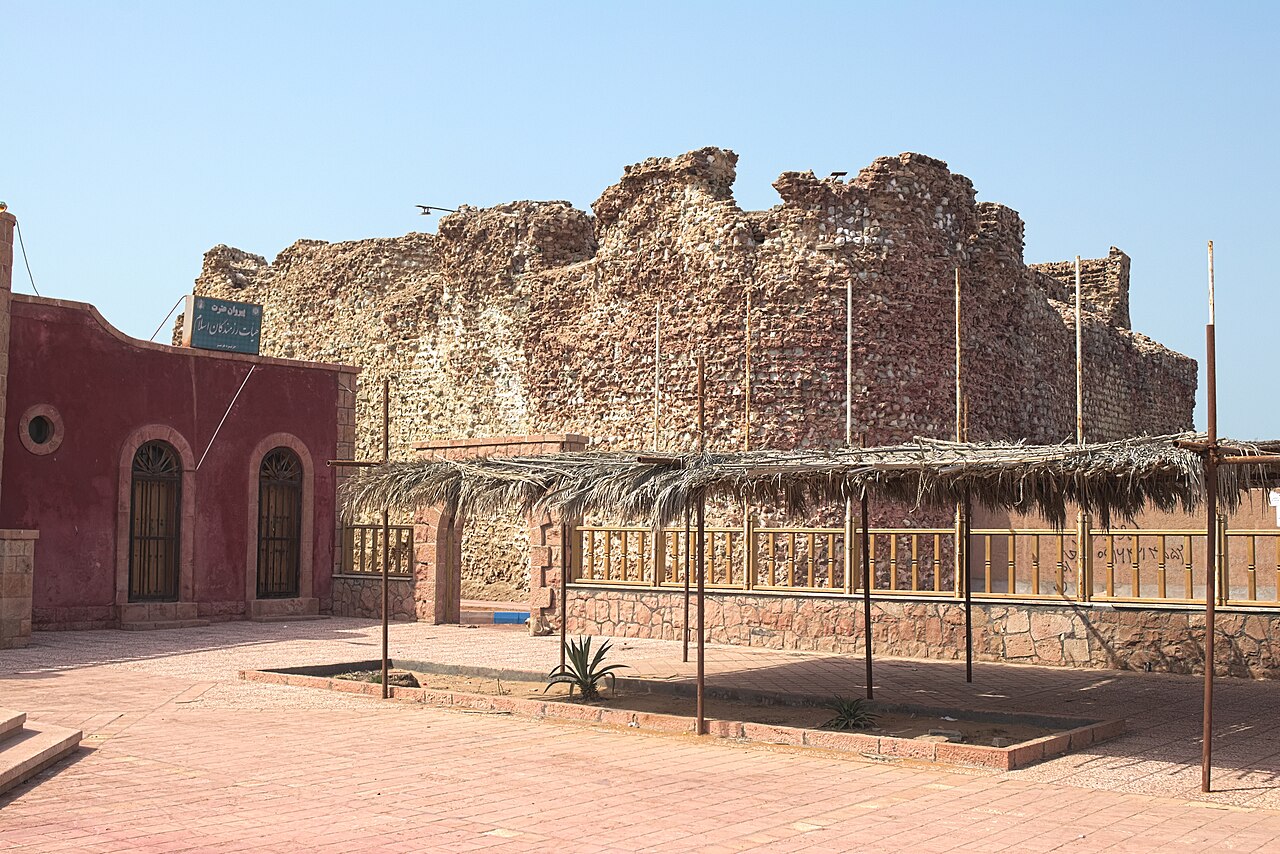
In Iran the capture of Hormuz is often presented as the liberation of an Iranian island from European rule, and the Portuguese fort is a reminder of that period on the island today. Portuguese historians see it as the start of the decline of their Asian empire. Historians of the East India Company, such as Rudi Matthee and earlier Niels Steensgaard, stress that Abbas used the English as a tool: without their ships he could not have reduced the fortress, but the terms that followed favoured the shah. The event belongs to the same years as Abbas’s wars in the west, told in Shah Abbas retakes the west, and to his wider strategy, described in Shah Abbas the Great.
For the island and the port today, see Hormuz Island, Qeshm Island and Bandar Abbas.
Persian words from this page
| هرمز | Hormoz | Hormuz |
| قشم | Qeshm | Qeshm |
| بندر عباس | Bandar Abbâs | port of Abbas |
| بندر | bandar | port |
| خلیج فارس | Khalij-e Fârs | Persian Gulf |
| قلعه | qal’e | fort, castle |
| کشتی | keshti | ship |
Sources and further reading
- Eskandar Beg Monshi, History of Shah ‘Abbas the Great, translated by Roger Savory, 1978.
- Niels Steensgaard, The Asian Trade Revolution of the Seventeenth Century, University of Chicago Press, 1974.
- Rudi Matthee, The Politics of Trade in Safavid Iran: Silk for Silver, 1600–1730, Cambridge University Press, 1999.
- J. G. Lorimer, Gazetteer of the Persian Gulf, Oman and Central Arabia, vol. I, Historical, 1915.
- Roger Savory, Iran under the Safavids, Cambridge University Press, 1980.
Want to learn Persian? Get the free Starter Pack
Get the 14-page printable Starter Pack (all 32 letters, a 7-day reading plan, 100 core words and 20 survival phrases) and a short 5-email course. Free.
More in The Safavid Empire (1501–1736)
- Shah Ismail I
- The Qizilbash
- Twelver Shi’ism Becomes Iran’s State Religion
- The Battle of Marv and the Uzbeks
- The Battle of Chaldiran (1514)
- Shah Tahmasp I
- The Ottoman–Safavid War and the Peace of Amasya
- Humayun’s Exile in Persia
- Qazvin: The Second Safavid Capital
- Ismail II and Mohammad Khodabanda
- Shah Abbas the Great
- Shah Abbas’s Military Reforms and the Ghulams
- The Sherley Brothers in Persia
- Isfahan: “Half the World”
- The Building of Naqsh-e Jahan Square
- Shah Abbas Retakes the West: The Ottoman Wars of 1603–1618
- The Capture of Hormuz from the Portuguese (1622)
- New Julfa and the Armenian Merchants
- The Safavid Silk Trade and Europe
- Sheikh Baha’i
- Reza Abbasi
- Shah Safi and the Treaty of Zuhab
- Shah Abbas II
- The Fight for Kandahar
- Chehel Sotoun Palace and Its War Paintings
- Shah Suleiman
- European Travellers in Safavid Persia
- Shah Soltan Hoseyn
- Safavid Art: Carpets, Miniatures and Tiles
- Mulla Sadra and the School of Isfahan
- The Afghan Revolt and the Battle of Gulnabad
- The Siege and Fall of Isfahan (1722)
- Peter the Great’s Persian Campaign (1722–1723)
- Tahmasp II and Hotaki Rule (1722–1732)
- Women of the Safavid Court
- The Safavid Legacy