Kandahar, the fortress city on the road between the Iranian plateau and India, changed hands between the Safavids and the Mughal emperors at least five times between 1545 and 1653. It was the one place where the two great Persianate empires came to blows, and three failed Mughal sieges in 1649–1653 left it in Safavid hands until the Afghan revolt of 1709.
| Place | Kandahar (Qandahar), southern Afghanistan |
|---|---|
| Contest | Safavid Iran against Mughal India |
| Main dates | 1558 Safavid; 1595 Mughal; 1622 Safavid; 1638 Mughal; 1649 Safavid |
| Shahs | Tahmasp I, Abbas I, Safi, Abbas II |
| Emperors | Humayun, Akbar, Jahangir, Shah Jahan |
| Outcome | Safavid until 1709, when the Ghilzai Afghans rebelled |
Why Kandahar mattered
Old Kandahar stood on a rocky ridge above the plain of the Arghandab river, with a citadel that was hard to storm. It controlled the southern route from Herat and Iran to the Indus valley, by way of the Bolan pass to Multan and Sind. Caravans carrying Indian textiles and indigo west, and horses and silver east, passed through it. Whoever held it held a gateway, and for both empires it was also a matter of prestige.
The rivalry was unusual because the two dynasties were close in culture. The Mughal court spoke and wrote Persian, Iranian poets and administrators found careers in India, and Mughal emperors and Safavid shahs addressed each other in elaborate letters as brothers. On Kandahar, though, neither would give way.
From Humayun to Akbar
The story begins with a debt. When the Mughal emperor Humayun fled to Iran in 1544, Shah Tahmasp I gave him troops, and in 1545 Humayun used them to take Kandahar from his own brother. He handed the city to Tahmasp’s infant son Murad, as promised, but when the prince died soon after, Humayun kept it. The episode is told in Humayun’s exile in Persia. After Humayun’s death, Tahmasp sent an army and took Kandahar in 1558.
It stayed Safavid for nearly forty years. In 1595, during the chaos of the Uzbek wars and with the Safavid state weak, its governor, the Safavid prince Mozaffar Hoseyn Mirza, surrendered the city to Akbar and entered Mughal service.
Abbas I takes it back (1622)
Shah Abbas I and Akbar’s son Jahangir kept up a show of friendship for years, exchanging embassies and gifts. Jahangir’s painters even produced an allegorical picture of the emperor embracing the shah. But Abbas had not forgotten Kandahar. In 1622, when Jahangir’s son Khurram, the future Shah Jahan, was refusing orders and the Mughal court was divided, Abbas marched east and took the city after a siege of about forty-five days. Jahangir protested, but he was in no position to respond.
Betrayal and recovery: 1638 and 1649
The next loss came from within. Ali Mardan Khan, the Safavid governor of Kandahar, feared that Shah Safi, who had purged many of his father’s grandees (see Shah Safi and the Treaty of Zuhab), would have him killed. In 1638 he handed the city to Shah Jahan and went to India, where he became one of the empire’s great nobles and builders, remembered for the canal that carried water to Lahore and Delhi.
The young Shah Abbas II set out to recover it. He left Isfahan in 1648, took the outlying fort of Bost on the way, and began the siege of Kandahar in late December 1648. The Mughal garrison surrendered on 22 February 1649. The campaign is also covered on the page on Shah Abbas II.
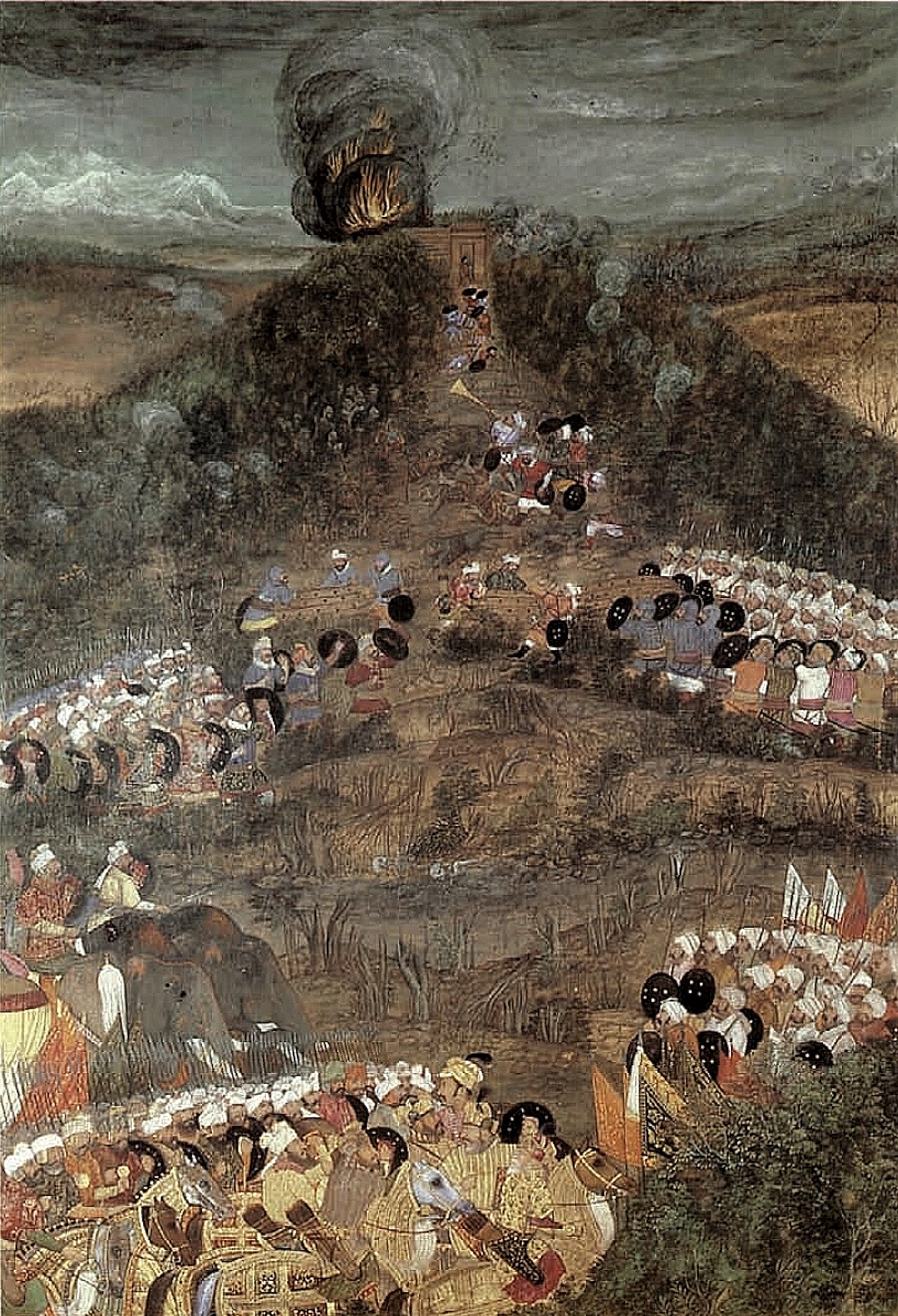

Three Mughal sieges (1649–1653)
Shah Jahan answered with the largest efforts the Mughals ever made west of the Indus. His son Aurangzeb besieged Kandahar in 1649 and again in 1652. The Mughal guns could not breach the walls, the Safavid garrison held, and the besiegers’ supply lines stretched back hundreds of kilometres over mountains. Each time the army withdrew before winter. In 1653 Shah Jahan’s eldest son Dara Shikoh tried again with heavier artillery and a large force; after a siege of about five months he too gave up, in September 1653.
These campaigns cost the Mughal treasury enormous sums and gained nothing. Historians of Mughal India often treat them as a turning point: the empire’s attention moved back to the Deccan, and Kandahar was never retaken. For the Safavids, the victory was the last great military success of the dynasty.
After the Safavids
Kandahar’s later history is closely tied to Iran. In 1709 the Ghilzai chief Mir Ways Hotak killed the Safavid governor and seized the city, the first step towards the fall of Isfahan (see the Afghan revolt and the battle of Gulnabad). Nader Shah took it back after a long siege in 1738 and destroyed the old city. After Nader’s death, Ahmad Shah Durrani built a new Kandahar nearby and made it the first capital of the Afghan kingdom, as told in Ahmad Shah Durrani and the birth of Afghanistan.
- 1545 Humayun takes Kandahar with Persian help
- 1558 Tahmasp I takes it for the Safavids
- 1595 Safavid governor surrenders it to Akbar
- 1622 Abbas I retakes it
- 1638 Ali Mardan Khan hands it to Shah Jahan
- Feb 1649 Abbas II retakes it
- 1649, 1652 Sieges by Aurangzeb fail
- 1653 Siege by Dara Shikoh fails
- 1709 Mir Ways Hotak seizes the city
Persian words from this page
| قندهار | Qandahâr | Kandahar |
| گورکانیان هند | Gurkâniyân-e Hend | the Mughals of India |
| قلعه | ghal’eh | fortress |
| توپ | tup | cannon |
| هرات | Herât | Herat |
The wider relationship between the two cultures is the subject of Iran and India through history.
Sources and further reading
- Eskandar Beg Monshi, History of Shah Abbas the Great (Tarikh-e Alamara-ye Abbasi), trans. Roger Savory (Boulder, 1978).
- Abd al-Hamid Lahori, Padshahnama, the official history of Shah Jahan’s reign.
- Riazul Islam, Indo-Persian Relations: A Study of the Political and Diplomatic Relations between the Mughul Empire and Iran (Tehran, 1970).
- Rudi Matthee, Persia in Crisis: Safavid Decline and the Fall of Isfahan (London, 2012).
- John F. Richards, The Mughal Empire (Cambridge, 1993).
Want to learn Persian? Get the free Starter Pack
Get the 14-page printable Starter Pack (all 32 letters, a 7-day reading plan, 100 core words and 20 survival phrases) and a short 5-email course. Free.
More in The Safavid Empire (1501–1736)
- Shah Ismail I
- The Qizilbash
- Twelver Shi’ism Becomes Iran’s State Religion
- The Battle of Marv and the Uzbeks
- The Battle of Chaldiran (1514)
- Shah Tahmasp I
- The Ottoman–Safavid War and the Peace of Amasya
- Humayun’s Exile in Persia
- Qazvin: The Second Safavid Capital
- Ismail II and Mohammad Khodabanda
- Shah Abbas the Great
- Shah Abbas’s Military Reforms and the Ghulams
- The Sherley Brothers in Persia
- Isfahan: “Half the World”
- The Building of Naqsh-e Jahan Square
- Shah Abbas Retakes the West: The Ottoman Wars of 1603–1618
- The Capture of Hormuz from the Portuguese (1622)
- New Julfa and the Armenian Merchants
- The Safavid Silk Trade and Europe
- Sheikh Baha’i
- Reza Abbasi
- Shah Safi and the Treaty of Zuhab
- Shah Abbas II
- The Fight for Kandahar
- Chehel Sotoun Palace and Its War Paintings
- Shah Suleiman
- European Travellers in Safavid Persia
- Shah Soltan Hoseyn
- Safavid Art: Carpets, Miniatures and Tiles
- Mulla Sadra and the School of Isfahan
- The Afghan Revolt and the Battle of Gulnabad
- The Siege and Fall of Isfahan (1722)
- Peter the Great’s Persian Campaign (1722–1723)
- Tahmasp II and Hotaki Rule (1722–1732)
- Women of the Safavid Court
- The Safavid Legacy