European travellers such as Pietro della Valle, Jean-Baptiste Tavernier and Jean Chardin visited Safavid Persia in the seventeenth century and wrote detailed accounts of its court, cities and daily life. Their books shaped how Europe imagined Iran for two centuries, and they remain essential, if one-sided, sources for historians of Safavid Isfahan.
| Period | c. 1600–1720, most of all 1617–1685 |
|---|---|
| Main writers | Pietro della Valle, Thomas Herbert, Adam Olearius, Jean-Baptiste Tavernier, Raphaël du Mans, Jean Chardin, Engelbert Kaempfer |
| Who they were | Diplomats, merchants, jewellers, missionaries, scientists |
| Best known work | Chardin, Voyages en Perse (1686; complete edition 1711) |
| Persian term | سفرنامه safarnâmeh, travel account |
Why Europeans came
Shah Abbas I opened Iran to Europeans more widely than any ruler before him. He wanted allies against the Ottomans and buyers for Iranian silk, and he welcomed envoys, merchants and Catholic missionaries to his new capital. The English and Dutch East India Companies set up offices after 1617, Carmelites, Augustinians and Capuchins built houses in Isfahan, and a stream of visitors followed. The commercial side of this story is told in the Safavid silk trade and Europe, and the first English adventurers in the Sherley brothers in Persia.
Pietro della Valle: the shah’s companion
The Roman nobleman Pietro della Valle (1586–1652) reached Iran in 1617 and stayed until 1623. He followed Abbas I on campaign, talked with him at length and wrote long letters home describing the shah’s informal manner, his court and his wars. Della Valle travelled with his wife, Sitti Maani, a Christian from Baghdad whom he had married there. When she died in southern Iran in 1621, he had her body embalmed and carried it with him for years until he could bury her in Rome. His letters, published in the 1650s as Viaggi, are vivid and personal.
Envoys and scholars
Thomas Herbert came with the English embassy of Sir Dodmore Cotton in 1627–1629 and saw the last days of Abbas I. Adam Olearius was secretary to an embassy from the Duke of Holstein in 1637, and his description of the journey through Russia and Iran became a standard German book. Olearius also learned Persian and translated Saadi’s Golestân into German in 1654, one of the first European translations of a classic of Persian literature.
Some of the best informed Europeans lived in Isfahan for decades. The French Capuchin Raphaël du Mans arrived in 1647 and stayed until his death in 1696. His État de la Perse, written in 1660, was a practical report on the government, and he helped later visitors with information and introductions.
Tavernier: the jeweller
Jean-Baptiste Tavernier (1605–1689) was a French gem merchant who made six journeys to the East between the 1630s and 1668. He bought diamonds in India and sold jewels to the Safavid and Mughal courts. His Six Voyages (1676) are a merchant’s book: routes, caravan stages, prices, customs duties and the habits of officials. They are less polished than Chardin’s work, and some passages were written up by others, but they are valuable for trade and travel.
Chardin: the fullest account
Jean Chardin (1643–1713), a Huguenot jeweller from Paris, spent two long periods in Iran, from 1666 to 1670 and from about 1672 to 1677, mostly in Isfahan. He arrived just as Shah Suleiman came to the throne and wrote an account of his coronation. Chardin learned Persian, had access to court officials and spent years collecting information. His Voyages en Perse, of which the first volume appeared in 1686 and the full edition in 1711, describe government, religion, law, science, crafts, buildings, food and manners. He settled in London after leaving France as a Protestant and was knighted by Charles II.
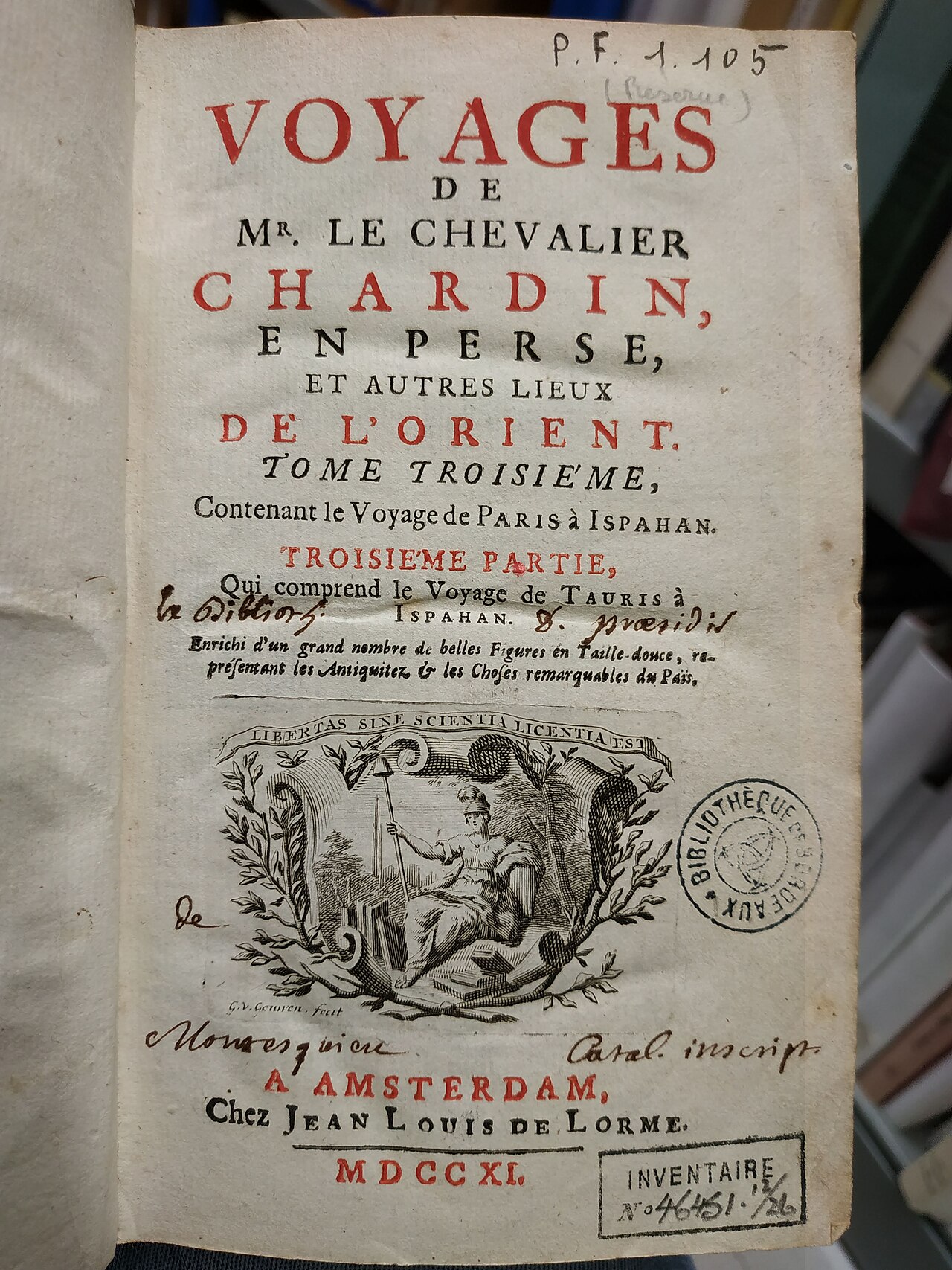

Chardin’s influence went far beyond Iranian studies. Montesquieu drew on him for the Persian Letters (1721) and The Spirit of the Laws, and later writers on Asian government used him as evidence. His picture of Shah Suleiman’s reign, mixing admiration for Persian civility with criticism of the court, is discussed in Shah Suleiman.
Kaempfer and the last visitors
The German physician Engelbert Kaempfer came with a Swedish embassy in 1684 and spent about twenty months in Isfahan. He studied plants, medicine and the court, and drew Persepolis and the palaces of Isfahan; his observations appeared in 1712. The Dutch artist Cornelis de Bruyn visited in 1703–1704 and made careful drawings of Persepolis. By then fewer Europeans came, and the next major accounts describe the Afghan siege of 1722, among them the Polish Jesuit Krusiński (see the siege and fall of Isfahan).
Reading the travellers today
The travellers saw things that Persian chroniclers rarely recorded: prices, coffee houses, street life, Armenian and Jewish communities, the look of buildings now gone. But they had their limits. Most knew little Persian, depended on interpreters and talked mainly to officials, merchants and other Europeans. Some copied from one another. Their judgements on the court, on women and on Islam reflect their own beliefs, and later European writers used them to build a picture of “oriental despotism”. Historians such as Rudi Matthee and Willem Floor use them alongside Persian chronicles, Dutch and English company archives and Iranian documents, checking one against another.
Persian words from this page
| سفرنامه | safarnâmeh | travel account |
| سیاح | sayyâh | traveller |
| کاروانسرا | kârvânsarâ | caravanserai |
| جواهر | javâher | jewels |
| گلستان | Golestân | Saadi’s Rose Garden |
| قهوهخانه | ghahveh-khâneh | coffee house |
Sources and further reading
- Jean Chardin, Voyages du chevalier Chardin en Perse, et autres lieux de l’Orient (Amsterdam, 1711).
- Jean-Baptiste Tavernier, Les Six Voyages de Jean-Baptiste Tavernier (Paris, 1676).
- Pietro della Valle, Viaggi di Pietro della Valle il pellegrino (Rome, 1650–1663).
- Engelbert Kaempfer, Amoenitatum exoticarum (Lemgo, 1712).
- Encyclopaedia Iranica, “Chardin, Jean” (John Emerson).
- Rudi Matthee, Persia in Crisis: Safavid Decline and the Fall of Isfahan (London, 2012).
Want to learn Persian? Get the free Starter Pack
Get the 14-page printable Starter Pack (all 32 letters, a 7-day reading plan, 100 core words and 20 survival phrases) and a short 5-email course. Free.
More in The Safavid Empire (1501–1736)
- Shah Ismail I
- The Qizilbash
- Twelver Shi’ism Becomes Iran’s State Religion
- The Battle of Marv and the Uzbeks
- The Battle of Chaldiran (1514)
- Shah Tahmasp I
- The Ottoman–Safavid War and the Peace of Amasya
- Humayun’s Exile in Persia
- Qazvin: The Second Safavid Capital
- Ismail II and Mohammad Khodabanda
- Shah Abbas the Great
- Shah Abbas’s Military Reforms and the Ghulams
- The Sherley Brothers in Persia
- Isfahan: “Half the World”
- The Building of Naqsh-e Jahan Square
- Shah Abbas Retakes the West: The Ottoman Wars of 1603–1618
- The Capture of Hormuz from the Portuguese (1622)
- New Julfa and the Armenian Merchants
- The Safavid Silk Trade and Europe
- Sheikh Baha’i
- Reza Abbasi
- Shah Safi and the Treaty of Zuhab
- Shah Abbas II
- The Fight for Kandahar
- Chehel Sotoun Palace and Its War Paintings
- Shah Suleiman
- European Travellers in Safavid Persia
- Shah Soltan Hoseyn
- Safavid Art: Carpets, Miniatures and Tiles
- Mulla Sadra and the School of Isfahan
- The Afghan Revolt and the Battle of Gulnabad
- The Siege and Fall of Isfahan (1722)
- Peter the Great’s Persian Campaign (1722–1723)
- Tahmasp II and Hotaki Rule (1722–1732)
- Women of the Safavid Court
- The Safavid Legacy