Qazvin was the capital of Safavid Iran for about half a century, from around 1548, when Shah Tahmasp I settled his court there, until Shah Abbas I moved to Isfahan in the late 1590s. Tahmasp built a new royal quarter of gardens, palaces and a tree-lined promenade north of the old city. Two of its buildings survive: the Chehel Sotoun pavilion and the Ali Qapu gate.
| Capital | c. 1548 to 1596–1598 |
|---|---|
| Founder of the royal quarter | Shah Tahmasp I; palace complex completed around 1557 |
| Royal garden | Sa’adatabad, north-east of the old city |
| Surviving buildings | Chehel Sotoun (Kolah Farangi) pavilion; Ali Qapu gate |
| Coronations held here | Ismail II (22 August 1576); Abbas I (1587–1588) |
| Persian name | قزوین (Ghazvin) |
Why Tahmasp left Tabriz
The first Safavid capital, Tabriz, was a great commercial city, but it lay only a few days’ march from the Ottoman frontier. Ottoman armies occupied it after Chaldiran in 1514 and again in 1534 and 1548. Qazvin, about 500 kilometres to the south-east, offered more safety. It stood on the main road from Azerbaijan to Khorasan, close to the Alborz mountains and the Caspian provinces, in a fertile plain watered by qanats. It was also an old city with a long Islamic past and a population used to hosting courts.
Iranica dates the settling of the court at Qazvin to 1548, while other historians give 1555 or 1557 for the formal transfer. The difference reflects a gradual move: the court spent more and more time there through the 1550s, and the new palaces were finished in about 1557, after the Peace of Amasya had brought quiet to the western frontier.
A garden city beside the old town
Tahmasp did not rebuild old Qazvin. He laid out a new royal quarter next to it, centred on the garden of Sa’adatabad, “abode of felicity”. Within it stood the palaces of the shah and his household, offices of state and pavilions set among channels and trees. The court poet Abdi Beg Shirazi, who lived through these years, celebrated the gardens in verse, and his poems remain one of the main sources for what the quarter looked like.
A straight, tree-lined promenade, the khiyaban, linked the old city to the new quarter, passing through two squares. When the German traveller Engelbert Kaempfer saw it in 1684, he described a long avenue planted with plane and mulberry trees in alternating rows. Abdi Beg says ordinary townspeople liked to stroll there. The idea of a royal avenue joining city and palace garden would be repeated on a grander scale at Isfahan; see Isfahan, “Half the World”.
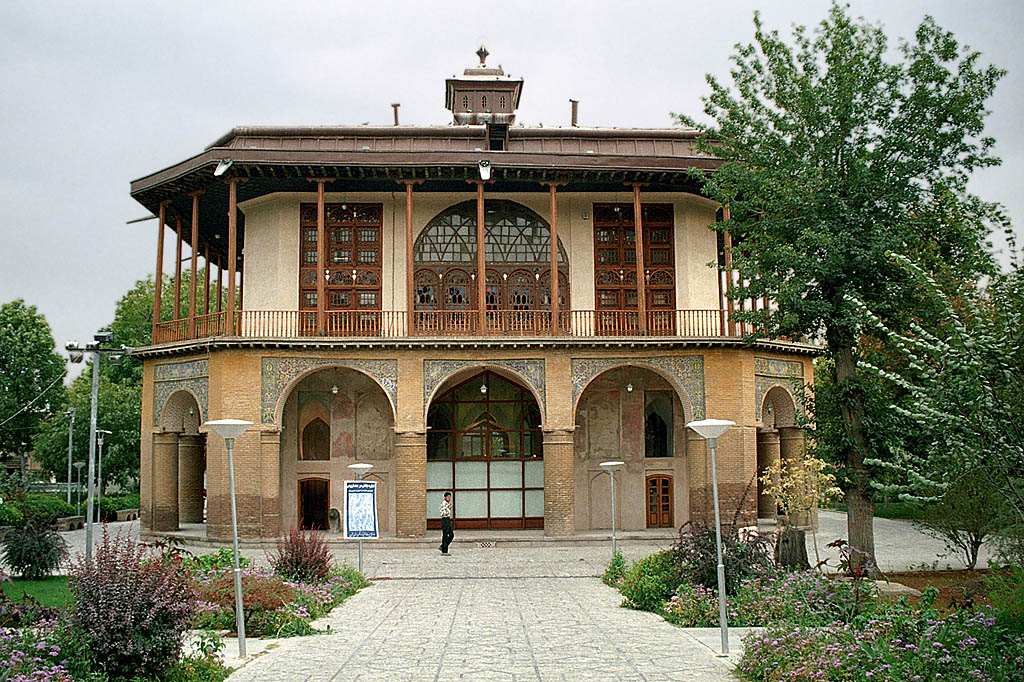

The Chehel Sotoun pavilion
The building now called Chehel Sotoun, “forty columns”, was originally known as the Kolah Farangi, a name used for a type of domed garden pavilion. It is usually attributed to Tahmasp, though no building inscription survives to prove it. The pavilion has two storeys on an irregular eight-sided plan. Eight heavy columns carry a gallery around the upper floor, and thirty-two slender wooden posts hold up the gallery roof. The ground floor has a central room opening onto four porches; upstairs is a cross-shaped hall.
The design looks forward to the later palaces of Isfahan, above all Hasht Behesht. Both Ismail II and Abbas I were enthroned here. In the nineteenth century the Qajar governor Sa’d al-Saltaneh remodelled the interior and added the tiles now seen outside. Restoration in the 1970s uncovered Safavid wall paintings on both floors, including a figure in European dress of the sixteenth or seventeenth century. The pavilion now houses a museum of calligraphy.
The Ali Qapu gate
The royal quarter was closed by seven gates. Only one survives: the Ali Qapu, “Sublime Gate”, the southern and most important entrance, at the start of today’s Sepah Street. Its present form dates from the reign of Shah Abbas I, and it carries an inscription in thuluth script by the calligrapher Ali Reza Abbasi. The French traveller Jean Chardin recorded the Persian verse over the gate, a prayer that the doorway might always stand open by God’s grace. It should not be confused with the better-known Ali Qapu palace in Isfahan, built for the same purpose a generation later.
Fifty years of court drama
Qazvin was the stage for the most dangerous years of the dynasty. Suleiman’s rebel son Bayezid was held there before his death in 1562. In May 1576 Tahmasp died in the palace, and the city filled with armed Qizilbash supporting rival princes. The winner, Ismail II, was crowned in the Chehel Sotoun in August 1576 and killed many of his relatives before his own sudden death the next year, as told on the page about Ismail II and Mohammad Khodabanda. In 1579 the queen Khayr al-Nisa Begum was murdered inside the palace precinct by Qizilbash chiefs.
In 1587 the young Abbas rode into Qazvin with his Qizilbash guardian and took the throne from his father. Here, in December 1598, he received the English adventurers Anthony and Robert Sherley, whose role in his reforms is discussed under Shah Abbas’s military reforms.
After the court left
From the mid-1590s Abbas spent more time in Isfahan, which he made his capital by 1598. Qazvin lost the court but not its importance. It remained a major provincial city on the road between Tehran, Tabriz and the Caspian, and the old royal quarter was gradually absorbed as the town grew northwards. For the city today, with its Qajar caravanserais, Jameh Mosque and the route to the Alamut valley, see the city guide to Qazvin.
Persian words from this page
| قزوین | Ghazvin | Qazvin |
| پایتخت | pâytakht | capital city |
| چهلستون | Chehel Sotun | “forty columns” |
| عالیقاپو | Âli Ghâpu | “Sublime Gate” |
| خیابان | khiyâbân | avenue, now “street” |
| سعادتآباد | Sa’âdat-âbâd | “abode of felicity” |
Sources and further reading
- “Čehel Sotūn, Qazvin”, Encyclopaedia Iranica: iranicaonline.org
- “Khiyaban (Qazvin)”, Middle East Garden Traditions, Archnet: archnet.org
- Sussan Babaie, Isfahan and Its Palaces: Statecraft, Shi’ism and the Architecture of Conviviality in Early Modern Iran (Edinburgh University Press, 2008)
- Engelbert Kaempfer, Amoenitatum exoticarum (1712)
- “Ṭahmāsp I”, Encyclopaedia Iranica: iranicaonline.org
Want to learn Persian? Get the free Starter Pack
Get the 14-page printable Starter Pack (all 32 letters, a 7-day reading plan, 100 core words and 20 survival phrases) and a short 5-email course. Free.
More in The Safavid Empire (1501–1736)
- Shah Ismail I
- The Qizilbash
- Twelver Shi’ism Becomes Iran’s State Religion
- The Battle of Marv and the Uzbeks
- The Battle of Chaldiran (1514)
- Shah Tahmasp I
- The Ottoman–Safavid War and the Peace of Amasya
- Humayun’s Exile in Persia
- Qazvin: The Second Safavid Capital
- Ismail II and Mohammad Khodabanda
- Shah Abbas the Great
- Shah Abbas’s Military Reforms and the Ghulams
- The Sherley Brothers in Persia
- Isfahan: “Half the World”
- The Building of Naqsh-e Jahan Square
- Shah Abbas Retakes the West: The Ottoman Wars of 1603–1618
- The Capture of Hormuz from the Portuguese (1622)
- New Julfa and the Armenian Merchants
- The Safavid Silk Trade and Europe
- Sheikh Baha’i
- Reza Abbasi
- Shah Safi and the Treaty of Zuhab
- Shah Abbas II
- The Fight for Kandahar
- Chehel Sotoun Palace and Its War Paintings
- Shah Suleiman
- European Travellers in Safavid Persia
- Shah Soltan Hoseyn
- Safavid Art: Carpets, Miniatures and Tiles
- Mulla Sadra and the School of Isfahan
- The Afghan Revolt and the Battle of Gulnabad
- The Siege and Fall of Isfahan (1722)
- Peter the Great’s Persian Campaign (1722–1723)
- Tahmasp II and Hotaki Rule (1722–1732)
- Women of the Safavid Court
- The Safavid Legacy