The Battle of Chaldiran was fought on 23 August 1514 on a plain in north-western Iran, south of Maku, between the Ottoman sultan Selim I and Shah Ismail I. Ottoman cannon and musket-armed Janissaries crushed the Safavid cavalry, Selim briefly occupied Tabriz, and the Safavids lost eastern Anatolia for good. The defeat also ended the belief of Ismail’s followers that he could not be beaten.
| Date | 23 August 1514 |
|---|---|
| Place | Chaldiran plain, south of Maku, in today’s West Azerbaijan province, Iran |
| Ottoman side | Sultan Selim I; estimates of 60,000 to 100,000 men, with 100 to 200 guns |
| Safavid side | Shah Ismail I; estimates of 40,000 to 80,000 cavalry, no artillery |
| Result | Ottoman victory; Tabriz occupied for about a week in September |
| Long-term result | Eastern Anatolia and later Diyarbakir pass to the Ottomans |
Why Selim marched east
The conflict began in Anatolia, not Iran. Many of Shah Ismail‘s most devoted followers were Turkmen tribes living under Ottoman rule, and Safavid preachers kept winning converts there. In 1511 a pro-Safavid rising led by a holy man called Shahkulu swept across western Anatolia and killed an Ottoman grand vizier before it was crushed. When Selim seized the throne from his father Bayezid II in 1512, he treated the Qizilbash as a danger inside his own borders. Ottoman scholars issued legal opinions calling the Safavids heretics, and Ottoman chroniclers claim some 40,000 suspected Safavid sympathisers in Anatolia were killed or imprisoned. Historians regard that number as a conventional figure rather than a count, but the persecution was real.
Insults then passed between the two rulers. Selim’s letters, preserved in Ottoman collections, called Ismail a usurper and a heretic. A well-known story says Ismail answered with a box of opium, suggesting that the sultan’s secretaries must have written while drugged. In the spring of 1514 Selim set out from Istanbul with a large army.
A hard march across Anatolia
The Safavids did not defend the frontier. Instead they burned crops and emptied villages along the route, hoping hunger and distance would stop the Ottomans. It almost worked. By late summer the Janissaries were grumbling openly about the march. Selim pressed on, and Ismail, whose authority rested on never refusing a fight, came out to meet him on the open plain of Chaldiran.

The battle on 23 August
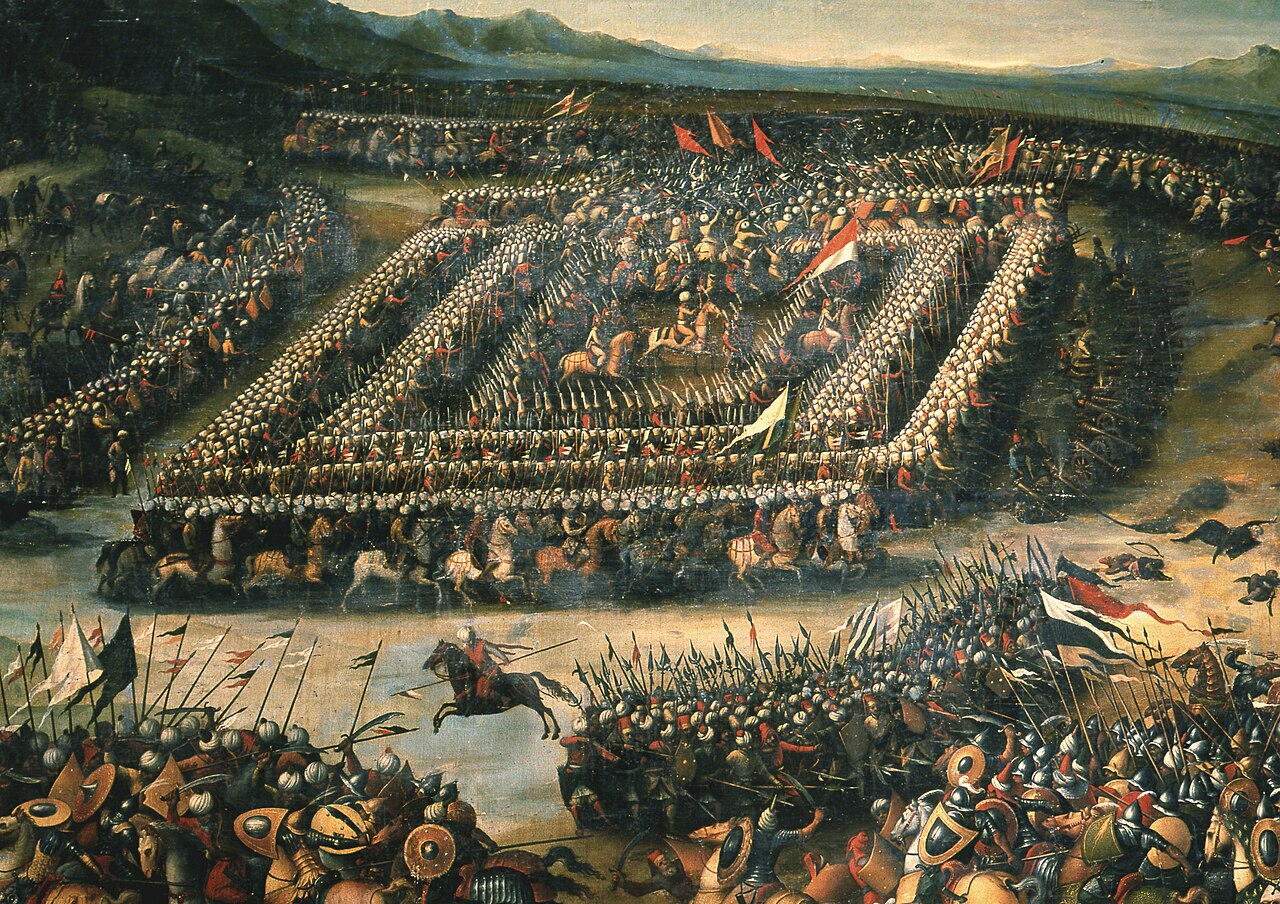
The two armies were built for different kinds of war. Selim drew up his infantry and guns behind a line of carts chained together, a field fortress the Ottomans had learned to use in the Balkans, with cavalry on the wings. Ismail had no artillery at all. His army was Qizilbash horsemen, brave and fast, who expected to win by shock and by faith in their leader.
Some chroniclers say Ismail’s commanders urged him to attack before the Ottoman guns were in position and that he refused. Whatever the truth of that story, the Safavid charge came against a prepared army. On one wing Ismail himself broke into the Ottoman cavalry and drove it back. On the other, the Qizilbash under Mohammad Khan Ustajlu rode into the guns and musket fire and were shattered; Mohammad Khan was killed. Ismail was wounded and his army withdrew from the field. Among the dead were several of the leading men of the state, including the sadr, Sayyed Sharif al-Din Ali Shirazi, and the shah’s deputy, Abd al-Baqi Yazdi.
How many fought and died
The numbers are uncertain. Ottoman and Safavid accounts each had reasons to inflate the enemy and shrink their own side. Modern estimates usually put the Ottoman army at about 60,000 or more and the Safavids at around 40,000, with some writers giving much higher figures for both. Casualty figures range so widely, from a few thousand to tens of thousands, that they are best treated as unknown. What is not in doubt is that firepower decided the day.
Selim in Tabriz
Selim marched to the Safavid capital and entered Tabriz in early September 1514. The Friday sermon was read in his name. Members of Ismail’s harem had been captured after the battle, and the sultan refused Safavid envoys who came to ransom them. He took craftsmen, artists and treasure from Tabriz back to Istanbul. Then, after only about a week, he left. The Janissaries refused to spend the winter on the Iranian plateau, and Selim could not hold the city.
What Chaldiran changed
- The frontier. In 1515–1516 the Ottomans took the Dhu’l-Qadr principality and Diyarbakir, helped by Kurdish chiefs who switched to their side. Eastern Anatolia was lost to Iran permanently.
- The Middle East. Free of danger from the east, Selim turned south and conquered the Mamluk sultanate, Syria and Egypt, in 1516–1517.
- Ismail himself. He never again led an army in person. For the Qizilbash, who had believed him close to divine, the defeat was a deep shock.
- Safavid warfare. Under Tahmasp I the Safavids began to use firearms and cannon, and they learned to avoid pitched battles with the Ottomans, relying on scorched earth instead.
- A long war. Ottoman–Safavid fighting continued on and off until the Peace of Amasya in 1555, and the border was not fixed until the Treaty of Zuhab in 1639.
Remembering the battle
A defeat might have been forgotten, but Chaldiran became part of Iranian memory. A century and a half later, a large wall painting of the battle was placed in the Chehel Sotoun palace in Isfahan, showing Ismail in single combat with an Ottoman champion. It turns the defeat into a scene of heroism, which is itself revealing about how the Safavids wanted to remember their founder. The painting is discussed on the page about Chehel Sotoun and its war paintings.
Persian words from this page
| چالدران | Châlderân | Chaldiran |
| عثمانی | Osmâni | Ottoman |
| توپ | tup | cannon |
| تفنگ | tofang | musket, rifle |
| سلطان سلیم | Soltân Salim | Sultan Selim |
| ماکو | Mâku | Maku |
Sources and further reading
- Roger M. Savory, “Esmāʿil I Ṣafawi”, Encyclopaedia Iranica: iranicaonline.org
- Adel Allouche, The Origins and Development of the Ottoman–Safavid Conflict (906–962/1500–1555) (Klaus Schwarz, 1983)
- Colin Imber, The Ottoman Empire, 1300–1650: The Structure of Power (Palgrave, 2002)
- Roger Savory, Iran under the Safavids (Cambridge University Press, 1980)
- “Battle of Chāldirān”, Encyclopaedia Britannica
Want to learn Persian? Get the free Starter Pack
Get the 14-page printable Starter Pack (all 32 letters, a 7-day reading plan, 100 core words and 20 survival phrases) and a short 5-email course. Free.
More in The Safavid Empire (1501–1736)
- Shah Ismail I
- The Qizilbash
- Twelver Shi’ism Becomes Iran’s State Religion
- The Battle of Marv and the Uzbeks
- The Battle of Chaldiran (1514)
- Shah Tahmasp I
- The Ottoman–Safavid War and the Peace of Amasya
- Humayun’s Exile in Persia
- Qazvin: The Second Safavid Capital
- Ismail II and Mohammad Khodabanda
- Shah Abbas the Great
- Shah Abbas’s Military Reforms and the Ghulams
- The Sherley Brothers in Persia
- Isfahan: “Half the World”
- The Building of Naqsh-e Jahan Square
- Shah Abbas Retakes the West: The Ottoman Wars of 1603–1618
- The Capture of Hormuz from the Portuguese (1622)
- New Julfa and the Armenian Merchants
- The Safavid Silk Trade and Europe
- Sheikh Baha’i
- Reza Abbasi
- Shah Safi and the Treaty of Zuhab
- Shah Abbas II
- The Fight for Kandahar
- Chehel Sotoun Palace and Its War Paintings
- Shah Suleiman
- European Travellers in Safavid Persia
- Shah Soltan Hoseyn
- Safavid Art: Carpets, Miniatures and Tiles
- Mulla Sadra and the School of Isfahan
- The Afghan Revolt and the Battle of Gulnabad
- The Siege and Fall of Isfahan (1722)
- Peter the Great’s Persian Campaign (1722–1723)
- Tahmasp II and Hotaki Rule (1722–1732)
- Women of the Safavid Court
- The Safavid Legacy