The Safavids (1501–1722, with puppet shahs until 1736) left Iran three lasting things: borders close to those of the modern country, Twelver Shi’ism as the faith of most Iranians and the basis of a powerful clergy, and an architecture and art centred on Isfahan that still defines the look of Persian culture. Historians still argue over whether they also created an Iranian nation.
| Dynasty | Safavid (صفویه Safaviyeh), 1501–1722; nominal shahs to 1736 |
|---|---|
| Capitals | Tabriz, Qazvin, Isfahan |
| Lasting border | Treaty of Zuhab with the Ottomans, 1639 |
| Religion | Twelver Shi’ism made the state faith from 1501 |
| Signature city | Isfahan, rebuilt from 1598 |
A map that lasted
Before 1501 the Iranian plateau had been divided among Turkmen confederations, Timurid princes and local dynasties. Ismail I and his successors put it back under one ruler for more than two centuries. The frontier with the Ottomans, fought over from Chaldiran in 1514 onwards, was fixed in broad outline by the Treaty of Zuhab in 1639, when Iran gave up Baghdad and Mesopotamia but kept the Zagros and Azerbaijan (see Shah Safi and the Treaty of Zuhab). That line, adjusted in later treaties, is still close to the border between Iran and its western neighbours today.
Other Safavid frontiers did not last. The Caucasus provinces, including eastern Georgia, Shirvan and Erivan, were lost to Russia in the nineteenth century, and Herat and Kandahar became part of Afghanistan (see the fight for Kandahar). The way the map changed over time is shown in how Iran’s borders changed.

A Shi’a country
The largest change was religious. When Ismail declared Twelver Shi’ism the state religion in 1501, most of the population of Iran was Sunni. Over the next two centuries, through official pressure, the import of scholars from Arab lands and the building of schools and shrines, Iran became a mainly Shi’a country. That process is described in Twelver Shi’ism becomes Iran’s state religion.
The Safavid religious settlement had three long-term results. It created a lasting divide between Shi’a Iran and its Sunni neighbours, the Ottomans, Uzbeks and Mughals. It made the Moharram rites of mourning for Imam Hoseyn, and pilgrimage to Mashhad and Qom, central parts of Iranian life. And it built up a learned clergy with its own schools, endowments and income. By the reign of Soltan Hoseyn, senior clerics such as Mohammad Baqer Majlesi had great influence at court. Under the Qajars the clergy grew more independent of the state, and its role in modern Iranian politics has roots in this Safavid foundation. The long view is in Shi’a Islam in Iranian history.
Isfahan and the look of Persian culture
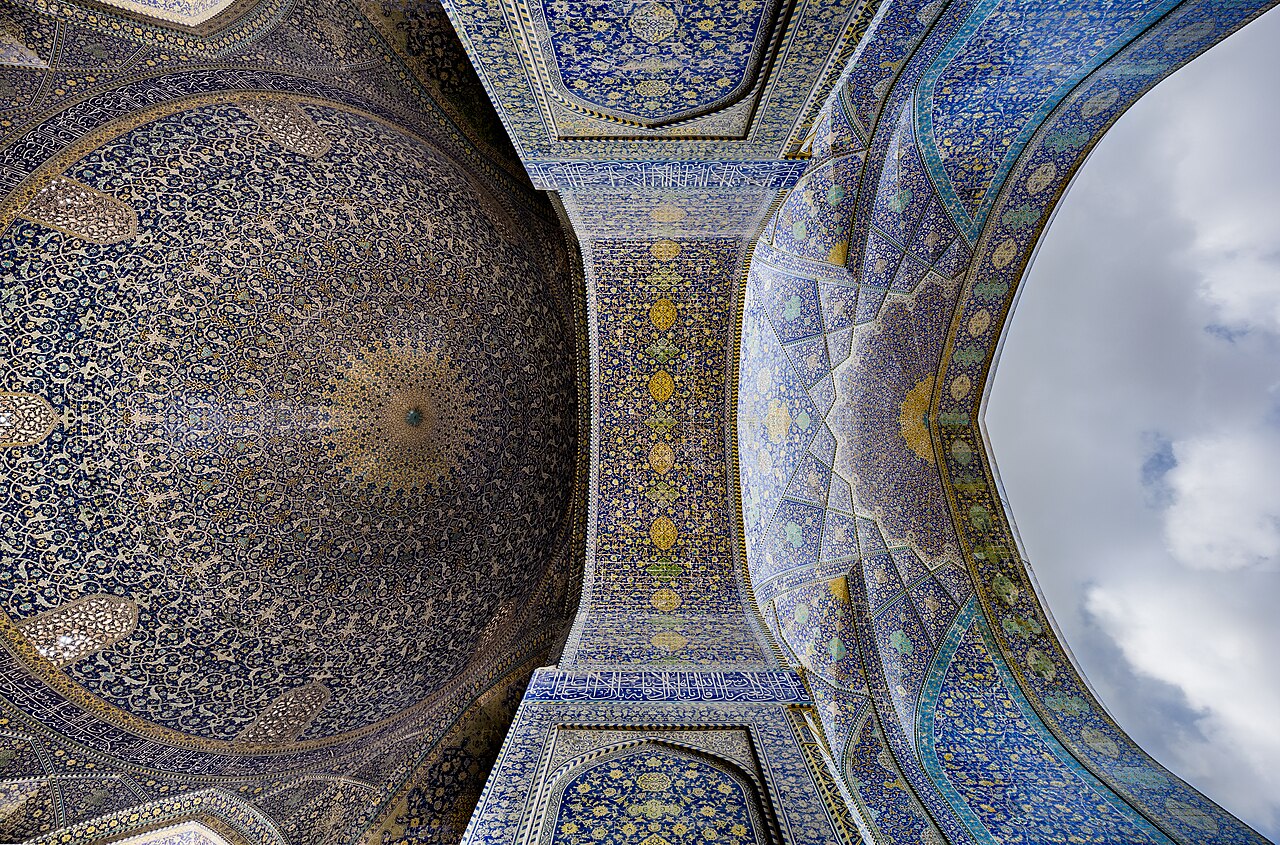
For many people, Persian architecture means the turquoise domes and tiled courtyards of Safavid Isfahan. Abbas I’s square, mosques, bazaar, bridges and the garden avenue of Chahar Bagh (see the building of Naqsh-e Jahan Square) set a model that later rulers copied. Across the country, roadside caravanserais of the Safavid type are still known as “Shah Abbasi” caravanserais, whether or not Abbas built them.
The arts followed the same path. Safavid carpets, such as the Ardabil carpet, and the album paintings of Reza Abbasi and his school are among the best known works of Iranian art in museums worldwide. In philosophy, the School of Isfahan of Mir Damad and Mulla Sadra remains the basis of Islamic philosophy as taught in Iran.
Language and people
The Safavid court was bilingual. Turkic was the language of the army and much of court life; Persian was the language of administration, history writing and poetry. Persian prose in this period became the model for official writing in Iran, Mughal India and Central Asia. The empire also brought new peoples into the heart of Iran: Armenians resettled in New Julfa, Georgians and Circassians at court and in the army, and Kurdish and Turkic tribes moved to guard frontiers. The Afshar and Qajar tribes that produced the next dynasties were Safavid creations in this sense.
Legitimacy after the fall
The Safavid name kept its power long after 1722. Nader ruled for years through Tahmasp II and the infant Abbas III before taking the crown himself (see Tahmasp II and Hotaki rule). Karim Khan Zand governed in the name of a Safavid prince, Ismail III, and never called himself shah. Throughout the eighteenth century, men claiming Safavid descent raised revolts. Only the Qajars, after 1789, built a monarchy that no longer needed the Safavid connection.
A national state?
Some historians, especially in the twentieth century, called the Safavid state the first Iranian national state of modern times, because it united the plateau, gave it a distinctive religion and set it apart from its neighbours. Others reject the label. They point out that the Safavids were a Turkic-speaking dynasty of Sufi origin, that loyalty was to the shah and the faith rather than to a nation, and that the empire included Georgians, Armenians, Arabs and Kurds as well as Persians. Most now take a middle view: the Safavids did not create Iranian identity, which was much older, but they gave it the political and religious shape it kept into the modern era.
Persian words from this page
| میراث | mirâs | heritage, legacy |
| صفویه | Safaviyeh | the Safavids |
| مرز | marz | border |
| شیعه | shi’eh | Shi’a |
| معماری | me’mâri | architecture |
| کاروانسرا | kârvânsarâ | caravanserai |
Sources and further reading
- Roger Savory, Iran under the Safavids (Cambridge, 1980).
- Andrew J. Newman, Safavid Iran: Rebirth of a Persian Empire (London, 2006).
- Rudi Matthee, Persia in Crisis: Safavid Decline and the Fall of Isfahan (London, 2012).
- Abbas Amanat, Iran: A Modern History (New Haven, 2017).
- The Cambridge History of Iran, vol. 6: The Timurid and Safavid Periods, ed. Peter Jackson and Laurence Lockhart (Cambridge, 1986).
- Encyclopaedia Iranica, “Safavid Dynasty”.
Want to learn Persian? Get the free Starter Pack
Get the 14-page printable Starter Pack (all 32 letters, a 7-day reading plan, 100 core words and 20 survival phrases) and a short 5-email course. Free.
More in The Safavid Empire (1501–1736)
- Shah Ismail I
- The Qizilbash
- Twelver Shi’ism Becomes Iran’s State Religion
- The Battle of Marv and the Uzbeks
- The Battle of Chaldiran (1514)
- Shah Tahmasp I
- The Ottoman–Safavid War and the Peace of Amasya
- Humayun’s Exile in Persia
- Qazvin: The Second Safavid Capital
- Ismail II and Mohammad Khodabanda
- Shah Abbas the Great
- Shah Abbas’s Military Reforms and the Ghulams
- The Sherley Brothers in Persia
- Isfahan: “Half the World”
- The Building of Naqsh-e Jahan Square
- Shah Abbas Retakes the West: The Ottoman Wars of 1603–1618
- The Capture of Hormuz from the Portuguese (1622)
- New Julfa and the Armenian Merchants
- The Safavid Silk Trade and Europe
- Sheikh Baha’i
- Reza Abbasi
- Shah Safi and the Treaty of Zuhab
- Shah Abbas II
- The Fight for Kandahar
- Chehel Sotoun Palace and Its War Paintings
- Shah Suleiman
- European Travellers in Safavid Persia
- Shah Soltan Hoseyn
- Safavid Art: Carpets, Miniatures and Tiles
- Mulla Sadra and the School of Isfahan
- The Afghan Revolt and the Battle of Gulnabad
- The Siege and Fall of Isfahan (1722)
- Peter the Great’s Persian Campaign (1722–1723)
- Tahmasp II and Hotaki Rule (1722–1732)
- Women of the Safavid Court
- The Safavid Legacy