Between 1532 and 1555 the Ottoman sultan Suleiman the Magnificent invaded Safavid Iran three times. He took Baghdad and Iraq and occupied Tabriz more than once, but Shah Tahmasp I avoided open battle and wore the invaders down. The Peace of Amasya, signed on 29 May 1555, was the first formal treaty between the two empires and kept the peace for over twenty years.
| Dates | 1532–1555 (main campaigns 1533–1536, 1548–1549, 1553–1555) |
|---|---|
| Ottoman side | Sultan Suleiman I; grand viziers Ibrahim Pasha and Rüstem Pasha |
| Safavid side | Shah Tahmasp I |
| Main Ottoman gains | Baghdad (December 1534), Iraq, Van, western Georgia |
| Treaty | Peace of Amasya, 29 May 1555 |
| Lasted until | 1578, when a new Ottoman war began |
Why the war began again
The defeat at Chaldiran in 1514 had not ended the rivalry. Both empires claimed the Kurdish and Armenian borderlands of eastern Anatolia and the rich lowlands of Iraq. In the early 1530s several disputes came together. The Kurdish lord of Bitlis placed himself under Safavid protection, the Safavid governor of Baghdad, who had leaned towards the Ottomans, was killed on Tahmasp’s orders, and Ulama Sultan Takkalu, the Safavid governor of Azerbaijan, defected to Istanbul and told Suleiman how weak the young shah’s position was. The Safavids were also in contact with the Habsburgs, Suleiman’s enemies in Europe, in the hope of an alliance on two fronts.
The campaign of the two Iraqs, 1533–1536
The grand vizier Ibrahim Pasha led the first army east and entered Tabriz in July 1534. Suleiman joined him there, and the combined army marched south across the Zagros in the autumn, suffering badly from cold and snow. In December 1534 Baghdad surrendered without a fight. Suleiman restored the tomb of Abu Hanifa, the founder of the Hanafi school of Sunni law, a gesture aimed squarely at the Safavids’ Shi’a claims. He returned to Tabriz in 1535 before going home.
The campaign was recorded by Matrakçı Nasuh, an Ottoman official and artist, in an illustrated book of the army’s stages known as the Beyan-ı Menazil. Its bird’s-eye pictures of Tabriz, Soltaniyeh and Baghdad are among the earliest surviving views of these cities.
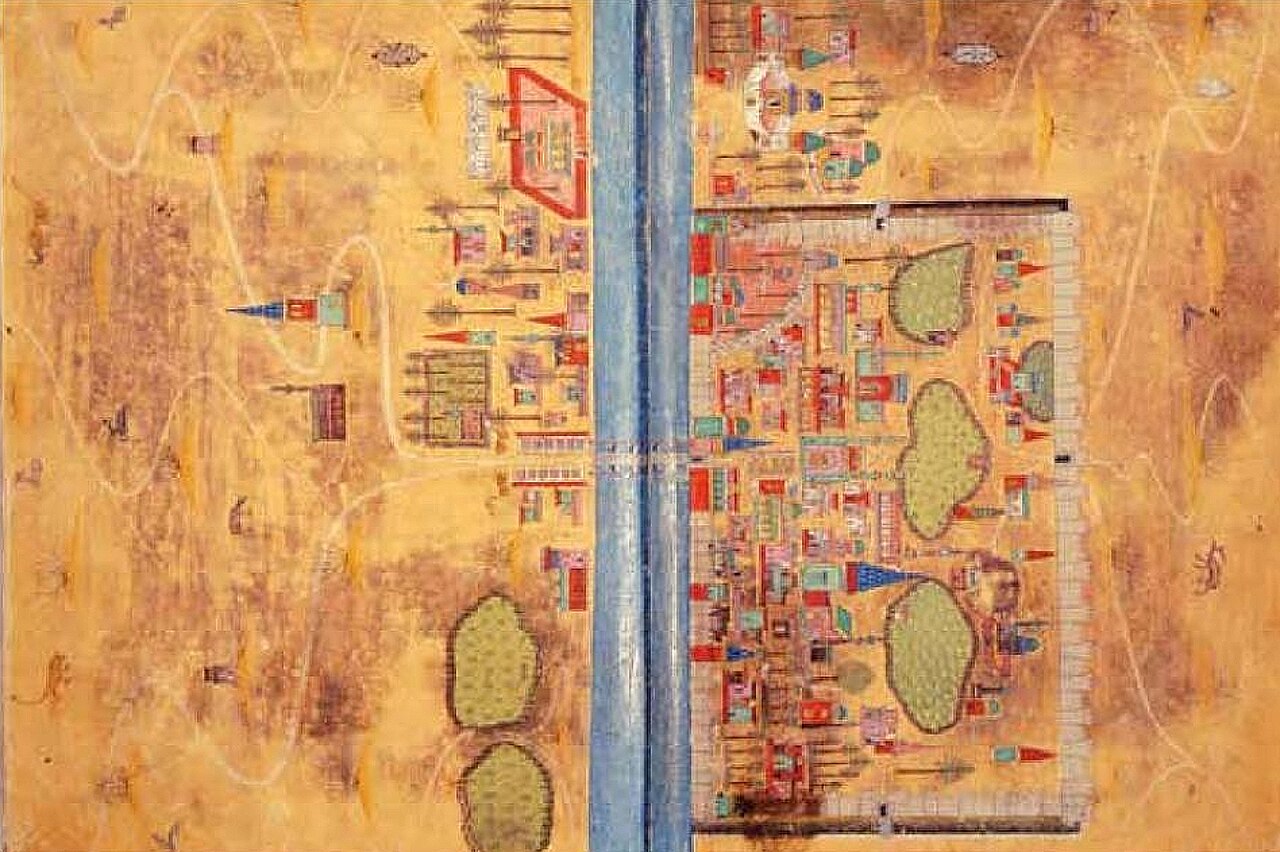

Baghdad was the war’s lasting prize. Apart from Shah Abbas’s reconquest of 1623–1638, it stayed Ottoman until the First World War. For Iran the loss mattered religiously as well as politically, since the great Shi’a shrines of Najaf and Karbala now lay in Ottoman territory.
Tahmasp’s way of war
Tahmasp had learned from his father’s defeat. He refused to give battle against Ottoman artillery and Janissaries. When an Ottoman army approached, he withdrew, burned crops, filled wells and drove off livestock, leaving the enemy to cross an empty, hostile land at the end of a very long supply line. When the invaders retreated, as they always had to before winter, Safavid cavalry harried their columns and retook the towns they had left behind. It was not a heroic strategy, but it worked: the Ottomans could take the frontier cities, but they could not hold the Iranian plateau.
A brother’s betrayal, 1547–1549
The second invasion grew out of a family quarrel. Tahmasp’s brother Alqas Mirza, governor of Shirvan, rebelled in 1547 and fled to Istanbul, promising Suleiman that the Qizilbash would rise for him. Suleiman marched east in 1548. Tahmasp evacuated Tabriz, which the Ottomans occupied in late July, and the fortress of Van fell in August after a siege in which a French ambassador, Gabriel de Luetz, is reported to have advised on the artillery. Alqas then led a raiding force deep into Iran, plundering as far as Qom and Kashan, but the expected rising never came. He was captured in 1549 and died in prison.
The last campaign, 1553–1555
In 1552 the Safavids struck first. Tahmasp’s son Ismail Mirza, later Shah Ismail II, raided the Ottoman frontier around Erzurum and defeated its governor, a success that made him popular with the Qizilbash and, in time, suspect to his father. Suleiman’s answer was his last eastern campaign. In 1554 his army ravaged Nakhchivan, Yerevan and Karabakh, but again Tahmasp would not fight a pitched battle. Both rulers were now ready to stop.
The Peace of Amasya, 29 May 1555
A Safavid embassy met Suleiman at Amasya in northern Anatolia, where the treaty was agreed. Its main terms, as historians reconstruct them from the surviving letters, were:
- The Ottomans kept Baghdad, most of Iraq and the lands they held in eastern Anatolia.
- The Safavids kept Azerbaijan, including Tabriz, and eastern Armenia.
- Georgia was divided, with the west under Ottoman influence and the east, Kartli and Kakheti, under the Safavids.
- Persian pilgrims were allowed to travel to Mecca and Medina and to the Shi’a shrines of Iraq.
- The Safavids promised to stop the public ritual cursing of the first three caliphs, a practice deeply offensive to Sunnis.
Some frontier zones, including the area of Kars, were to be left as a kind of buffer. The border was described only roughly, which helps explain why later wars kept returning to the same districts.
What the war meant
Amasya marked a turning point. The Ottoman Empire, for the first time, formally recognised the Safavid state as a legitimate neighbour rather than a heretical rebellion. For the Safavids, the treaty confirmed that Iran’s frontier with the Ottomans would run roughly along the Zagros and the Armenian highlands, close to where it still runs today. It also confirmed that Tabriz was too close to the border to be a safe capital, and the court settled at Qazvin.
The peace held through the rest of Tahmasp’s reign. After his death, the Ottomans saw Safavid weakness and attacked in 1578, starting a war that lasted until 1590. Shah Abbas reversed those losses in the wars of 1603–1618, and the border agreed in the Treaty of Zuhab in 1639 largely followed the line first sketched at Amasya.
Persian words from this page
| بغداد | Baghdâd | Baghdad |
| سلطان سلیمان | Soltân Soleymân | Sultan Suleiman |
| صلح | solh | peace |
| آماسیه | Âmâsiye | Amasya |
| مرز | marz | border |
| القاص میرزا | Alghâs Mirzâ | Alqas Mirza |
Sources and further reading
- “Ṭahmāsp I”, Encyclopaedia Iranica: iranicaonline.org
- Adel Allouche, The Origins and Development of the Ottoman–Safavid Conflict (906–962/1500–1555) (Klaus Schwarz, 1983)
- Colin Imber, The Ottoman Empire, 1300–1650: The Structure of Power (Palgrave, 2002)
- Matrakçı Nasuh, Beyan-ı Menazil-i Sefer-i Irakeyn (1537), Istanbul University Library
- The Cambridge History of Iran, vol. 6: The Timurid and Safavid Periods (1986)
Want to learn Persian? Get the free Starter Pack
Get the 14-page printable Starter Pack (all 32 letters, a 7-day reading plan, 100 core words and 20 survival phrases) and a short 5-email course. Free.
More in The Safavid Empire (1501–1736)
- Shah Ismail I
- The Qizilbash
- Twelver Shi’ism Becomes Iran’s State Religion
- The Battle of Marv and the Uzbeks
- The Battle of Chaldiran (1514)
- Shah Tahmasp I
- The Ottoman–Safavid War and the Peace of Amasya
- Humayun’s Exile in Persia
- Qazvin: The Second Safavid Capital
- Ismail II and Mohammad Khodabanda
- Shah Abbas the Great
- Shah Abbas’s Military Reforms and the Ghulams
- The Sherley Brothers in Persia
- Isfahan: “Half the World”
- The Building of Naqsh-e Jahan Square
- Shah Abbas Retakes the West: The Ottoman Wars of 1603–1618
- The Capture of Hormuz from the Portuguese (1622)
- New Julfa and the Armenian Merchants
- The Safavid Silk Trade and Europe
- Sheikh Baha’i
- Reza Abbasi
- Shah Safi and the Treaty of Zuhab
- Shah Abbas II
- The Fight for Kandahar
- Chehel Sotoun Palace and Its War Paintings
- Shah Suleiman
- European Travellers in Safavid Persia
- Shah Soltan Hoseyn
- Safavid Art: Carpets, Miniatures and Tiles
- Mulla Sadra and the School of Isfahan
- The Afghan Revolt and the Battle of Gulnabad
- The Siege and Fall of Isfahan (1722)
- Peter the Great’s Persian Campaign (1722–1723)
- Tahmasp II and Hotaki Rule (1722–1732)
- Women of the Safavid Court
- The Safavid Legacy