Shah Tahmasp I ruled Safavid Iran from 1524 to 1576, the longest reign of the dynasty. He came to the throne at ten, survived a decade of civil war among the Qizilbash chiefs, held off repeated Ottoman and Uzbek invasions, and moved the capital from exposed Tabriz to Qazvin. When he died, the Safavid state that his father had won by conquest had become a lasting kingdom.
| Born | 22 February 1514, Shahabad near Isfahan |
|---|---|
| Reigned | 23 May 1524 – 14 May 1576 (52 years) |
| Father | Shah Ismail I |
| Capitals | Tabriz, then Qazvin |
| Major treaty | Peace of Amasya with the Ottomans, 29 May 1555 |
| Memoir | Tazkera-ye Shah Tahmasp, completed 1561 |
| Died | 14 May 1576, Qazvin |
A boy king and the Qizilbash civil war
When Ismail I died in 1524, real power passed to the Turkmen chiefs of the Qizilbash tribes, who fought one another for control of the young shah. Div Sultan Rumlu acted as regent until Tahmasp, then thirteen, had him executed in 1527. Köpek Sultan Ustajlu was killed the same year. Chuha Sultan Takkalu then dominated the court until 1530, when the shah’s guards massacred Takkalu tribesmen in the royal camp, an episode remembered as the “Takkalu pestilence”. The last of the overmighty regents, Hosayn Khan Shamlu, was put to death in 1533.
From that point Tahmasp ruled in person. The lesson of his youth stayed with him: the tribes that had made the dynasty could also destroy it. Much of his reign was spent playing tribal leaders against one another and building alternative sources of loyalty.
Two fronts: Uzbeks and Ottomans
Tahmasp inherited the two enemies his father had fought. In the east, Uzbek armies under Ubaydullah Khan raided Khorasan almost every year and besieged Herat several times. Tahmasp won a hard victory over them at Jam on 24 September 1528, but it settled nothing, and the Khorasan frontier stayed violent for the rest of the century.
In the west, Sultan Suleiman the Magnificent invaded in 1534, 1548 and 1553. Tahmasp’s answer was to avoid the kind of pitched battle his father had lost at Chaldiran. He pulled back, laid waste the land before the Ottoman armies, and struck at their supply lines and garrisons when they withdrew. Baghdad and Iraq were lost, and Tabriz was occupied more than once, but the heartland held. The wars ended with the Peace of Amasya in 1555, told on the page about the Ottoman–Safavid war of 1532–1555.
His own family made the danger worse. His brother Sam Mirza was accused of encouraging the Ottoman invasion of 1534, and another brother, Alqas Mirza, rebelled in 1547, fled to Istanbul and returned with Suleiman’s army the next year.

A new capital at Qazvin
Tabriz, close to the Ottoman frontier, had been taken by Ottoman troops in 1514, 1534 and 1548. Tahmasp moved the court to Qazvin, further east and closer to the centre of the plateau. Preparations began in the 1540s; the formal date of the move is debated, with both 1555 and 1557 given. He laid out a royal quarter of gardens and palaces there, described on the page about Qazvin as the second Safavid capital.
Georgian captives and a new kind of servant
Between 1540 and 1553 Tahmasp led four campaigns into the Caucasus. By the fourth he had taken Tbilisi and Kartli, and tens of thousands of people, mostly women and children, were brought back to Iran; Iranica gives a figure of more than 30,000 for the 1553 campaign alone. Georgian, Circassian and Armenian captives entered the royal household as slaves, converts and wives. Their sons became a body of servants loyal to the shah alone, outside the tribal system. This was the seed of the slave soldiers, or gholams, whom his grandson Abbas would turn into a standing army; see Shah Abbas’s military reforms.
Piety, painting and the guests of the shah
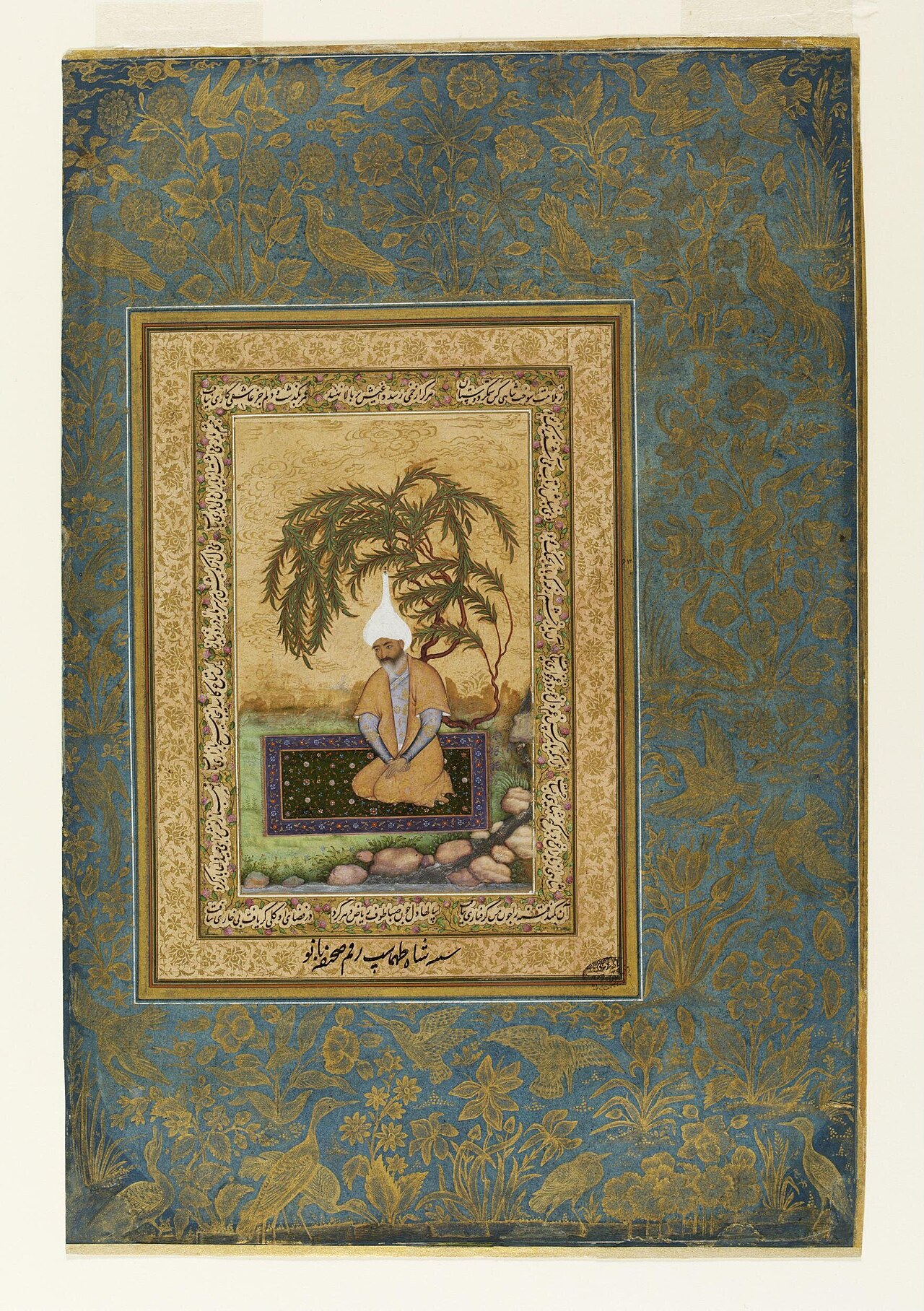
As a young man Tahmasp was a keen painter and patron. His workshop produced the great illustrated Shahnameh made in his name, with about 258 paintings by the leading artists of Tabriz, among them Soltan Mohammad and Mir Mosavver. Later he turned to strict religious observance. He made public acts of “repentance”, banning wine, music and other vices at court, and he gave Shi’a scholars such as Ali al-Karaki great authority (see Shi’ism as Iran’s state religion). As his interest in painting waned, several court artists left. Two of them, Mir Sayyed Ali and Abd al-Samad, joined the Mughal emperor Humayun and helped create Mughal painting.
Humayun himself was Tahmasp’s most famous guest, sheltering at the Safavid court in 1544 after losing his throne in India; his stay is told in Humayun’s exile in Persia. A darker episode followed in 1559, when Suleiman’s rebel son Bayezid fled to Iran. After long bargaining, Tahmasp allowed Ottoman agents to put Bayezid and his sons to death in 1562, in return for payment and continued peace. When Selim II became sultan in 1566, Tahmasp sent him a lavish embassy, and the great Shahnameh went to Istanbul as a gift soon after.
In his own words
Tahmasp is unusual among Safavid shahs in having written a memoir, the Tazkera-ye Shah Tahmasp, finished in 1561. It covers his wars and is full of dreams and signs of divine favour, and it shows a ruler anxious to present himself as a pious Shi’a king rather than a Sufi warrior like his father. An English translation by Andrew Peacock was published in 2024.
A crisis left behind
Tahmasp died at Qazvin on 14 May 1576. He had not settled the succession, and for many years he had kept his son Ismail Mirza confined in a fortress. The Qizilbash factions quickly split over his sons, and the troubled years that followed are covered on the page about Ismail II and Mohammad Khodabanda.
Historians now see Tahmasp as the ruler who saved the dynasty. He lacked his father’s charisma and his grandson’s brilliance, but he outlasted every enemy, gave the state a Shi’a scholarly establishment, and began the reforms that made Shah Abbas possible.
Persian words from this page
| شاه طهماسب | Shâh Tahmâsb | Shah Tahmasp |
| قزوین | Ghazvin | Qazvin |
| توبه | towbe | repentance |
| غلام | gholâm | slave, royal servant |
| تذکره | tazkere | memoir, biographical record |
| شاهنامه | Shâhnâme | the Book of Kings |
Sources and further reading
- “Ṭahmāsp I”, Encyclopaedia Iranica: iranicaonline.org
- The Memoirs of Shah Tahmasp I, Safavid Ruler of Iran, trans. Andrew Peacock (I.B. Tauris, 2024)
- Roger Savory, Iran under the Safavids (Cambridge University Press, 1980)
- Andrew J. Newman, Safavid Iran: Rebirth of a Persian Empire (I.B. Tauris, 2006)
- Sheila R. Canby, The Shahnama of Shah Tahmasp: The Persian Book of Kings (Metropolitan Museum of Art, 2014)
Want to learn Persian? Get the free Starter Pack
Get the 14-page printable Starter Pack (all 32 letters, a 7-day reading plan, 100 core words and 20 survival phrases) and a short 5-email course. Free.
More in The Safavid Empire (1501–1736)
- Shah Ismail I
- The Qizilbash
- Twelver Shi’ism Becomes Iran’s State Religion
- The Battle of Marv and the Uzbeks
- The Battle of Chaldiran (1514)
- Shah Tahmasp I
- The Ottoman–Safavid War and the Peace of Amasya
- Humayun’s Exile in Persia
- Qazvin: The Second Safavid Capital
- Ismail II and Mohammad Khodabanda
- Shah Abbas the Great
- Shah Abbas’s Military Reforms and the Ghulams
- The Sherley Brothers in Persia
- Isfahan: “Half the World”
- The Building of Naqsh-e Jahan Square
- Shah Abbas Retakes the West: The Ottoman Wars of 1603–1618
- The Capture of Hormuz from the Portuguese (1622)
- New Julfa and the Armenian Merchants
- The Safavid Silk Trade and Europe
- Sheikh Baha’i
- Reza Abbasi
- Shah Safi and the Treaty of Zuhab
- Shah Abbas II
- The Fight for Kandahar
- Chehel Sotoun Palace and Its War Paintings
- Shah Suleiman
- European Travellers in Safavid Persia
- Shah Soltan Hoseyn
- Safavid Art: Carpets, Miniatures and Tiles
- Mulla Sadra and the School of Isfahan
- The Afghan Revolt and the Battle of Gulnabad
- The Siege and Fall of Isfahan (1722)
- Peter the Great’s Persian Campaign (1722–1723)
- Tahmasp II and Hotaki Rule (1722–1732)
- Women of the Safavid Court
- The Safavid Legacy