After the death of Shah Tahmasp I in 1576, the Safavid state came close to collapse. His son Ismail II, released after nineteen years in prison, ruled for fifteen months, killed most of his male relatives and tried to roll back Shi’ism. His half-blind brother Mohammad Khodabanda (r. 1578–1587) could not control the Qizilbash chiefs, while his wife Khayr al-Nisa Begum briefly ran the state, and Ottoman and Uzbek armies seized whole provinces.
| Ismail II | Born 31 May 1537, Qom; reigned August 1576 – 24 November 1577 |
|---|---|
| Mohammad Khodabanda | Born 1532, Tabriz; reigned February 1578 – October 1587; died c. 1595–1596 |
| Capital | Qazvin |
| Key women | Pari Khan Khanum (d. 1578), daughter of Tahmasp; Khayr al-Nisa Begum, known as Mahd-e Olya (d. 1579) |
| Wars | Ottoman war of 1578–1590; Uzbek invasions of Khorasan |
| Ended by | The accession of Khodabanda’s son, Abbas I, in 1587 |
The prisoner of Qahqaheh
Ismail Mirza had once been the most admired of Tahmasp‘s sons. As a young commander he won fame raiding the Ottoman frontier around Erzurum in 1552. That popularity with the Qizilbash may have been his undoing. In 1557 his father had him locked up in the fortress of Qahqaheh, in the mountains of Azerbaijan. Chroniclers give various reasons: Tahmasp’s fear of a rival, the prince’s quarrels with powerful governors, and his drinking and drug use. He stayed there until his father died, nineteen or twenty years later.
A bloody succession, 1576
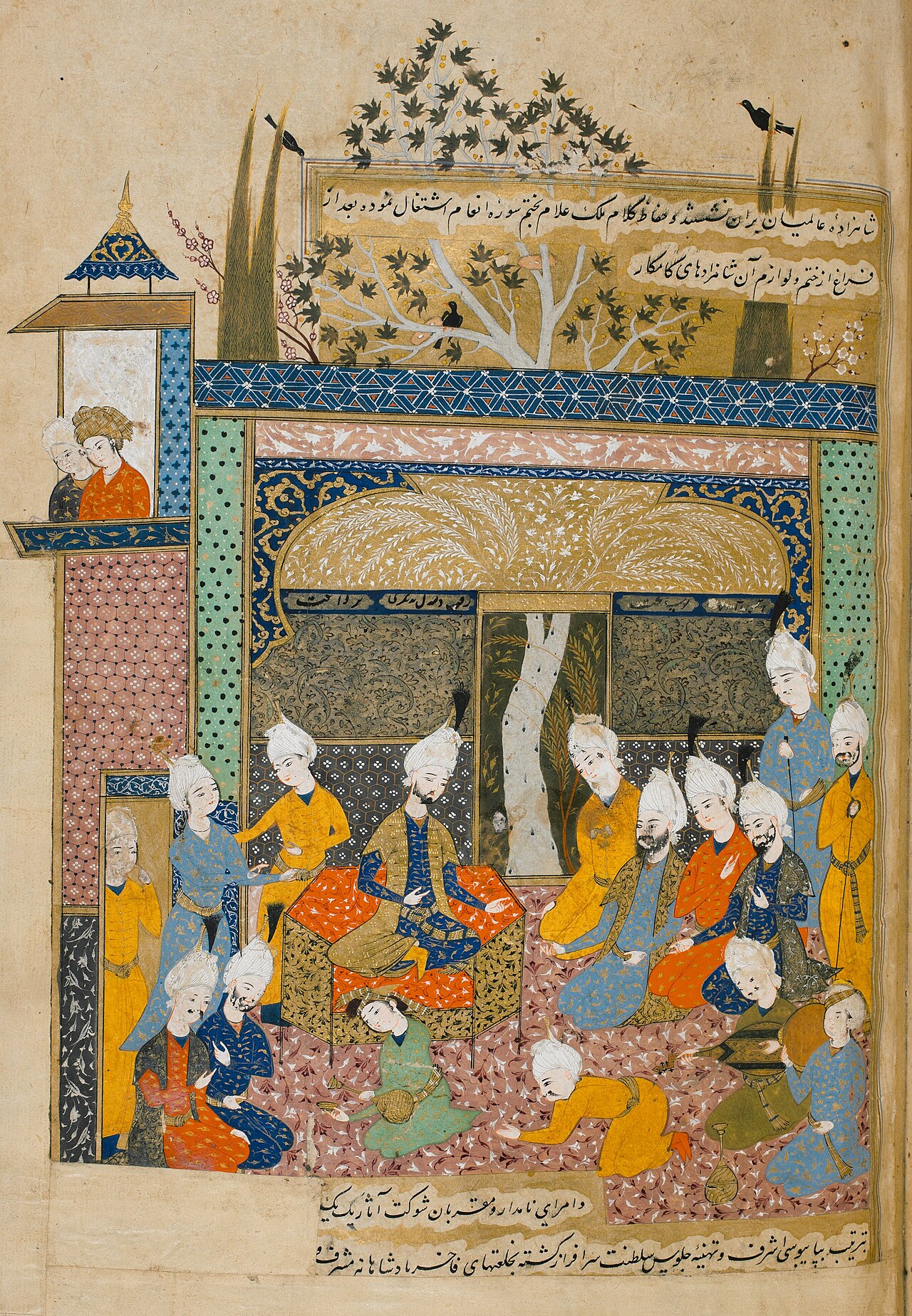
Tahmasp died in Qazvin in May 1576 without settling the succession. One son, Haydar Mirza, backed by the Ustajlu tribe and the Georgians at court, declared himself shah, but was killed inside the palace within a day. The decisive supporter of the other side was Tahmasp’s daughter Pari Khan Khanum, an able and politically experienced princess who had served as her father’s confidante. She and the Qizilbash factions opposed to Haydar sent for Ismail. He rode from Qahqaheh to Qazvin and was enthroned in the Chehel Sotoun pavilion in late August 1576.
Ismail II’s fifteen months
Years of prison had made the new shah suspicious. He soon pushed Pari Khan Khanum aside, placing her under house arrest and seizing her property. Then he began to kill his relatives. His brother Soleyman Mirza and his cousin Ebrahim Mirza, a poet and patron of painting, were among the princes put to death, with several other brothers and cousins. Only the half-blind Mohammad Khodabanda and his small sons, in distant Shiraz and Herat, survived, and Ismail is said to have ordered their deaths too shortly before he died.

A turn away from Shi’ism
Ismail II also tried to reverse the religious policy of his father and grandfather. He ended the public cursing of the first three caliphs, removed Shi’a slogans from his coins, and harassed leading Shi’a clerics. The German historian Walther Hinz read this as a sign of Sunni sympathies. Others, including Colin Mitchell, argue that he was trying to reduce the power of the clerical establishment and ease relations with the Ottomans rather than change his faith. Either way, the policy alarmed both the clerics and the Qizilbash.
On 24 November 1577 Ismail was found dead after a night out in Qazvin, reportedly from poisoned opium. Many historians suspect that Pari Khan Khanum and Qizilbash chiefs arranged it, but there is no proof. He was buried at the shrine of Imamzadeh Hosayn in Qazvin.
Mohammad Khodabanda and Khayr al-Nisa Begum
The only adult prince left was Mohammad Khodabanda, Tahmasp’s eldest son, whose eye disease left him almost blind. He was gentle, pious and unsuited to rule. Pari Khan Khanum expected to govern through him. She misjudged his wife. Khayr al-Nisa Begum, a daughter of the Mar’ashi sayyid rulers of Mazandaran, came to Qazvin with her husband in February 1578, and on the day they arrived Pari Khan Khanum was strangled on her orders.
For the next eighteen months Khayr al-Nisa, given the title Mahd-e Olya, “the sublime cradle”, was the real ruler of Iran. She attended councils, made appointments and pushed the claims of her elder son Hamza Mirza. She was intelligent and decisive, but the Qizilbash chiefs resented a woman, and a Persian outsider, giving them orders. In July 1579 a group of them broke into the harem and strangled her.
Losing provinces on two fronts
The Ottoman sultan Murad III saw his chance. In 1578 his armies under Lala Mustafa Pasha invaded the Caucasus, beginning a war that lasted until 1590. Shirvan and Georgia fell, and in 1585 the Ottomans took Tabriz, which they held for twenty years. Hamza Mirza, still a teenager, led the Safavid resistance with real courage and won several fights. In December 1586 he was murdered in his camp in mysterious circumstances. In the east, the Uzbeks under Abdullah Khan raided deep into Khorasan.
The Qizilbash, meanwhile, fought each other. In Khorasan, the Shamlu chief Ali Qoli Khan, guardian of Khodabanda’s younger son Abbas, proclaimed the boy shah in 1581. Khodabanda’s army marched east but could not crush the rebellion.
The way to Abbas
In 1587 Morshed Qoli Khan Ustajlu, who had taken control of the young Abbas, rode with him to Qazvin. Khodabanda offered no resistance and handed over the throne in October 1587. He lived quietly for several more years and died in about 1595–1596. His sixteen-year-old son became Shah Abbas I, and within a few years he had executed Morshed Qoli Khan and set about breaking the power of the tribal chiefs who had made these years so dangerous.
Why these reigns matter
The years 1576–1587 show how fragile the Safavid system was. Power depended on the loyalty of the Qizilbash tribes, and when the shah was weak they turned on each other and on the royal family. The period also shows how much royal women could achieve: Pari Khan Khanum and Khayr al-Nisa Begum were, for a time, the most powerful people in Iran. Both paid with their lives. Abbas, who grew up in the middle of this chaos, drew his own conclusions, which shaped his military reforms.
Persian words from this page
| خدابنده | Khodâbande | “servant of God” |
| پریخان خانم | Parikhân Khânom | Pari Khan Khanum |
| خیرالنسا بیگم | Kheyr-on-Nesâ Beygom | Khayr al-Nisa Begum |
| مهد علیا | Mahd-e Olyâ | “the sublime cradle”, title of a queen mother |
| زندان | zendân | prison |
| مازندران | Mâzandarân | Mazandaran |
Sources and further reading
- Eskandar Beg Monshi, Tarikh-e Alam-ara-ye Abbasi, trans. Roger Savory as History of Shah ‘Abbas the Great (Westview, 1978)
- Qazi Ahmad Qomi, Kholasat al-Tavarikh (late sixteenth-century chronicle)
- Shohreh Gholsorkhi, “Pari Khan Khanum: A Masterful Safavid Princess”, Iranian Studies 28 (1995)
- Colin P. Mitchell, The Practice of Politics in Safavid Iran: Power, Religion and Rhetoric (I.B. Tauris, 2009)
- Roger Savory, Iran under the Safavids (Cambridge University Press, 1980)
Want to learn Persian? Get the free Starter Pack
Get the 14-page printable Starter Pack (all 32 letters, a 7-day reading plan, 100 core words and 20 survival phrases) and a short 5-email course. Free.
More in The Safavid Empire (1501–1736)
- Shah Ismail I
- The Qizilbash
- Twelver Shi’ism Becomes Iran’s State Religion
- The Battle of Marv and the Uzbeks
- The Battle of Chaldiran (1514)
- Shah Tahmasp I
- The Ottoman–Safavid War and the Peace of Amasya
- Humayun’s Exile in Persia
- Qazvin: The Second Safavid Capital
- Ismail II and Mohammad Khodabanda
- Shah Abbas the Great
- Shah Abbas’s Military Reforms and the Ghulams
- The Sherley Brothers in Persia
- Isfahan: “Half the World”
- The Building of Naqsh-e Jahan Square
- Shah Abbas Retakes the West: The Ottoman Wars of 1603–1618
- The Capture of Hormuz from the Portuguese (1622)
- New Julfa and the Armenian Merchants
- The Safavid Silk Trade and Europe
- Sheikh Baha’i
- Reza Abbasi
- Shah Safi and the Treaty of Zuhab
- Shah Abbas II
- The Fight for Kandahar
- Chehel Sotoun Palace and Its War Paintings
- Shah Suleiman
- European Travellers in Safavid Persia
- Shah Soltan Hoseyn
- Safavid Art: Carpets, Miniatures and Tiles
- Mulla Sadra and the School of Isfahan
- The Afghan Revolt and the Battle of Gulnabad
- The Siege and Fall of Isfahan (1722)
- Peter the Great’s Persian Campaign (1722–1723)
- Tahmasp II and Hotaki Rule (1722–1732)
- Women of the Safavid Court
- The Safavid Legacy