Reza Abbasi (c. 1565–1635) was the leading painter of Shah Abbas I’s Isfahan and the artist who did most to turn Persian painting from book illustration to the single-page drawing and portrait. His fluid, calligraphic line and his studies of elegant youths, lovers, dervishes and labourers set the style of Persian painting for the rest of the seventeenth century.
| Name | Aqa Reza, later Reza-ye Abbasi رضا عباسی |
|---|---|
| Born | c. 1565, son of the court painter Ali Asghar |
| Died | 1635, Isfahan |
| Patron | Shah Abbas I and his court |
| Known for | Single-figure paintings and drawings for albums (moraqqa’) |
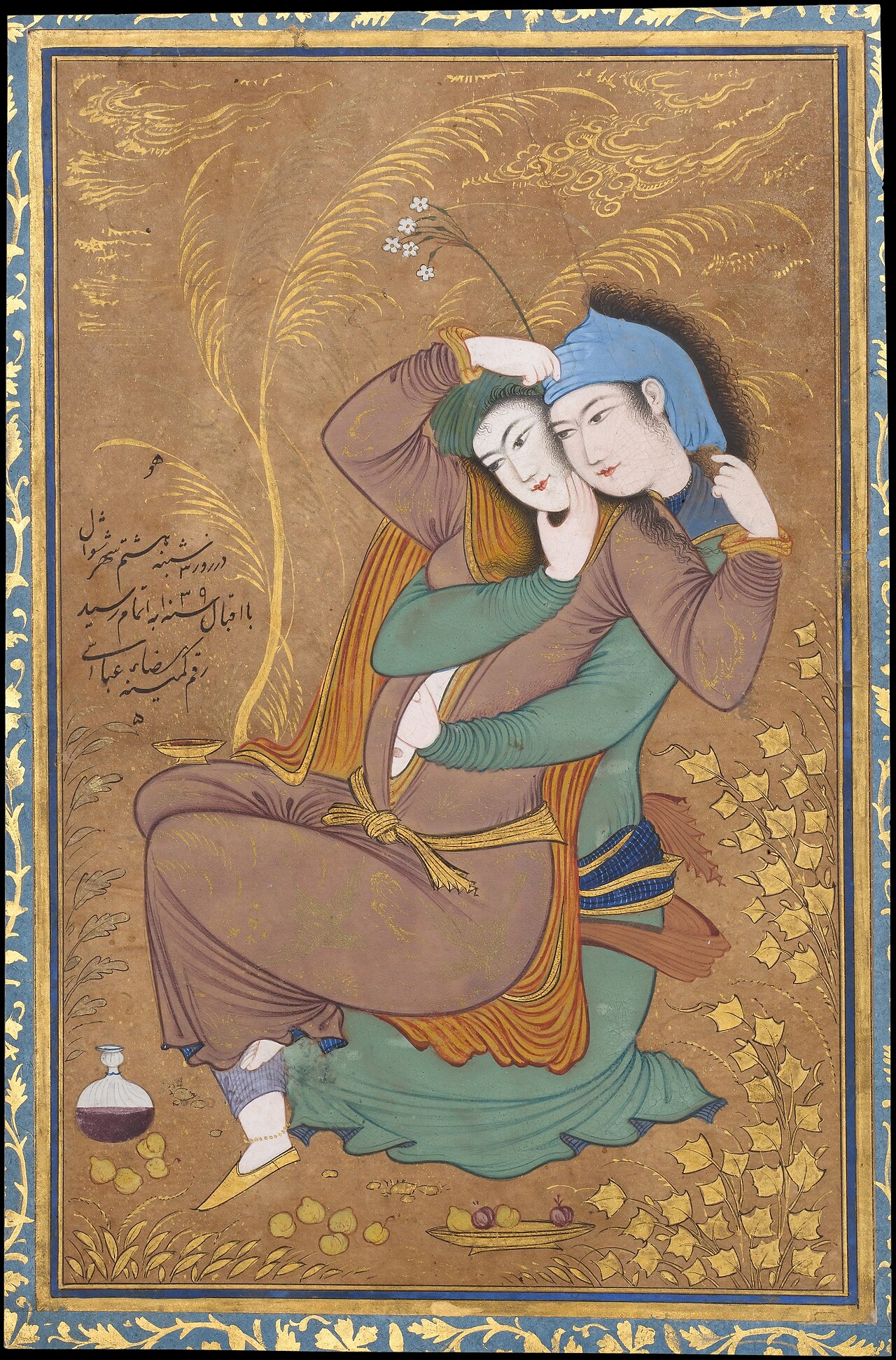
| Famous work | Two Lovers (1630), Metropolitan Museum of Art, New York |
A painter’s son at the royal library
Reza was the son of Ali Asghar, a painter who worked for the Safavid court in Qazvin in the 1570s. He trained in the royal workshop, the ketâbkhâneh or library, where painters, calligraphers, gilders and binders produced manuscripts for the shah. By the early 1590s, as Aqa Reza, he was already admired. The historian Qazi Ahmad, writing about painters around 1600, praised his skill in portraiture and said that masters of his day acknowledged him.
Abbas I was then gathering artists around him, and in the early 1600s Reza received the honorific “Abbasi”, “of Abbas”, which he used in his signatures for the rest of his life. When the court moved to Isfahan (see Isfahan: “Half the World”), he moved with it.
The years away from court
For several years in the first decade of the seventeenth century Reza seems to have left regular court service. The court chronicler Eskandar Beg Monshi wrote that he had fallen into the company of wrestlers and other low companions, neglected his art and become ill-tempered, though he still received the shah’s favour. Works from these years include drawings of ordinary people, dervishes and workers rather than courtiers. Around 1610 he returned to royal service, and he stayed in it until his death.
Sheila Canby, the author of the standard study of his work, titled her book The Rebellious Reformer. It is not clear how much of the “rebellion” was real and how much reflects a court writer’s disapproval, but the story fits his art, which looks beyond the palace more than earlier Persian painting did.

From the book to the single page
Earlier Safavid painting, at the courts of Tabriz and Qazvin, was mostly made to illustrate books such as the Shahnameh. By Reza’s time, wealthy buyers in Isfahan, not only the shah, were collecting single paintings and drawings and having them bound into albums, the moraqqa’, alongside samples of calligraphy. This shift is traced in Safavid art: carpets, miniatures and tiles.
Reza was the master of this form. His typical work shows one or two figures, often a languid young man or woman in fashionable dress, with a turban, sash, wine cup, book or flower, set against a plain or lightly tinted ground. The outline is drawn with a pen or fine brush in quick, swelling and thinning strokes, like calligraphy. Colour is often limited to a few areas of gold, blue or red.
Subjects
- Lovers and youths. The Two Lovers of 1630, a young man and woman entwined, is his most reproduced work.
- Dervishes, shepherds and old men. Studies of age and poverty, often drawn in ink with little or no colour.
- Foreigners. Portraits of Europeans, Georgians and Indians who came to Isfahan, including a European with a dog, dated 1634.
- Book painting. Late in life he also illustrated manuscripts of Persian poetry.
Many of his works are signed and dated, which is unusual for Persian painting before him and has allowed art historians to trace his development year by year.
Students and influence
Reza had many followers. His son Shafi Abbasi became a painter of birds and flowers, and his pupil Mo’in Mosavver painted in his manner into the 1690s. In 1673 Mo’in finished a well-known portrait of his master at work, inscribed with a note that he had begun it in the year of Reza’s death. Through these painters, and the many imitators who signed “Reza”, his style dominated Isfahan painting until the end of the dynasty. Wall paintings of the same kind of elegant figures survive in palaces such as Chehel Sotoun.
Two Rezas: the painter and the calligrapher
Reza Abbasi should not be confused with his contemporary Alireza Abbasi, the great calligrapher who designed the inscriptions of the Shah Mosque and the Sheikh Lotfollah Mosque on Naqsh-e Jahan Square. Some early scholars thought the two were one person. They are now known to have been different men who both bore the title “Abbasi”. The Reza Abbasi Museum in Tehran, opened in 1977 and named after the painter, holds Iranian art from many periods.
Persian words from this page
| رضا عباسی | Rezâ Abbâsi | Reza Abbasi |
| نگارگری | negârgari | Persian miniature painting |
| مرقع | moraqqa’ | album |
| کتابخانه | ketâbkhâneh | library; royal workshop |
| قلم | ghalam | pen, brush |
| خوشنویسی | khoshnevisi | calligraphy |
For the longer story of the art form, see a history of Persian painting.
Sources and further reading
- Sheila R. Canby, The Rebellious Reformer: The Drawings and Paintings of Riza-yi Abbasi of Isfahan (London, 1996).
- Encyclopaedia Iranica, “Reżā ʿAbbāsī” (Sheila R. Canby).
- Qazi Ahmad, Calligraphers and Painters (Golestan-e honar), trans. V. Minorsky (Washington, 1959).
- Eskandar Beg Monshi, History of Shah Abbas the Great, trans. Roger Savory (Boulder, 1978).
- Metropolitan Museum of Art, Two Lovers, Reza Abbasi, 1630, catalogue entry.
Want to learn Persian? Get the free Starter Pack
Get the 14-page printable Starter Pack (all 32 letters, a 7-day reading plan, 100 core words and 20 survival phrases) and a short 5-email course. Free.
More in The Safavid Empire (1501–1736)
- Shah Ismail I
- The Qizilbash
- Twelver Shi’ism Becomes Iran’s State Religion
- The Battle of Marv and the Uzbeks
- The Battle of Chaldiran (1514)
- Shah Tahmasp I
- The Ottoman–Safavid War and the Peace of Amasya
- Humayun’s Exile in Persia
- Qazvin: The Second Safavid Capital
- Ismail II and Mohammad Khodabanda
- Shah Abbas the Great
- Shah Abbas’s Military Reforms and the Ghulams
- The Sherley Brothers in Persia
- Isfahan: “Half the World”
- The Building of Naqsh-e Jahan Square
- Shah Abbas Retakes the West: The Ottoman Wars of 1603–1618
- The Capture of Hormuz from the Portuguese (1622)
- New Julfa and the Armenian Merchants
- The Safavid Silk Trade and Europe
- Sheikh Baha’i
- Reza Abbasi
- Shah Safi and the Treaty of Zuhab
- Shah Abbas II
- The Fight for Kandahar
- Chehel Sotoun Palace and Its War Paintings
- Shah Suleiman
- European Travellers in Safavid Persia
- Shah Soltan Hoseyn
- Safavid Art: Carpets, Miniatures and Tiles
- Mulla Sadra and the School of Isfahan
- The Afghan Revolt and the Battle of Gulnabad
- The Siege and Fall of Isfahan (1722)
- Peter the Great’s Persian Campaign (1722–1723)
- Tahmasp II and Hotaki Rule (1722–1732)
- Women of the Safavid Court
- The Safavid Legacy