Peter the Great’s Persian campaign of 1722–1723 was Russia’s invasion of the Safavid Caspian provinces while Isfahan was under Afghan siege. Russian forces took Derbent in August 1722, occupied Rasht and Gilan, and captured Baku in 1723, and a treaty signed at St Petersburg that year handed the whole western and southern Caspian coast to Russia on paper.
| Date | July 1722 to 1723 (occupation until 1732–1735) |
|---|---|
| Theatre | Dagestan, Shirvan, Gilan, the Caspian coast |
| Russian commanders | Peter I in person (1722), General Mikhail Matyushkin, Colonel Shipov |
| Key events | Derbent submits 23 August 1722; Baku falls 26 June 1723 |
| Treaty | St Petersburg, 12 September 1723 (never ratified by Tahmasp II) |
| Outcome | Territories returned by the treaties of Rasht (1732) and Ganja (1735) |
Why Peter looked south
Peter had wanted a route to the silk of Gilan and the trade of India for years. His envoy Artemy Volynsky, who visited Isfahan in 1717, reported that the Safavid state was weak and could be pushed. The Caspian also mattered in a wider contest: if the Ottomans moved into the Caucasus first, Russia would be shut out.
The pretext came in August 1721, when Lezgin and other Sunni rebels from Dagestan sacked Shamakhi, the main town of Shirvan. Russian merchants trading there were killed and their goods plundered. Peter demanded satisfaction from the shah, knowing that the Safavid government, by then facing the Afghan advance, could not provide it. Shortly after making peace with Sweden in 1721, he prepared an expedition.

The campaign of 1722
Peter sailed from Astrakhan in July 1722 with an army made up of regular infantry and dragoons, Cossacks and Kalmyk and Tatar auxiliaries. Figures given for its size vary widely, from about 20,000 regulars to totals of more than 60,000 when all irregulars are counted. The fleet landed on the Dagestan coast, and the army moved south past Tarki, where the local ruler, the shamkhal, submitted.
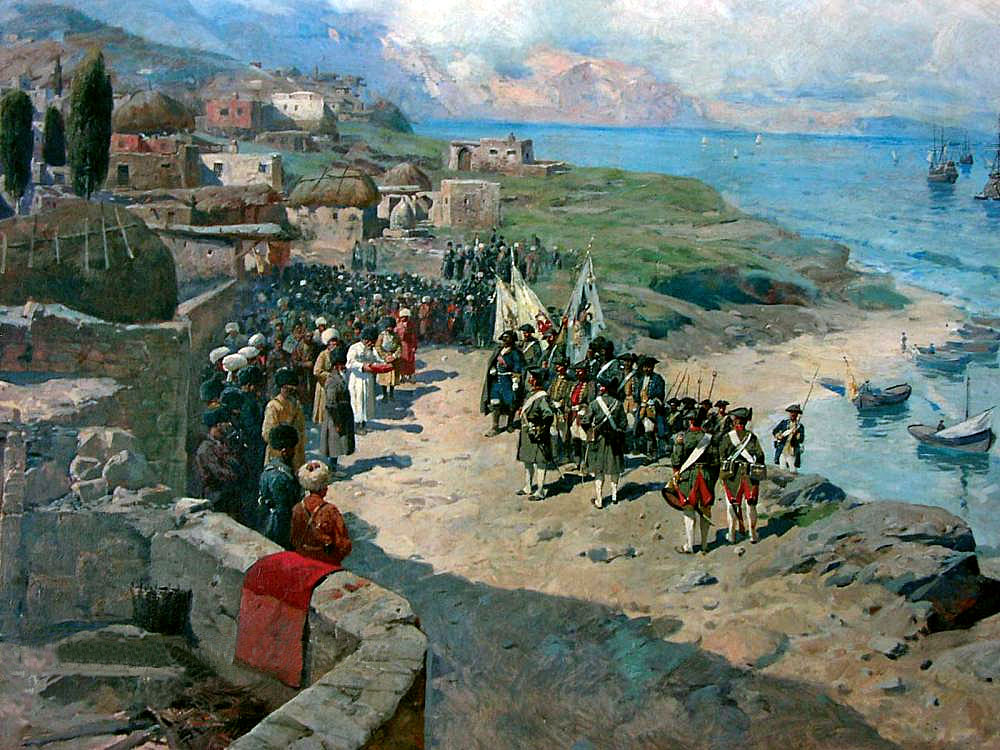
On 23 August 1722 the governor of Derbent, the ancient fortress city that controls the narrow passage between the Caucasus and the sea, came out and handed Peter the keys of the city. The tsar treated it as a triumph. But storms wrecked supply ships, horses died for lack of fodder, and the heat and disease weakened the troops. Peter left a garrison in Derbent, returned to Astrakhan in the autumn and was back in Moscow in December 1722. He never went south again.
Rasht and Baku
The war then shifted to the south-west Caspian. In November 1722 a small Russian force under Colonel Shipov landed at the port of Anzali and entered Rasht, the capital of Gilan. Local officials had asked for help against the Afghans and the rebels, and at first the Russians were treated as allies. When it became clear they meant to stay, the people of Gilan turned against them, and there was fighting around Rasht before the Russians secured the town in early 1723.
In the north, General Mikhail Matyushkin besieged Baku and took it on 26 June 1723. With Derbent, Baku and Rasht in Russian hands, Peter controlled most of the western and southern shore of the Caspian.
The Treaty of St Petersburg (1723)
Prince Tahmasp, who had escaped from besieged Isfahan and proclaimed himself shah, needed allies. His envoy, Esmail Beg, signed a treaty at St Petersburg on 12 September 1723. Russia promised to help Tahmasp drive out the Afghans. In return Iran would cede Derbent and Baku with their districts and the provinces of Gilan, Mazandaran and Astarabad. Tahmasp refused to ratify the agreement, which his envoy had gone far beyond his instructions to accept, and Russia never sent the promised help.
The Ottomans, who had begun their own invasion of western Iran, saw the Russian advance as a threat. War between the two empires was avoided by the Treaty of Constantinople in June 1724, in which Russia and the Ottomans divided the Iranian north-west between them: Russia kept the Caspian coast, and the Ottomans took most of Transcaucasia and western Iran. Iran was not a party. How these losses played out for Tahmasp is told in Tahmasp II and Hotaki rule.
An expensive occupation
Holding the coast proved costly. Gilan’s damp, malarial lowlands killed Russian soldiers in large numbers; historians estimate that disease caused far more deaths than fighting. Mazandaran and Astarabad were never actually occupied. After Peter’s death in 1725 his successors were less committed to the project.
When Nader, the general who restored Iranian power in the late 1720s, began to threaten both the Ottomans and Russia, the Russian government chose to withdraw. By the Treaty of Rasht (1732) it returned the south Caspian provinces, and by the Treaty of Ganja (1735) it gave back Baku and Derbent. The rise of Nader is covered in the next era, from the rise of Nader.
Why it matters
The campaign was short and its gains were temporary, but it marked the first time Russia had annexed Iranian territory, and it set a pattern. Russian interest in the Caspian and the Caucasus returned under Catherine the Great and led to the wars of the early nineteenth century that cost Iran its Caucasian provinces. The long view is traced in Iran and Russia through history.
- August 1721 Sack of Shamakhi; Russian merchants killed
- July 1722 Peter sails from Astrakhan
- 23 August 1722 Derbent submits
- November 1722 Russian troops land at Anzali and enter Rasht
- 26 June 1723 Baku taken by Matyushkin
- 12 September 1723 Treaty of St Petersburg
- June 1724 Russo-Ottoman Treaty of Constantinople
- 1732 and 1735 Treaties of Rasht and Ganja return the land
Persian words from this page
| پطر کبیر | Petr-e Kabir | Peter the Great |
| دربند | Darband | Derbent |
| باکو | Bâku | Baku |
| گیلان | Gilân | Gilan |
| رشت | Rasht | Rasht |
| دریای خزر | Daryâ-ye Khazar | the Caspian Sea |
Sources and further reading
- Laurence Lockhart, The Fall of the Safavi Dynasty and the Afghan Occupation of Persia (Cambridge, 1958).
- Muriel Atkin, Russia and Iran, 1780–1828 (Minneapolis, 1980), for the background and later wars.
- Rudi Matthee, Persia in Crisis: Safavid Decline and the Fall of Isfahan (London, 2012).
- Encyclopaedia Iranica, “Russia i. Russo-Iranian relations up to the Bolshevik Revolution”.
- Michael Axworthy, The Sword of Persia (London, 2006).
Want to learn Persian? Get the free Starter Pack
Get the 14-page printable Starter Pack (all 32 letters, a 7-day reading plan, 100 core words and 20 survival phrases) and a short 5-email course. Free.
More in The Safavid Empire (1501–1736)
- Shah Ismail I
- The Qizilbash
- Twelver Shi’ism Becomes Iran’s State Religion
- The Battle of Marv and the Uzbeks
- The Battle of Chaldiran (1514)
- Shah Tahmasp I
- The Ottoman–Safavid War and the Peace of Amasya
- Humayun’s Exile in Persia
- Qazvin: The Second Safavid Capital
- Ismail II and Mohammad Khodabanda
- Shah Abbas the Great
- Shah Abbas’s Military Reforms and the Ghulams
- The Sherley Brothers in Persia
- Isfahan: “Half the World”
- The Building of Naqsh-e Jahan Square
- Shah Abbas Retakes the West: The Ottoman Wars of 1603–1618
- The Capture of Hormuz from the Portuguese (1622)
- New Julfa and the Armenian Merchants
- The Safavid Silk Trade and Europe
- Sheikh Baha’i
- Reza Abbasi
- Shah Safi and the Treaty of Zuhab
- Shah Abbas II
- The Fight for Kandahar
- Chehel Sotoun Palace and Its War Paintings
- Shah Suleiman
- European Travellers in Safavid Persia
- Shah Soltan Hoseyn
- Safavid Art: Carpets, Miniatures and Tiles
- Mulla Sadra and the School of Isfahan
- The Afghan Revolt and the Battle of Gulnabad
- The Siege and Fall of Isfahan (1722)
- Peter the Great’s Persian Campaign (1722–1723)
- Tahmasp II and Hotaki Rule (1722–1732)
- Women of the Safavid Court
- The Safavid Legacy