Shah Abbas II (1632–1666) came to the throne at the age of nine in 1642 and ruled Safavid Iran for twenty-four years. He took back Kandahar from the Mughals in 1649, held the city against three Mughal sieges, and in Isfahan completed the Chehel Sotoun palace and the Khaju bridge. Historians usually see his reign as the last strong one of the dynasty.
| Birth name | Soltan Mohammad Mirza, born 1632 (30 August according to a Dutch report) |
|---|---|
| Reign | 15 May 1642 to 1666 |
| Father | Shah Safi |
| Grand viziers | Saru Taqi (to 1645), Khalifeh Soltan (1645–1654), Mohammad Beg (1654–1661), Mirza Mohammad Karaki (from 1661) |
| Main military event | Recapture of Kandahar, February 1649 |
| Buildings | Chehel Sotoun palace, Khaju bridge, porch of the Ali Qapu |
| Successor | Shah Suleiman |
A boy king and his minister
When Shah Safi died in Kashan in May 1642, his eldest son was crowned there four days later. Real power stayed with the grand vizier Saru Taqi, the official who had built up the crown’s finances under Safi, as told on the Shah Safi page. Saru Taqi had many enemies among the military nobility. In October 1645 a group led by Jani Khan Shamlu, commander of the royal guard, killed him in his house, apparently with the young shah’s approval.
Abbas, now thirteen, then struck back at the killers. Jani Khan and his allies were put to death, and Dutch observers reported thousands of deaths in the purge that followed. From then on the shah ruled in person. The new grand vizier, Khalifeh Soltan, was a scholar from a family of sayyeds who had served Abbas I and married one of his daughters.
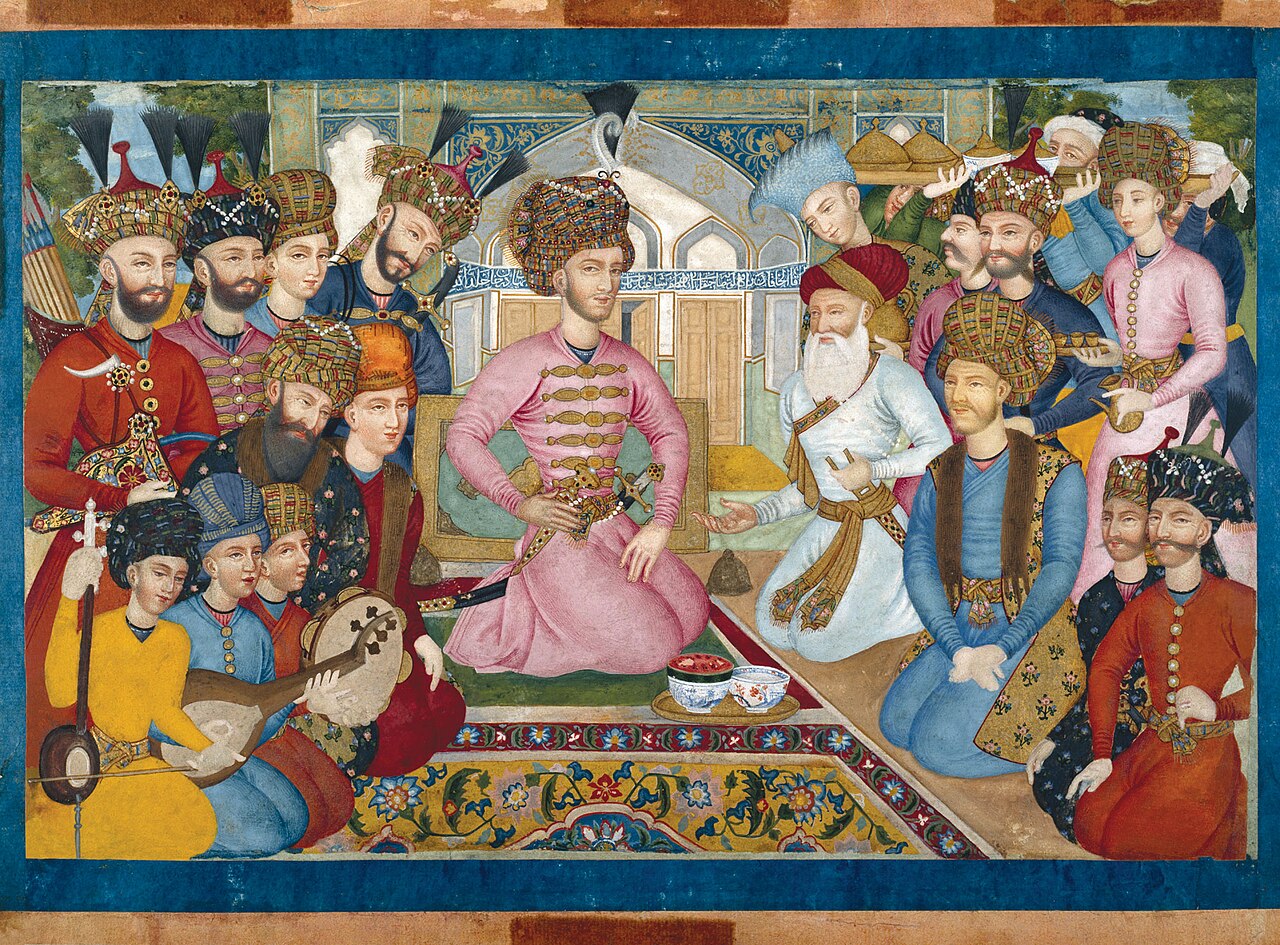

Kandahar won back
Kandahar, the fortress city on the road between Iran and India, had been handed to the Mughals by its governor in 1638. In the winter of 1648 Abbas, aged sixteen, led an army east himself. After about two months of siege the Mughal garrison surrendered in February 1649.
The Mughal emperor Shah Jahan answered with three great expeditions: two under his son Aurangzeb, in 1649 and 1652, and one under his eldest son Dara Shikoh in 1653. Each brought heavy artillery and large armies; each failed against the walls and the Safavid garrison, and had to retreat before winter. Kandahar stayed in Iranian hands until 1709. The whole Safavid–Mughal struggle for the city is told in the fight for Kandahar.
Governing the realm
In the west, the peace of Zuhab with the Ottomans held, and Abbas avoided war on that front. In Georgia he used one Georgian king against another: in 1648 he had Rostom, the Muslim ruler of Kartli, drive out the rebellious Teimuraz I of Kakheti, and after a revolt in 1659–1660 he recognised Vakhtang V of Kartli while executing its leaders.
At home the shah tried to keep the state’s finances in order. The vizier Mohammad Beg, appointed in 1654, cut costs, searched for new mines and tried to raise revenue, but was dismissed in 1661 accused of mismanagement and of taking bribes from the Dutch East India Company. The Company was a constant source of pressure: in 1645 its ships blockaded Bandar Abbas to win better terms in the silk trade.
Religious minorities
European visitors remembered Abbas II as friendly to Christians. He invited European residents to his drinking parties, employed Dutch painters and allowed new missions. The Jews of Iran had a very different experience. According to the Judaeo-Persian chronicle of Babai ibn Lutf, studied by the historian Vera Moreen, in the late 1650s and early 1660s, under the vizier Mohammad Beg, Jews in Isfahan and other towns were forced to convert to Islam. Estimates of the numbers involved differ widely between sources. Many returned openly to Judaism after the campaign ended.
Building in Isfahan
Abbas II added the last great monuments of the Safavid capital. On the garden ground behind the Ali Qapu he completed the Chehel Sotoun, the “forty columns” palace, a reception hall with a deep wooden porch reflected in a long pool. An inscription dates it to 1647. Its great wall paintings show royal banquets and battles, including the Safavid defeat at Chaldiran and the reception of the Mughal emperor Humayun. They are discussed on Chehel Sotoun palace and its war paintings, and our article on the Chehel Sotoun palace covers a visit.
Downstream from the Allahverdi Khan bridge, the shah built the Khaju bridge around 1650. It is both a bridge and a weir, with sluices that held back the Zayandeh Rud, and has a pavilion in the middle where the shah could sit. At the Ali Qapu he added the high columned porch overlooking the square, told on the building of Naqsh-e Jahan Square. The bridges today are described on Si-o-se Pol and Khaju Bridge.
The shah as Europeans saw him
The French jeweller Jean-Baptiste Tavernier, who did business at the court, and later Jean Chardin, who arrived in Iran just as the reign ended, both described Abbas II as intelligent, active and keen to give justice in person. Chardin’s admiring account helped create the image of Abbas II as the last of the great Safavids. The same writers also record his heavy drinking and sudden violence. Their accounts are introduced in European travellers in Safavid Persia.
Death and reputation
Abbas II died in 1666, aged about 34, after a long illness that contemporaries linked to his drinking; he was buried at Qom. Like his father, he had kept his sons in the harem, and his successor, Shah Suleiman, came to the throne with no experience of government.
Modern historians, including Rudi Matthee and Andrew Newman, still rate Abbas II highly as a ruler who kept the state solvent, the frontiers secure and the court under control. They also note that the problems which would grow under his successors, from falling silk income to the loss of military strength, were already visible during his reign.
Persian words from this page
| شاه عباس دوم | Shâh Abbâs-e Dovvom | Shah Abbas II |
| چهلستون | Chehel Sotun | forty columns |
| پل خواجو | Pol-e Khâju | Khaju bridge |
| قندهار | Qandahâr | Kandahar |
| وزیر اعظم | vazir-e a’zam | grand vizier |
| عدالت | edâlat | justice |
Sources and further reading
- Rudi Matthee, Persia in Crisis: Safavid Decline and the Fall of Isfahan, I.B. Tauris, 2012.
- Andrew J. Newman, Safavid Iran: Rebirth of a Persian Empire, I.B. Tauris, 2006.
- Vera B. Moreen, Iranian Jewry’s Hour of Peril and Heroism: A Study of Babai ibn Luṭf’s Chronicle (1617–1662), 1987.
- Jean-Baptiste Tavernier, Les Six Voyages, 1676.
- Sussan Babaie, Isfahan and Its Palaces, Edinburgh University Press, 2008.
Want to learn Persian? Get the free Starter Pack
Get the 14-page printable Starter Pack (all 32 letters, a 7-day reading plan, 100 core words and 20 survival phrases) and a short 5-email course. Free.
More in The Safavid Empire (1501–1736)
- Shah Ismail I
- The Qizilbash
- Twelver Shi’ism Becomes Iran’s State Religion
- The Battle of Marv and the Uzbeks
- The Battle of Chaldiran (1514)
- Shah Tahmasp I
- The Ottoman–Safavid War and the Peace of Amasya
- Humayun’s Exile in Persia
- Qazvin: The Second Safavid Capital
- Ismail II and Mohammad Khodabanda
- Shah Abbas the Great
- Shah Abbas’s Military Reforms and the Ghulams
- The Sherley Brothers in Persia
- Isfahan: “Half the World”
- The Building of Naqsh-e Jahan Square
- Shah Abbas Retakes the West: The Ottoman Wars of 1603–1618
- The Capture of Hormuz from the Portuguese (1622)
- New Julfa and the Armenian Merchants
- The Safavid Silk Trade and Europe
- Sheikh Baha’i
- Reza Abbasi
- Shah Safi and the Treaty of Zuhab
- Shah Abbas II
- The Fight for Kandahar
- Chehel Sotoun Palace and Its War Paintings
- Shah Suleiman
- European Travellers in Safavid Persia
- Shah Soltan Hoseyn
- Safavid Art: Carpets, Miniatures and Tiles
- Mulla Sadra and the School of Isfahan
- The Afghan Revolt and the Battle of Gulnabad
- The Siege and Fall of Isfahan (1722)
- Peter the Great’s Persian Campaign (1722–1723)
- Tahmasp II and Hotaki Rule (1722–1732)
- Women of the Safavid Court
- The Safavid Legacy