Shah Safi (born 1611, reigned 1629–1642) was the grandson and successor of Shah Abbas I. His reign is remembered for bloody purges of the royal family and the great nobles, for the loss of Baghdad and Kandahar, and above all for the Treaty of Zuhab of 17 May 1639, which ended more than a century of Ottoman–Safavid wars and fixed a frontier that still runs, in large part, along the modern Iran–Iraq and Iran–Turkey borders.
| Birth name | Sam Mirza, born 1611, son of Mohammad Baqer Mirza (Safi Mirza) |
|---|---|
| Reign | January 1629 to 12 May 1642 |
| Capital | Isfahan |
| Grand vizier | Mirza Mohammad Taqi, known as Saru Taqi (1634–1645) |
| Treaty | Zuhab (Qasr-e Shirin), 17 May 1639, with Sultan Murad IV |
| Died | 12 May 1642, Kashan; buried at Qom |
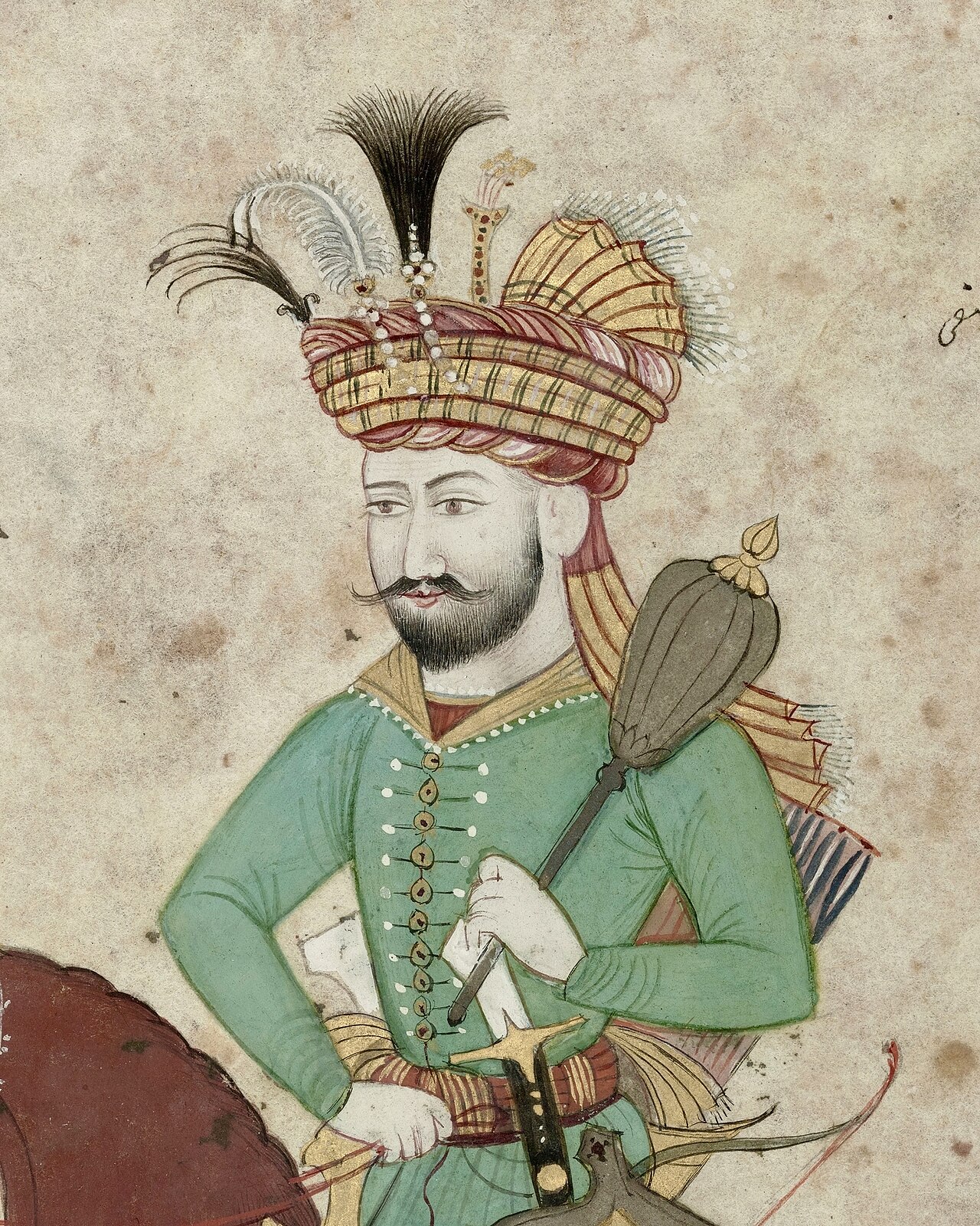

A grandson raised in the harem
Abbas I had killed or blinded his own sons out of fear of rebellion. Safi’s father, Mohammad Baqer Mirza, the eldest, was murdered on the shah’s orders in 1615. When Abbas lay dying in January 1629 he named this grandson, then about seventeen, as his heir. The young prince took his father’s title and was crowned as Shah Safi.
Safi was the first Safavid ruler to grow up entirely inside the palace, with no experience of governing a province or leading an army. This change in how princes were raised, begun by Abbas I’s fear of his sons, is often seen by historians as one root of the weaker kingship of the later dynasty. It is discussed further on the Shah Abbas the Great page.
Purges of the early 1630s
Safi’s first years were marked by killings. Princes of the blood who might become rivals were killed or blinded, among them sons of Abbas’s daughters. In 1632–1633 the shah turned on the great office-holders of his grandfather’s reign. The most famous victim was Imam Qoli Khan, governor of Fars and conqueror of Hormuz, who was executed with his sons. The court chroniclers explain these deaths as answers to plots; modern historians tend to see a weak young ruler and court factions removing anyone with an independent power base.
The purges had a lasting administrative result. With Imam Qoli Khan dead, his province of Fars was turned from a state province, governed by a khan who kept most of its revenue, into crown land (khâsse), run by royal agents for the treasury. The policy was pushed hard by Saru Taqi, a eunuch official who became grand vizier in 1634 and dominated the government until his murder in 1645. It filled the treasury in the short run, but many historians argue that it left the frontier provinces with fewer local troops.
The last Ottoman war
The war with the Ottomans that Abbas had begun by taking Baghdad in 1624, told in Shah Abbas retakes the west, was still going on. Ottoman armies failed to retake Baghdad in 1625–1626 and 1630. Then a strong sultan, Murad IV, took personal command. In 1635 he captured Yerevan and sacked Tabriz; the Safavids recovered Yerevan the following year. In 1638 Murad marched on Baghdad himself, and after a siege of about six weeks the city fell in December 1638. Its Safavid garrison was massacred after the surrender.
The Treaty of Zuhab, 1639
Both sides were now exhausted, and envoys met near Qasr-e Shirin, in the Zuhab district on the edge of the Zagros. The peace signed there on 17 May 1639 was simple in outline:
- the Ottomans kept Baghdad and all of Iraq, including the Shi’i shrine cities of Najaf and Karbala;
- Iran kept Yerevan, eastern Armenia, eastern Georgia, Shirvan and Dagestan;
- the frontier in the central Zagros was described by naming tribes, villages and forts on each side, rather than by a surveyed line.
The treaty held, with only short interruptions, until the collapse of the Safavid state in the 1720s. Later Ottoman–Iranian agreements, from the treaties of Nader Shah’s time to those of Erzurum in 1823 and 1847, took Zuhab as their starting point, and its vagueness about the border generated disputes into the twentieth century. The present Iran–Iraq border in the Zagros broadly follows the line it set. For Nader Shah’s later wars on this frontier see Nader Shah’s wars with the Ottomans.
- 1611 Sam Mirza born
- 1615 His father is killed on Abbas I’s orders
- Jan 1629 Death of Abbas I; Safi crowned
- 1629 Revolt of Gharib Shah in Gilan
- 1632–1633 Purge of nobles; Imam Qoli Khan executed
- 1634 Saru Taqi becomes grand vizier
- 1635 Murad IV takes Yerevan and sacks Tabriz
- 1638 Kandahar handed to the Mughals; Baghdad falls to the Ottomans
- 17 May 1639 Treaty of Zuhab
- 12 May 1642 Safi dies at Kashan
Kandahar lost
In the east, the city of Kandahar, taken by Abbas I from the Mughals in 1622, was lost in 1638 without a battle. Its governor, Ali Mardan Khan, fearing he would share the fate of other nobles summoned to court, handed the fortress to the Mughal emperor Shah Jahan and entered his service, where he became a celebrated builder. The long contest for the city is followed on the fight for Kandahar.
Court and character
European visitors left mixed portraits. The Holstein embassy that came to Isfahan in 1637, whose secretary Adam Olearius wrote a detailed account, found an elaborate court and a young shah fond of hunting and of wine. Persian and European sources agree that Safi drank heavily, and his death in Kashan in May 1642, at about thirty, is generally put down to drink. He was buried at the shrine of Fatemeh Masumeh in Qom, which became the burial place of later Safavid kings.
How historians see the reign
For older historians such as Laurence Lockhart, Safi’s reign was the start of the long Safavid decline. Recent writers, including Andrew Newman and Rudi Matthee, give a more balanced picture. The purges were savage, but the administration Abbas had built kept working, the silk trade continued, and the peace of Zuhab spared Iran a costly war for eighty years. The next reign, that of his son Shah Abbas II, would show that the state could still recover Kandahar and govern firmly.
Persian words from this page
| شاه صفی | Shâh Safi | Shah Safi |
| ذهاب | Zahâb | Zuhab |
| قصر شیرین | Qasr-e Shirin | Qasr-e Shirin |
| مرز | marz | border |
| وزیر | vazir | minister, vizier |
| خاصه | khâsse | crown land |
| قندهار | Qandahâr | Kandahar |
Sources and further reading
- Rudi Matthee, Persia in Crisis: Safavid Decline and the Fall of Isfahan, I.B. Tauris, 2012.
- Andrew J. Newman, Safavid Iran: Rebirth of a Persian Empire, I.B. Tauris, 2006.
- Roger Savory, Iran under the Safavids, Cambridge University Press, 1980.
- Adam Olearius, The Voyages and Travels of the Ambassadors sent by Frederick, Duke of Holstein (English translation 1662).
- The Cambridge History of Iran, vol. 6: The Timurid and Safavid Periods, 1986.
Want to learn Persian? Get the free Starter Pack
Get the 14-page printable Starter Pack (all 32 letters, a 7-day reading plan, 100 core words and 20 survival phrases) and a short 5-email course. Free.
More in The Safavid Empire (1501–1736)
- Shah Ismail I
- The Qizilbash
- Twelver Shi’ism Becomes Iran’s State Religion
- The Battle of Marv and the Uzbeks
- The Battle of Chaldiran (1514)
- Shah Tahmasp I
- The Ottoman–Safavid War and the Peace of Amasya
- Humayun’s Exile in Persia
- Qazvin: The Second Safavid Capital
- Ismail II and Mohammad Khodabanda
- Shah Abbas the Great
- Shah Abbas’s Military Reforms and the Ghulams
- The Sherley Brothers in Persia
- Isfahan: “Half the World”
- The Building of Naqsh-e Jahan Square
- Shah Abbas Retakes the West: The Ottoman Wars of 1603–1618
- The Capture of Hormuz from the Portuguese (1622)
- New Julfa and the Armenian Merchants
- The Safavid Silk Trade and Europe
- Sheikh Baha’i
- Reza Abbasi
- Shah Safi and the Treaty of Zuhab
- Shah Abbas II
- The Fight for Kandahar
- Chehel Sotoun Palace and Its War Paintings
- Shah Suleiman
- European Travellers in Safavid Persia
- Shah Soltan Hoseyn
- Safavid Art: Carpets, Miniatures and Tiles
- Mulla Sadra and the School of Isfahan
- The Afghan Revolt and the Battle of Gulnabad
- The Siege and Fall of Isfahan (1722)
- Peter the Great’s Persian Campaign (1722–1723)
- Tahmasp II and Hotaki Rule (1722–1732)
- Women of the Safavid Court
- The Safavid Legacy