Shah Abbas I made Isfahan the capital of Safavid Iran in 1598 and rebuilt it as a planned royal city: a vast new square, a palace quarter, a tree-lined avenue running down to a new bridge over the Zayandeh Rud, and suburbs for resettled merchants. The result so impressed its inhabitants and visitors that the city earned the rhyming nickname اصفهان نصف جهان, Esfahan nesf-e jahan, “Isfahan is half the world”.
| Capital | 1598 to 1722 (the court moved from Qazvin in 1596–1598) |
|---|---|
| Builder | Shah Abbas I and his successors |
| Main elements | Naqsh-e Jahan Square; the Dowlatkhaneh palace quarter; Chahar Bagh avenue; Allahverdi Khan bridge (Si-o-se Pol); New Julfa |
| River | Zayandeh Rud |
| Population | Unknown; seventeenth-century European estimates range from a few hundred thousand to around a million, none based on a count |
| UNESCO | Meidan Emam (Naqsh-e Jahan Square) inscribed 1979 |
The city Abbas found
Isfahan was already old and famous. It had been a Seljuk capital in the eleventh and twelfth centuries, and its heart was the great Jameh Mosque and the old square beside it, the Meydan-e Kohneh, surrounded by the bazaar. The city had suffered under Timur, who massacred much of its population in 1387, but it recovered as a provincial centre on the trade routes of central Iran.
For Abbas it had clear advantages over Qazvin. It lay in the middle of the plateau, far from the Ottoman frontier, on the roads linking the Persian Gulf, Khorasan and the north. The Zayandeh Rud, “the life-giving river”, watered a broad, fertile plain. Abbas spent more and more time there from the early 1590s, and by 1598 the court had moved.
A new centre, not a rebuilt one
Abbas did not tear down the old city. According to Robert McChesney’s study of the contemporary sources, he first tried to renovate the old square near the Jameh Mosque, but met resistance from the local notables who owned property there. He turned instead to an open area to the south-west, the Naqsh-e Jahan garden, and built a new centre there. The old city, with its mosque and markets, stayed as it was, and a long bazaar linked old and new.
The new centre was the great square of Naqsh-e Jahan, “image of the world”, about 510 metres long and 160 metres wide. It was gradually surrounded by a two-storey arcade of shops, and by four landmark buildings: the Shah Mosque, the Sheikh Lotfollah Mosque, the Ali Qapu palace gateway and the monumental entrance to the royal bazaar. How the square was built is told on the building of Naqsh-e Jahan Square; for a visit, see Naqsh-e Jahan Square and our article on Naghsh-e Jahan.

The plan of the royal city
The palace quarter
Behind the Ali Qapu, on the west side of the square, lay the Dowlatkhaneh, the royal precinct. It was not one large palace but a walled park of gardens, pavilions, offices, kitchens and the harem, built up over the century. Later shahs added the buildings that survive today, the Chehel Sotoun of Abbas II (1647) and the Hasht Behesht (1669). The palace quarter opened both onto the public square and onto the avenue behind it, so the shah could appear to his subjects or withdraw into his gardens.
Chahar Bagh: the royal avenue
From the Dowlat Gate, beside the palace quarter, a broad promenade called the Chahar Bagh ran south for several kilometres to the river and on to a royal garden at the foot of Mount Sofeh. Work began in about 1597. A stone-lined water channel ran down the middle, feeding pools at intervals, and the avenue was planted with rows of trees. The plots along each side were given to emirs and notables, who had to build gardens with gateways and pavilions in a matching royal style, according to the court chronicler Eskandar Beg Monshi. The gardens were finished by about 1616. The avenue was an enlarged version of the khiyaban Tahmasp had laid out in Qazvin, and it was meant as a public promenade as much as a royal road.
The bridge
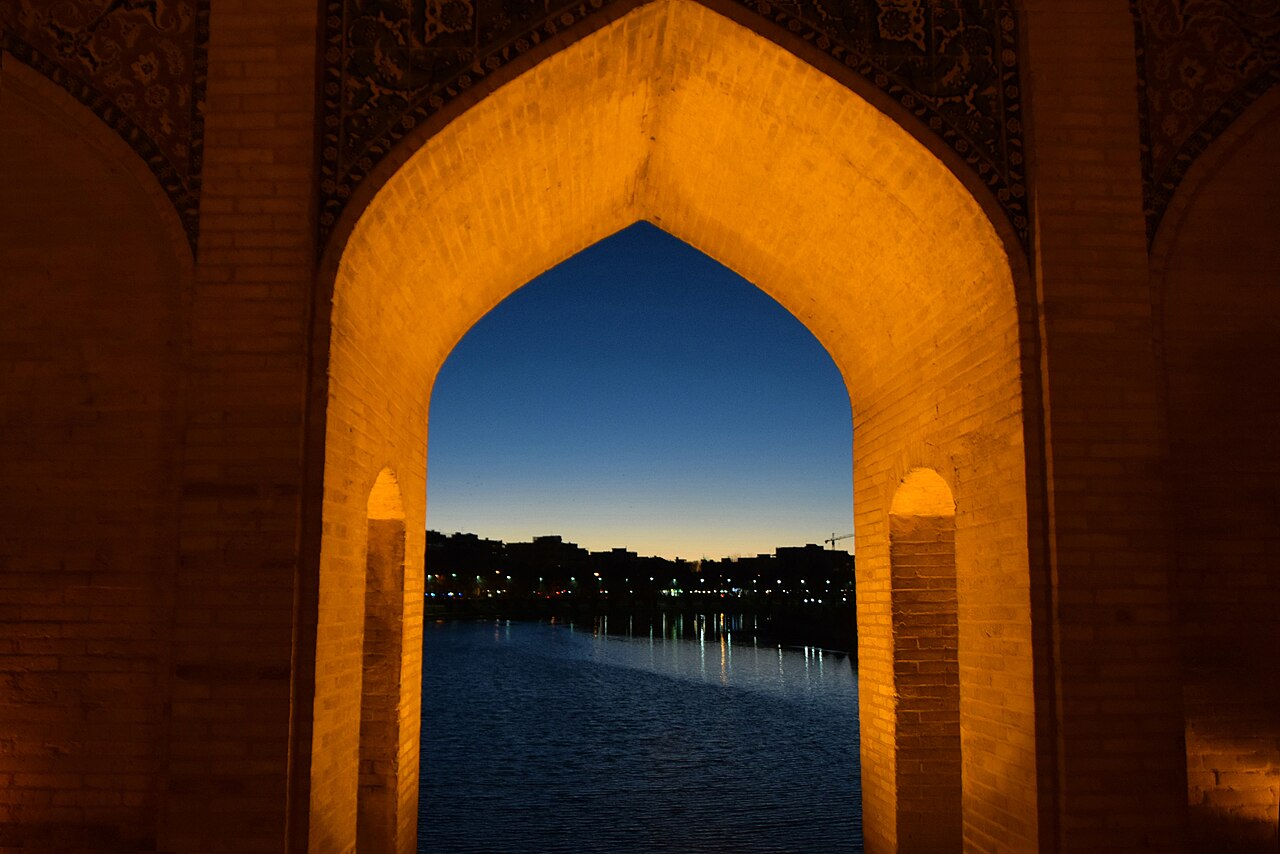
Where Chahar Bagh met the Zayandeh Rud, Abbas’s commander Allahverdi Khan built a bridge of thirty-three arches, completed in about 1602 and known today as Si-o-se Pol. It carried the avenue across the river to the southern gardens and to the new suburbs. Later shahs added the Khaju bridge downstream; see Zayandeh Rud and Isfahan’s bridges.
Suburbs of resettled peoples
Abbas filled his capital partly by moving people into it. In 1604–1605, during his war with the Ottomans, Armenians from Julfa on the Aras river were brought to Isfahan and settled south of the river in New Julfa, where they became the leading merchants of the silk trade; see New Julfa and the Armenian merchants. Families from Tabriz were settled in a new quarter called Abbasabad, and Zoroastrians lived in their own suburb, Gabrabad. Georgians, Indians and European traders added to the mix. Isfahan became a cosmopolitan city in a way no earlier Iranian capital had been.
“Half the world”
The saying Esfahan nesf-e jahan is usually traced to the Safavid period, though its exact origin is unknown. European visitors in the seventeenth century, such as the French jeweller Jean Chardin, who lived there in the 1660s and 1670s, wrote long descriptions of the city’s size, gardens and crowds. Their population figures are guesses. What is clear is that Safavid Isfahan was one of the largest cities in western Asia and the centre of Iran’s government, trade, scholarship and art for over a century.
After Abbas
Abbas’s successors kept building: palaces under Abbas II, the Khaju bridge, and, under Soltan Hoseyn, the Chahar Bagh madrasa. The city’s prosperity ended with the Afghan siege of 1722, when famine killed a large part of its population; see the siege and fall of Isfahan. Isfahan never again became the capital, but its Safavid plan still shapes the city centre. For the city today, see the guide to Isfahan.
Persian words from this page
| اصفهان | Esfahân | Isfahan |
| نصف جهان | nesf-e jahân | half the world |
| میدان | meydân | square |
| نقش جهان | Naghsh-e Jahân | “image of the world” |
| چهارباغ | Chahâr Bâgh | “four gardens”, the royal avenue |
| زایندهرود | Zâyande Rud | “life-giving river” |
| دولتخانه | dowlat-khâne | royal palace quarter |
Sources and further reading
- Robert D. McChesney, “Four Sources on Shah ‘Abbas’s Building of Isfahan”, Muqarnas 5 (1988)
- Sussan Babaie, Isfahan and Its Palaces: Statecraft, Shi’ism and the Architecture of Conviviality in Early Modern Iran (Edinburgh University Press, 2008)
- Stephen P. Blake, Half the World: The Social Architecture of Safavid Isfahan, 1590–1722 (Mazda, 1999)
- “Khiyaban-i Chaharbagh (Isfahan)”, Middle East Garden Traditions, Archnet: archnet.org
- UNESCO World Heritage Centre, “Meidan Emam, Esfahan”: whc.unesco.org
- Jean Chardin, Voyages du chevalier Chardin en Perse (1711)
Want to learn Persian? Get the free Starter Pack
Get the 14-page printable Starter Pack (all 32 letters, a 7-day reading plan, 100 core words and 20 survival phrases) and a short 5-email course. Free.
More in The Safavid Empire (1501–1736)
- Shah Ismail I
- The Qizilbash
- Twelver Shi’ism Becomes Iran’s State Religion
- The Battle of Marv and the Uzbeks
- The Battle of Chaldiran (1514)
- Shah Tahmasp I
- The Ottoman–Safavid War and the Peace of Amasya
- Humayun’s Exile in Persia
- Qazvin: The Second Safavid Capital
- Ismail II and Mohammad Khodabanda
- Shah Abbas the Great
- Shah Abbas’s Military Reforms and the Ghulams
- The Sherley Brothers in Persia
- Isfahan: “Half the World”
- The Building of Naqsh-e Jahan Square
- Shah Abbas Retakes the West: The Ottoman Wars of 1603–1618
- The Capture of Hormuz from the Portuguese (1622)
- New Julfa and the Armenian Merchants
- The Safavid Silk Trade and Europe
- Sheikh Baha’i
- Reza Abbasi
- Shah Safi and the Treaty of Zuhab
- Shah Abbas II
- The Fight for Kandahar
- Chehel Sotoun Palace and Its War Paintings
- Shah Suleiman
- European Travellers in Safavid Persia
- Shah Soltan Hoseyn
- Safavid Art: Carpets, Miniatures and Tiles
- Mulla Sadra and the School of Isfahan
- The Afghan Revolt and the Battle of Gulnabad
- The Siege and Fall of Isfahan (1722)
- Peter the Great’s Persian Campaign (1722–1723)
- Tahmasp II and Hotaki Rule (1722–1732)
- Women of the Safavid Court
- The Safavid Legacy