The siege of Isfahan lasted from March to October 1722, when the Afghan army of Mahmud Hotak blockaded the Safavid capital after its victory at Gulnabad. Starvation broke the city: on 23 October Shah Soltan Hoseyn rode out and handed his crown to Mahmud, ending more than two centuries of effective Safavid rule from Isfahan.
| Date | March to 23 October 1722 |
|---|---|
| Place | Isfahan and its suburbs, central Iran |
| Besiegers | Ghilzai Afghans under Mahmud Hotak, with Baluch and other allies |
| Defenders | Shah Soltan Hoseyn, his court and the city’s population |
| Result | Abdication of Soltan Hoseyn; Mahmud enters Isfahan on 25 October 1722 |
| Main eyewitnesses | Judasz Tadeusz Krusiński (Polish Jesuit), Petros di Sarkis Gilanentz (Armenian), Dutch East India Company staff |
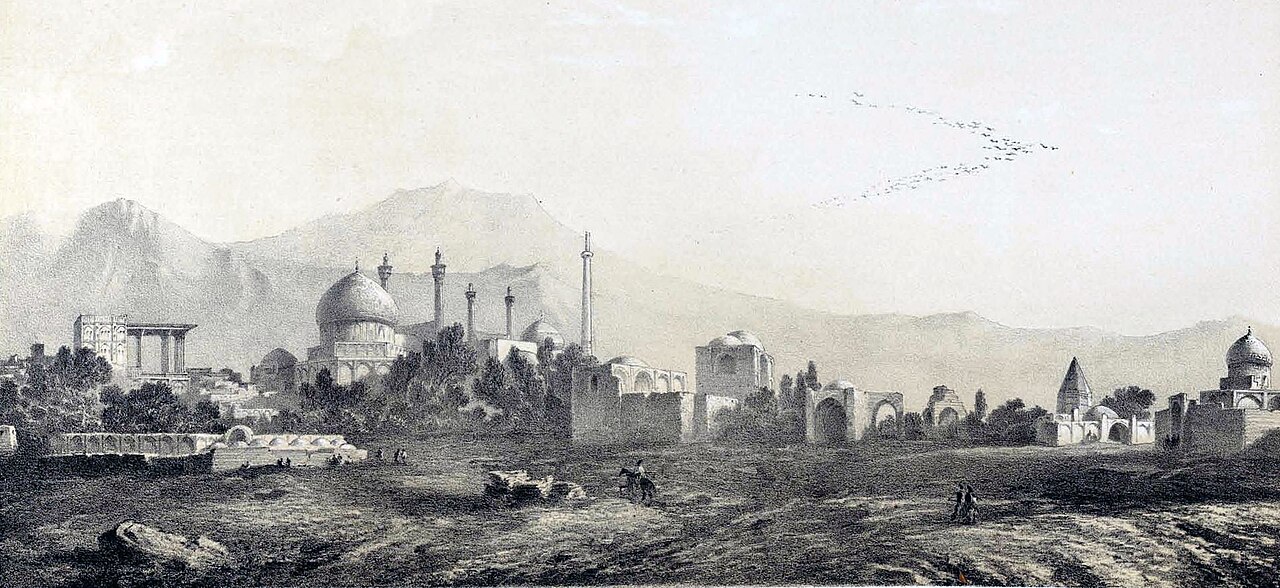

An army too small to storm a city
Mahmud’s force that won at Gulnabad on 8 March 1722 was small for the task in front of it. Isfahan was one of the largest cities in western Asia, with a population that modern estimates place in the hundreds of thousands, and the Afghans had no heavy siege guns worth the name. The story of how Mahmud reached the city is told in the Afghan revolt and the battle of Gulnabad; this page follows what happened next.
Instead of an assault, Mahmud chose a blockade. He set up his headquarters in the royal garden palace of Farahabad فرحآباد, built by Soltan Hoseyn just south of the city, and took the Armenian suburb of New Julfa, whose merchants paid a heavy ransom. Early attempts to force a way across the bridges of the Zayandeh Rud into the city proper were beaten back by the defenders.
Indecision inside the walls
Inside Isfahan the court argued. Some officers urged a fresh attack while the Afghans were still few; others wanted to wait for provincial armies. Soltan Hoseyn, by every account a pious and hesitant ruler (see Shah Soltan Hoseyn), could not settle on either course. He changed commanders, held councils and consulted astrologers and clerics, while food stocks were not seriously organised.
The question of succession added to the confusion. The shah named one son and then another as heir. In June 1722 the prince Tahmasp, newly chosen, slipped out of the city with a few hundred horsemen to raise an army in the north. He reached Qazvin, but the army he hoped to bring back never came.
The relief that failed
Help was expected from several directions. Vakhtang VI, the Georgian king of Kartli and a Safavid vassal, refused to march, partly because of old grievances and partly because he was then in contact with Peter the Great of Russia. Provincial governors and tribal leaders gathered men but did not break through. Some bands reached the edge of the Afghan lines and were driven off or bought off. By midsummer Mahmud had closed the ring around the city on both banks of the river.
Famine
From about July the blockade turned into a famine. The eyewitness accounts agree on the sequence: prices of grain rose beyond reach, then people ate horses, mules, dogs and cats, then leather and tree bark. Several witnesses, including the Jesuit Krusiński, report cases of people eating human flesh. Disease followed hunger, and the dead lay unburied in the streets and in the dry channels of the city.
How many died is unknown. European writers gave figures of 80,000 dead or more for the siege, and historians such as Laurence Lockhart repeated estimates of this order, but no count was made and the city’s pre-siege population is itself uncertain. What the sources do show is that the losses were enormous and that Isfahan took decades to recover.
Surrender at Farahabad
By October resistance was over. After negotiations, Soltan Hoseyn left the city on 23 October 1722 with a small escort, dressed in mourning, and went to Mahmud’s camp at Farahabad. There he took the royal plume, the jeqqeh, from his own turban and placed it on Mahmud’s, recognising the Afghan leader as shah. Mahmud made his formal entry into Isfahan two days later, on 25 October.
At first Mahmud acted with some restraint. He kept the former shah under guard with members of his family, retained a number of Safavid officials and tried to govern through the existing administration. That changed within a few years, as described in Tahmasp II and Hotaki rule.
- 8 March 1722 Safavid army routed at Gulnabad
- March 1722 Afghans occupy Farahabad and New Julfa; blockade begins
- June 1722 Prince Tahmasp escapes from Isfahan
- Summer 1722 Relief efforts fail; famine spreads
- 23 October 1722 Soltan Hoseyn abdicates at Farahabad
- 25 October 1722 Mahmud Hotak enters Isfahan
Why the capital fell
Older European histories, following Krusiński and the Scottish historian John Malcolm, blamed the fall on a corrupt and effeminate court ruled by eunuchs and clerics. Recent historians, above all Rudi Matthee in Persia in Crisis, describe a longer crisis: a shrinking treasury, an army that had not fought a major war for decades, weakened control of the provinces and a court system that left decisions to rival factions. The siege exposed these weaknesses, but they were not created in 1722.
The fall also had immediate effects outside Isfahan. Russia and the Ottoman Empire both used the collapse to seize Iranian territory; Russia’s moves along the Caspian are covered in Peter the Great’s Persian campaign. For the city itself, its monuments and bridges as they stand today, see the Isfahan city guide.
Persian words from this page
| اصفهان | Esfahân | Isfahan |
| محاصره | mohâsereh | siege |
| قحطی | ghahti | famine |
| فرحآباد | Farahâbâd | Farahabad palace |
| زایندهرود | Zâyandeh Rud | Isfahan’s river |
| سلطان حسین | Soltân Hoseyn | the last shah in Isfahan |
Sources and further reading
- Judasz Tadeusz Krusiński, The History of the Late Revolutions of Persia (English edition 1728), an eyewitness account by a Jesuit living in Isfahan.
- The Chronicle of Petros di Sarkis Gilanentz, trans. Caro Owen Minasian (1959), an Armenian eyewitness account of the siege.
- Laurence Lockhart, The Fall of the Safavi Dynasty and the Afghan Occupation of Persia (Cambridge, 1958).
- Willem Floor, The Afghan Occupation of Safavid Persia, 1721–1729 (Paris, 1998), based on Dutch East India Company records.
- Rudi Matthee, Persia in Crisis: Safavid Decline and the Fall of Isfahan (London, 2012).
- Michael Axworthy, The Sword of Persia: Nader Shah, from Tribal Warrior to Conquering Tyrant (London, 2006).
Want to learn Persian? Get the free Starter Pack
Get the 14-page printable Starter Pack (all 32 letters, a 7-day reading plan, 100 core words and 20 survival phrases) and a short 5-email course. Free.
More in The Safavid Empire (1501–1736)
- Shah Ismail I
- The Qizilbash
- Twelver Shi’ism Becomes Iran’s State Religion
- The Battle of Marv and the Uzbeks
- The Battle of Chaldiran (1514)
- Shah Tahmasp I
- The Ottoman–Safavid War and the Peace of Amasya
- Humayun’s Exile in Persia
- Qazvin: The Second Safavid Capital
- Ismail II and Mohammad Khodabanda
- Shah Abbas the Great
- Shah Abbas’s Military Reforms and the Ghulams
- The Sherley Brothers in Persia
- Isfahan: “Half the World”
- The Building of Naqsh-e Jahan Square
- Shah Abbas Retakes the West: The Ottoman Wars of 1603–1618
- The Capture of Hormuz from the Portuguese (1622)
- New Julfa and the Armenian Merchants
- The Safavid Silk Trade and Europe
- Sheikh Baha’i
- Reza Abbasi
- Shah Safi and the Treaty of Zuhab
- Shah Abbas II
- The Fight for Kandahar
- Chehel Sotoun Palace and Its War Paintings
- Shah Suleiman
- European Travellers in Safavid Persia
- Shah Soltan Hoseyn
- Safavid Art: Carpets, Miniatures and Tiles
- Mulla Sadra and the School of Isfahan
- The Afghan Revolt and the Battle of Gulnabad
- The Siege and Fall of Isfahan (1722)
- Peter the Great’s Persian Campaign (1722–1723)
- Tahmasp II and Hotaki Rule (1722–1732)
- Women of the Safavid Court
- The Safavid Legacy