In 1544 the Mughal emperor Humayun, driven out of India by the Afghan ruler Sher Shah Suri, took refuge at the court of Shah Tahmasp I. The shah received him with great ceremony, pressed him to accept Shi’ism, and finally lent him a Safavid army that helped him win back Kandahar and Kabul. The year in Iran tied the Mughal court closely to Persian art, language and administration.
| When | Late 1543 to 1545 |
|---|---|
| Guest | Nasir al-Din Muhammad Humayun, second Mughal emperor (r. 1530–1540 and 1555–1556) |
| Host | Shah Tahmasp I |
| Where they met | The royal camp between Abhar and Soltaniyeh, north-western Iran, July 1544 |
| Safavid help | About 12,000 cavalry under the infant prince Morad Mirza |
| Main sources | Jauhar Aftabchi, Tazkirat al-Waqi’at; Gulbadan Begum, Humayun-nama; Abu’l-Fazl, Akbarnama |
An emperor without a kingdom
Humayun had inherited the new Mughal empire from his father Babur in 1530. Within ten years he had lost it. Sher Shah Suri defeated him at Chausa in 1539 and at Kannauj in 1540, and his own brothers, who held Kabul and Kandahar, refused to help. For three years he wandered through Sindh and Rajasthan with a shrinking band of followers. His son Akbar was born during these wanderings, at Umarkot in 1542. When his brother Askari blocked the road to Kandahar in 1543, Humayun left the infant Akbar behind and crossed into Safavid territory with only a few companions.
Turning to Iran was a natural choice, and a humbling one. Babur had once accepted Safavid help against the Uzbeks after the Battle of Marv, but now his son came as a refugee, not an ally.
A royal welcome across Khorasan
Tahmasp decided to receive his guest in style. He sent orders to the governor of Herat describing in detail how Humayun was to be treated, with banquets, gifts and escorts at every stage. Humayun spent Nowruz in Herat, visited the shrine of Imam Reza in Mashhad, and travelled west across the plateau. He reached the royal camp in July 1544, in the summer pastures between Abhar and Soltaniyeh, west of Qazvin. There were daily feasts, exchanges of gifts and royal hunts. Among Humayun’s presents was a large diamond; some later writers identified it with the Koh-i-Noor, but that link is not certain.

The question of religion
The welcome had a price. Humayun was a Sunni, and Tahmasp in these years was a devout Shi’a king who had made Shi’ism the faith of his state. According to Humayun’s ewer-bearer Jauhar Aftabchi, who was there, the shah first asked his guest to wear the Safavid crown cap and then demanded that he accept Shi’ism, with threats against his Sunni followers if he refused. Humayun at first refused and then gave way, at least outwardly. Jauhar says Tahmasp’s sister pleaded for the guest and helped to soften the shah.
The official Mughal history, the Akbarnama written later for Akbar by Abu’l-Fazl, mentions the tension only briefly and presents the visit as a meeting of equals. Historians therefore lean on Jauhar for what happened, while remembering that he too wrote years later. Humayun’s half-sister Gulbadan Begum, who wrote her own memoir of the family, adds detail on the Mughal side.
The bargain: an army for Kandahar
In the end Tahmasp agreed to help. Humayun left Iran with about 12,000 Safavid horsemen and a body of the shah’s guards, nominally led by Tahmasp’s infant son Morad Mirza. In return he promised Kandahar to the Safavids. In 1545 the joint army took Kandahar from Askari, and the city was handed over to Morad Mirza. When the young prince died soon after, Humayun took Kandahar back for himself, and later that year he captured Kabul from his brother Kamran.
The broken promise left a lasting grievance. Kandahar, on the road between Iran and India, changed hands between Safavids and Mughals several times over the next century, until Shah Abbas II took it for the last time in 1649; see the page on Shah Abbas II.
Persian painters for the Mughal court
The longest-lasting result of the exile was cultural. While in Iran, Humayun met painters of the royal workshop at a moment when Tahmasp was losing interest in painting. Two of them, Mir Sayyed Ali and Abd al-Samad, later joined Humayun in Kabul. They led the studio that, under Akbar, produced the huge illustrated Hamzanama and trained the Indian artists who created the Mughal style. Mughal painting grew from this meeting of the Safavid tradition with Indian painters.
Persian was already the language of the Mughal court, but the exile strengthened the link. Humayun returned with Iranian officers and administrators. His most important commander, Bayram Khan, was a Turkmen of the Qara Qoyunlu line who became Akbar’s regent. Iranians continued to find careers in Mughal India for two centuries.
Return to India
Humayun recaptured Delhi in July 1555, fifteen years after losing it, but he did not enjoy his restored throne for long. In January 1556 he fell down the stone stairs of his library in Delhi and died a few days later. His tomb in Delhi, built for him in the 1560s by a Persian architect, Mirak Mirza Ghiyas, is one of the clearest signs of Iranian influence on Mughal architecture.
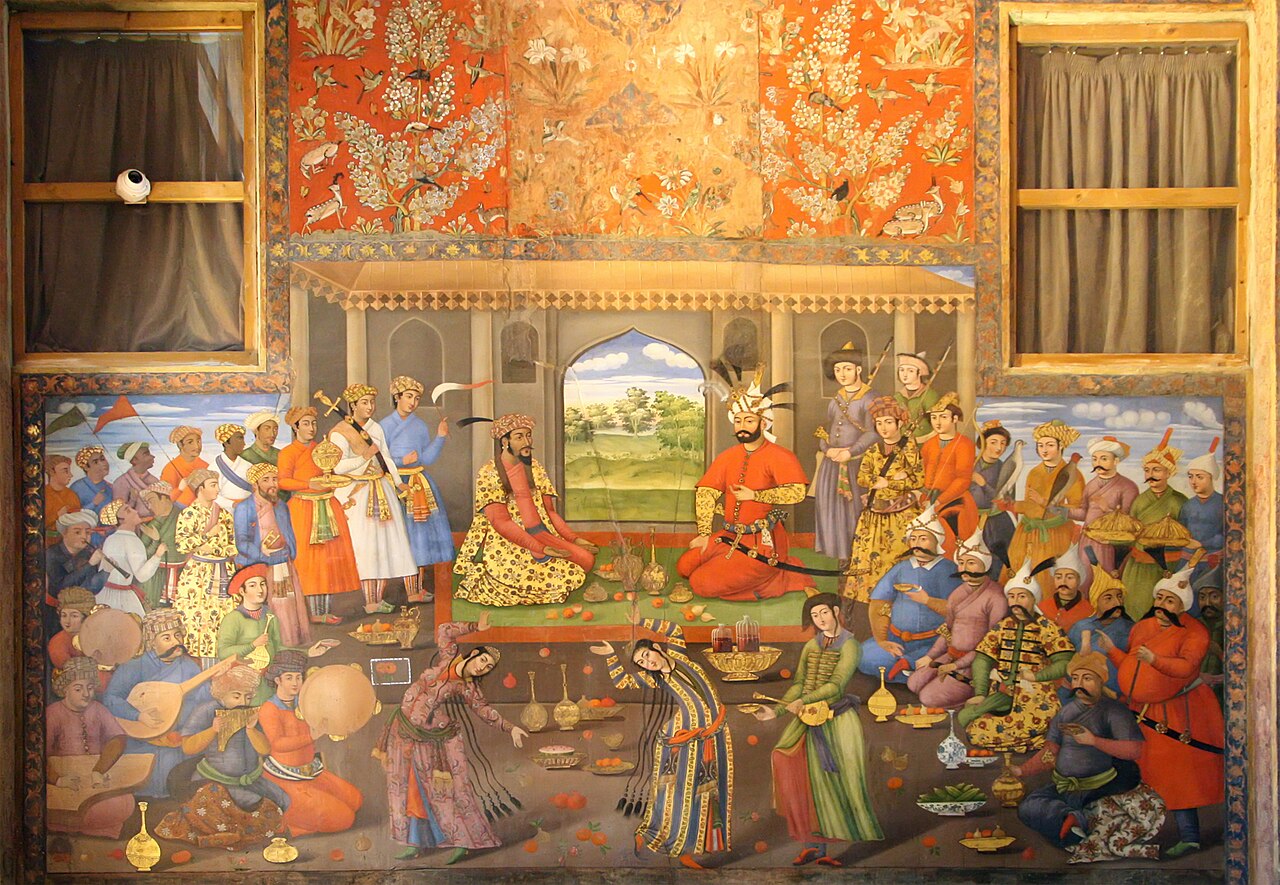
The visit was remembered in Iran too. A century later, a wall painting of Tahmasp entertaining Humayun was placed in the Chehel Sotoun palace in Isfahan, beside battle scenes of Safavid triumph. It shows how the Safavids liked to remember the episode: the Shah of Iran as generous host to the Emperor of India. More on those paintings is on the Chehel Sotoun war paintings page.
Persian words from this page
| همایون | Homâyun | Humayun (“fortunate”) |
| پناهنده | panâhande | refugee |
| مهمان | mehmân | guest |
| قندهار | Ghandehâr | Kandahar |
| کابل | Kâbol | Kabul |
| سلطانیه | Soltâniye | Soltaniyeh |
Sources and further reading
- Jauhar Aftabchi, Tazkirat al-Waqi’at, trans. Charles Stewart as The Tezkereh al Vakiat, or Private Memoirs of the Moghul Emperor Humayun (1832)
- Gulbadan Begum, The History of Humayun (Humayun-nama), trans. Annette S. Beveridge (1902)
- Abu’l-Fazl, The Akbarnama, trans. H. Beveridge (1897–1921)
- “Ṭahmāsp I”, Encyclopaedia Iranica: iranicaonline.org
- Riazul Islam, Indo-Persian Relations: A Study of the Political and Diplomatic Relations between the Mughul Empire and Iran (Iranian Culture Foundation, 1970)
Want to learn Persian? Get the free Starter Pack
Get the 14-page printable Starter Pack (all 32 letters, a 7-day reading plan, 100 core words and 20 survival phrases) and a short 5-email course. Free.
More in The Safavid Empire (1501–1736)
- Shah Ismail I
- The Qizilbash
- Twelver Shi’ism Becomes Iran’s State Religion
- The Battle of Marv and the Uzbeks
- The Battle of Chaldiran (1514)
- Shah Tahmasp I
- The Ottoman–Safavid War and the Peace of Amasya
- Humayun’s Exile in Persia
- Qazvin: The Second Safavid Capital
- Ismail II and Mohammad Khodabanda
- Shah Abbas the Great
- Shah Abbas’s Military Reforms and the Ghulams
- The Sherley Brothers in Persia
- Isfahan: “Half the World”
- The Building of Naqsh-e Jahan Square
- Shah Abbas Retakes the West: The Ottoman Wars of 1603–1618
- The Capture of Hormuz from the Portuguese (1622)
- New Julfa and the Armenian Merchants
- The Safavid Silk Trade and Europe
- Sheikh Baha’i
- Reza Abbasi
- Shah Safi and the Treaty of Zuhab
- Shah Abbas II
- The Fight for Kandahar
- Chehel Sotoun Palace and Its War Paintings
- Shah Suleiman
- European Travellers in Safavid Persia
- Shah Soltan Hoseyn
- Safavid Art: Carpets, Miniatures and Tiles
- Mulla Sadra and the School of Isfahan
- The Afghan Revolt and the Battle of Gulnabad
- The Siege and Fall of Isfahan (1722)
- Peter the Great’s Persian Campaign (1722–1723)
- Tahmasp II and Hotaki Rule (1722–1732)
- Women of the Safavid Court
- The Safavid Legacy