The Battle of Marv, fought on 2 December 1510 near the oasis city of Marv (Merv, in today’s Turkmenistan), was Shah Ismail I’s great victory over the Uzbek ruler Muhammad Shaybani Khan. Shaybani was killed, Herat and most of Khorasan passed to the Safavids, and the Amu Darya (Oxus) began to settle into the frontier between Iran and Central Asia.
| Date | 2 December 1510 |
|---|---|
| Place | Near Marv, Khorasan (now Mary province, Turkmenistan) |
| Safavid commander | Shah Ismail I |
| Uzbek commander | Muhammad Shaybani Khan (killed) |
| Forces | Often given as about 17,000 Qizilbash; Uzbek numbers unknown, though the Uzbeks are usually said to have been the larger army |
| Result | Safavid victory; Herat and Khorasan become Safavid |
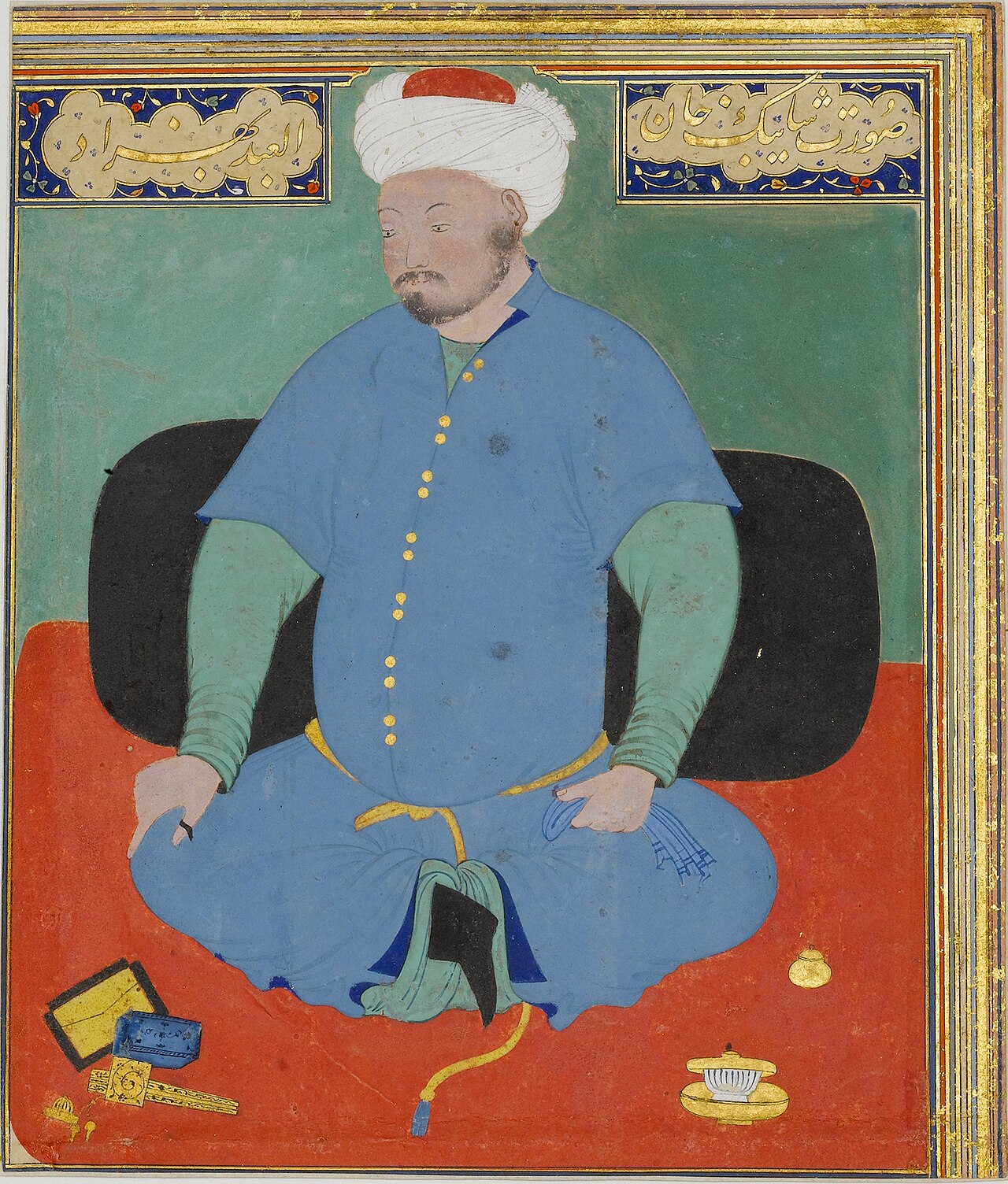
Shaybani Khan, master of Central Asia
Muhammad Shaybani, a grandson of the Uzbek khan Abu’l-Khayr, led the Uzbek tribes south from the steppe at the end of the fifteenth century. In 1500 he took Samarkand from the young Timurid prince Babur, and in 1507 he captured Herat, the brilliant capital of the last great Timurid, Sultan Husayn Bayqara. With Transoxiana and Khorasan in his hands, he was the strongest Sunni ruler east of the Ottomans, and his raids reached into central Iran.
Two expanding powers now faced each other across Khorasan. Each claimed to be the champion of the true faith: Shaybani as a Sunni descendant of Genghis Khan, Ismail as the head of a Shi’a Sufi movement. Chroniclers tell of insulting messages. Shaybani is said to have advised Ismail to take up his ancestors’ dervish begging bowl and leave kingship to kings, and Ismail to have replied that he was coming to meet him in person. The exact wording varies from source to source, but the exchange shows how personal and religious the quarrel had become.

The campaign of 1510
Ismail marched into Khorasan in the autumn of 1510. Shaybani’s timing was poor: his forces had been weakened by campaigns against the Kazakhs and the Hazaras, and many of his troops were scattered. Rather than meet the Qizilbash in the open, he withdrew behind the walls of Marv to wait for reinforcements from Transoxiana.
Ismail could not afford a long siege so far from home. He pulled his army back as if retreating, leaving a small force to draw the Uzbeks out. Shaybani followed with his army, crossed a river, and was caught by the main Qizilbash force waiting in ambush. Cut off from the city, the Uzbek army broke. Shaybani fled with his guard and was trapped and killed in an enclosure where they had taken refuge. Around 10,000 Uzbeks are said to have died, though, as with most battles of the period, this is a chronicler’s figure rather than a count.
A skull for a drinking cup
What happened to Shaybani’s body became one of the best-known stories of the reign. According to the chronicles, Ismail had the skull set in gold and used it as a drinking cup. Parts of the body were sent around the empire as trophies, and the stuffed skin was sent to the Ottoman sultan Bayezid II, a pointed warning to another Sunni neighbour. Such displays were meant to frighten rivals and to show the Qizilbash that their leader was unbeatable. Four years later, at Chaldiran, the Ottomans would prove that he was not.
Babur, Samarkand and Ghijduvan
Marv changed the balance in Central Asia. Among the captives found after the battle was Khanzada Begum, Babur’s elder sister, who had been married to Shaybani. Ismail sent her back to her brother with honour, and Babur, then ruling in Kabul, made an alliance with the shah. With Safavid troops he retook Samarkand in 1511. To keep Ismail’s support he is said to have worn the Qizilbash cap, which cost him the loyalty of the Sunni population.
The alliance did not last. The Uzbeks regrouped under Shaybani’s nephew Ubaydullah, drove Babur out, and in November 1512 destroyed a Safavid army under Ismail’s Persian deputy Najm-e Sani at Ghijduvan, near Bukhara. Najm-e Sani was killed. Babur gave up on Samarkand for good and later turned to India, where he founded the Mughal empire. His son’s later stay at the Safavid court is told on the page about Humayun’s exile in Persia.
Results: a frontier, not a final victory
After Ghijduvan the two sides settled into a long, wearing rivalry. The Safavids held Khorasan; the Uzbeks held Transoxiana, and the river Amu Darya, with the desert to its south, became a rough boundary. Uzbek armies kept raiding Khorasan and besieged Herat and Mashhad several times under Tahmasp I, and they held Herat again in the late sixteenth century until Shah Abbas drove them out in 1598.
The conquest of Herat also had a cultural result. The Timurid court had been the centre of Persian painting and poetry, and its artists now came within Safavid reach. The great painter Kamal al-Din Behzad later moved to Tabriz, where Ismail appointed him head of the royal library workshop in 1522, carrying Herat’s style into Safavid art. His career is covered on the page about Behzad and Persian miniature painting.
Marv today
The battlefield lies near the ruins of ancient Merv, a city that had been one of the great centres of the eastern Islamic world before the Mongols sacked it in 1221. Its ruins are now a UNESCO World Heritage Site in Turkmenistan. By 1510 the city was a shadow of its medieval self, but it still guarded the road between Khorasan and Bukhara, which is why both armies fought for it.
Persian words from this page
| مرو | Marv | Merv |
| ازبک | Ozbak | Uzbek |
| خراسان | Khorâsân | Khorasan |
| هرات | Herât | Herat |
| جیحون | Jeyhun | the Amu Darya (Oxus) |
| بهزاد | Behzâd | Behzad, the painter |
Sources and further reading
- Roger M. Savory, “Esmāʿil I Ṣafawi”, Encyclopaedia Iranica: iranicaonline.org
- Roger Savory, Iran under the Safavids (Cambridge University Press, 1980)
- Babur, The Baburnama, trans. Wheeler M. Thackston (Oxford University Press, 1996)
- Martin B. Dickson, Shah Tahmasb and the Uzbeks (PhD dissertation, Princeton University, 1958)
- UNESCO World Heritage Centre, “State Historical and Cultural Park ‘Ancient Merv'”: whc.unesco.org
Want to learn Persian? Get the free Starter Pack
Get the 14-page printable Starter Pack (all 32 letters, a 7-day reading plan, 100 core words and 20 survival phrases) and a short 5-email course. Free.
More in The Safavid Empire (1501–1736)
- Shah Ismail I
- The Qizilbash
- Twelver Shi’ism Becomes Iran’s State Religion
- The Battle of Marv and the Uzbeks
- The Battle of Chaldiran (1514)
- Shah Tahmasp I
- The Ottoman–Safavid War and the Peace of Amasya
- Humayun’s Exile in Persia
- Qazvin: The Second Safavid Capital
- Ismail II and Mohammad Khodabanda
- Shah Abbas the Great
- Shah Abbas’s Military Reforms and the Ghulams
- The Sherley Brothers in Persia
- Isfahan: “Half the World”
- The Building of Naqsh-e Jahan Square
- Shah Abbas Retakes the West: The Ottoman Wars of 1603–1618
- The Capture of Hormuz from the Portuguese (1622)
- New Julfa and the Armenian Merchants
- The Safavid Silk Trade and Europe
- Sheikh Baha’i
- Reza Abbasi
- Shah Safi and the Treaty of Zuhab
- Shah Abbas II
- The Fight for Kandahar
- Chehel Sotoun Palace and Its War Paintings
- Shah Suleiman
- European Travellers in Safavid Persia
- Shah Soltan Hoseyn
- Safavid Art: Carpets, Miniatures and Tiles
- Mulla Sadra and the School of Isfahan
- The Afghan Revolt and the Battle of Gulnabad
- The Siege and Fall of Isfahan (1722)
- Peter the Great’s Persian Campaign (1722–1723)
- Tahmasp II and Hotaki Rule (1722–1732)
- Women of the Safavid Court
- The Safavid Legacy