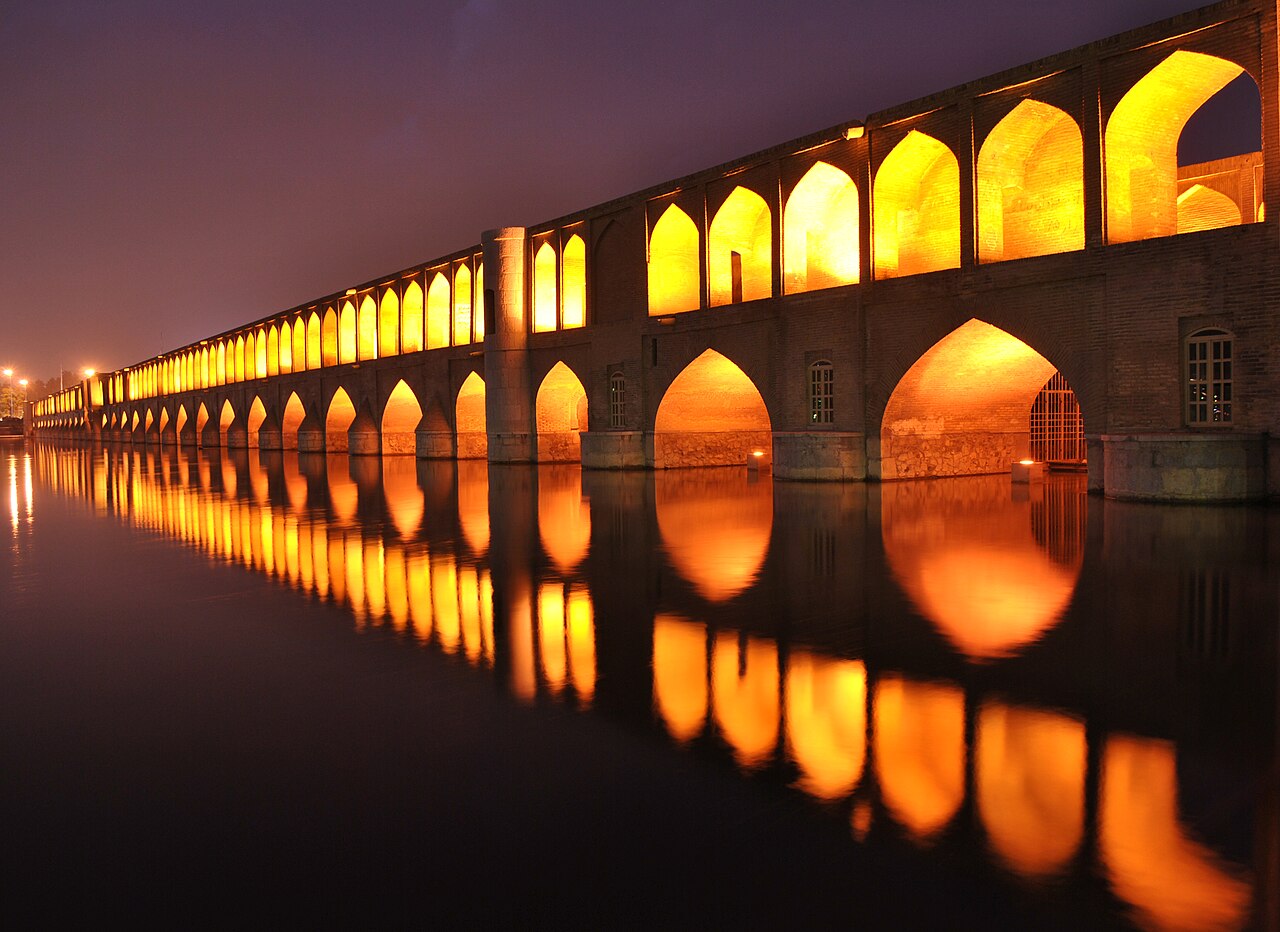
Si-o-se Pol (سی و سه پل, “thirty-three bridges”) and the Khaju Bridge (پل خواجو) are the two famous Safavid bridges across the Zayandeh Rud in Isfahan. Si-o-se Pol, built around 1600 for Shah Abbas I, carried the royal Chahar Bagh avenue over the river; the Khaju Bridge, built around 1650 under Shah Abbas II, is both a bridge and a weir. In the evenings both are places where Isfahanis walk, sit and sing.
| Bridge | Si-o-se Pol / Khaju Bridge |
|---|---|
| Built | c. 1599–1602 / c. 1650 |
| Patron | Shah Abbas I, built by his commander Allahverdi Khan / Shah Abbas II |
| Length | About 300 m / about 130 m |
| Persian names | Si-o-se Pol, Pol-e Allâhverdi Khân / Pol-e Khâju |
| Character | Long arcaded causeway / short, wide bridge with pavilions and sluices |

The river itself, Isfahan’s other bridges (the older Shahrestan and Marnan bridges and the small Joui bridge) and the water problems of recent decades are covered in Zayandeh Rud and Isfahan’s Bridges. This page looks closely at the two bridges most visitors come to see.
Si-o-se Pol: the avenue over the river
When Shah Abbas laid out his new capital in the late 1590s, its spine was Chahar Bagh, a long avenue of gardens and water channels running south from the palace quarter. Si-o-se Pol took it across the river towards the royal gardens on the south bank. The bridge was built by Allahverdi Khan, a Georgian-born general who was one of Abbas’s most powerful commanders, and it is still often called by his name. Its place in the city plan is explained in Isfahan: “Half the World”.
The name comes from the 33 arches of the main span. The bridge has two levels. On top is a wide roadway, now for pedestrians only, lined on both sides by a covered arcade of small arches, so you can walk in shade and look out over the water through the openings. Below, at river level, a walkway crosses through the thick piers, with stepping places where people sit with their feet over the water when the river is flowing.
What to look for
- The rhythm of the arcades seen from the river bank, especially at dusk when the arches are lit from inside and reflected in the water.
- The lower passage through the piers, which gives the best sense of the bridge’s mass and of how it was built from brick on stone foundations.
- The view north along Chahar Bagh, which still runs as a busy avenue from the bridge towards the city centre.
Khaju Bridge: a bridge that holds back water
The Khaju Bridge, about two kilometres downstream, is shorter but more elaborate. It was built under Shah Abbas II around 1650, probably on the site of an older crossing, and it linked the Khaju quarter on the north bank with the road to Shiraz and gardens on the south. Its key feature is that it is also a weir. The lower level is a row of channels with sluice gates; when they were closed, the river rose upstream into a broad pool, which supplied water to gardens and made a lake for boating and for the shah’s entertainments.
Downstream, the water spilled over a series of wide stone steps. These steps are the bridge’s social centre today: people sit on them in the evening to talk, eat sunflower seeds and watch the water.
What to look for
- The two pavilions in the middle of the upper level, with painted decoration inside, where the shah and his court sat to watch the river. The central pavilion is usually called the shâh-neshin, “the shah’s seat”.
- The tilework in the spandrels of the upper arches, in yellow, blue and green, which Si-o-se Pol lacks.
- The stepped downstream face, and the way the stone piers are cut to the shape of the flow.
Evenings and singing
The best time to visit both bridges is from late afternoon into the evening. As the heat goes, Isfahanis come out to walk along the river. Under the arches of the lower level, especially at Khaju, men often gather to sing âvâz, traditional Persian vocal music, sometimes poems of Hafez or Saadi, and the vaults amplify their voices. Listeners stand around; nobody sells tickets and nobody performs for tourists. It is one of the most memorable things to experience in Isfahan, and also a reminder that these bridges were built as much for pleasure as for crossing.
When the river is dry
For much of the past two decades the Zayandeh Rud in Isfahan has been dry for long periods, because of drought and the diversion of water upstream for farming, industry and other cities. Water is released for limited periods, and when it is, crowds come to the banks. Whether you see the bridges over a flowing river or a dry bed of sand depends on the season and the year; the bridges are worth seeing either way, but the lower walkways and steps feel very different with water. Local news will tell you whether the river is flowing during your visit.
Practical notes
- Si-o-se Pol is at the southern end of Chahar Bagh, about 20 minutes’ walk from the Chehel Sotoun and Hasht Behesht palaces. A walk along the north bank from Si-o-se Pol to Khaju takes about half an hour.
- South of Si-o-se Pol, the Armenian quarter of New Julfa and Vank Cathedral are a short taxi ride or a longer walk away, and make a natural pairing for an afternoon ending at the river.
- Both bridges are public crossings, so you can come back at different times of day.
For the city as a whole, see our Isfahan city guide.
Persian words from this page
| پل | pol | bridge |
| سی و سه | si-o-se | thirty-three |
| رود | rud | river |
| زایندهرود | Zâyande Rud | “the life-giving river” |
| چهارباغ | Chahâr Bâgh | “four gardens”, Isfahan’s royal avenue |
| آواز | âvâz | song, traditional vocal music |
| شاهنشین | shâh-neshin | the shah’s seat, a raised alcove |
Sources and further reading
- Encyclopaedia Iranica, “Bridges” and “Isfahan” (article series).
- Sussan Babaie, Isfahan and Its Palaces (Edinburgh University Press, 2008).
- Robert Hillenbrand, “Safavid Architecture”, in The Cambridge History of Iran, vol. 6 (1986).
- Wilfrid Blunt, Isfahan: Pearl of Persia (1966).
Want to learn Persian? Get the free Starter Pack
Get the 14-page printable Starter Pack (all 32 letters, a 7-day reading plan, 100 core words and 20 survival phrases) and a short 5-email course. Free.
More in Top Places to Visit in Iran
- Naqsh-e Jahan Square
- Shah (Imam) Mosque, Isfahan
- Sheikh Lotfollah Mosque
- Ali Qapu Palace
- Jameh Mosque of Isfahan
- Si-o-se Pol and Khaju Bridge
- Vank Cathedral
- Hasht Behesht Palace
- Naqsh-e Rostam
- Eram Garden, Shiraz
- Nasir al-Molk (Pink) Mosque
- Tomb of Hafez (Hafezieh)
- Tomb of Saadi (Saadieh)
- Shah Cheragh Shrine
- Arg of Karim Khan
- Fin Garden, Kashan
- Historic Houses of Kashan
- Jameh Mosque of Yazd
- Yazd Fire Temple and Towers of Silence
- Dowlatabad Garden and Windcatcher
- Amir Chakhmaq Complex
- Golestan Palace
- National Museum of Iran
- Treasury of National Jewels
- Tehran Grand Bazaar
- Milad Tower
- Imam Reza Shrine, Mashhad
- Tomb of Ferdowsi, Tus
- Tomb of Omar Khayyam, Neyshabur
- Tomb of Avicenna, Hamadan
- Ganjnameh Inscriptions, Hamadan
- Behistun (Bisotun): Visiting the Site
- Taq-e Bostan: Visiting the Site
- Tabriz Historic Bazaar
- Takht-e Soleyman
- Armenian Monastic Ensembles of Iran
- Sheikh Safi al-Din Shrine, Ardabil
- Dome of Soltaniyeh
- Alamut Castle
- Falak-ol-Aflak Castle
- Shushtar Historical Hydraulic System
- Chogha Zanbil: Visiting the Ziggurat
- Susa Archaeological Site
- Arg-e Bam
- Ganjali Khan Complex, Kerman
- Shazdeh Garden, Mahan
- Rayen Castle
- Dasht-e Lut (Lut Desert)
- Maranjab Desert and Caravanserai
- Varzaneh Desert
- Mount Damavand
- Hyrcanian Forests
- Lake Urmia
- Badab-e Surt Springs
- Ali Sadr Cave
- The Kaluts of Shahdad
- Qeshm Geopark
- Hormuz Island Colours
- Visiting Persepolis: A Day Trip from Shiraz
- Visiting Pasargadae
- Persian Caravanserais
- The Qanat of Gonabad
- Meymand Village
- Sasanian Sites of Fars: Firuzabad, Bishapur and Sarvestan
- Gonbad-e Qabus: Visiting the Tower
- Zayandeh Rud and Isfahan’s Bridges
- Tochal and Darband: Hiking Above Tehran
- Mount Sabalan
- Skiing in Iran: Dizin and Shemshak
- Golestan National Park