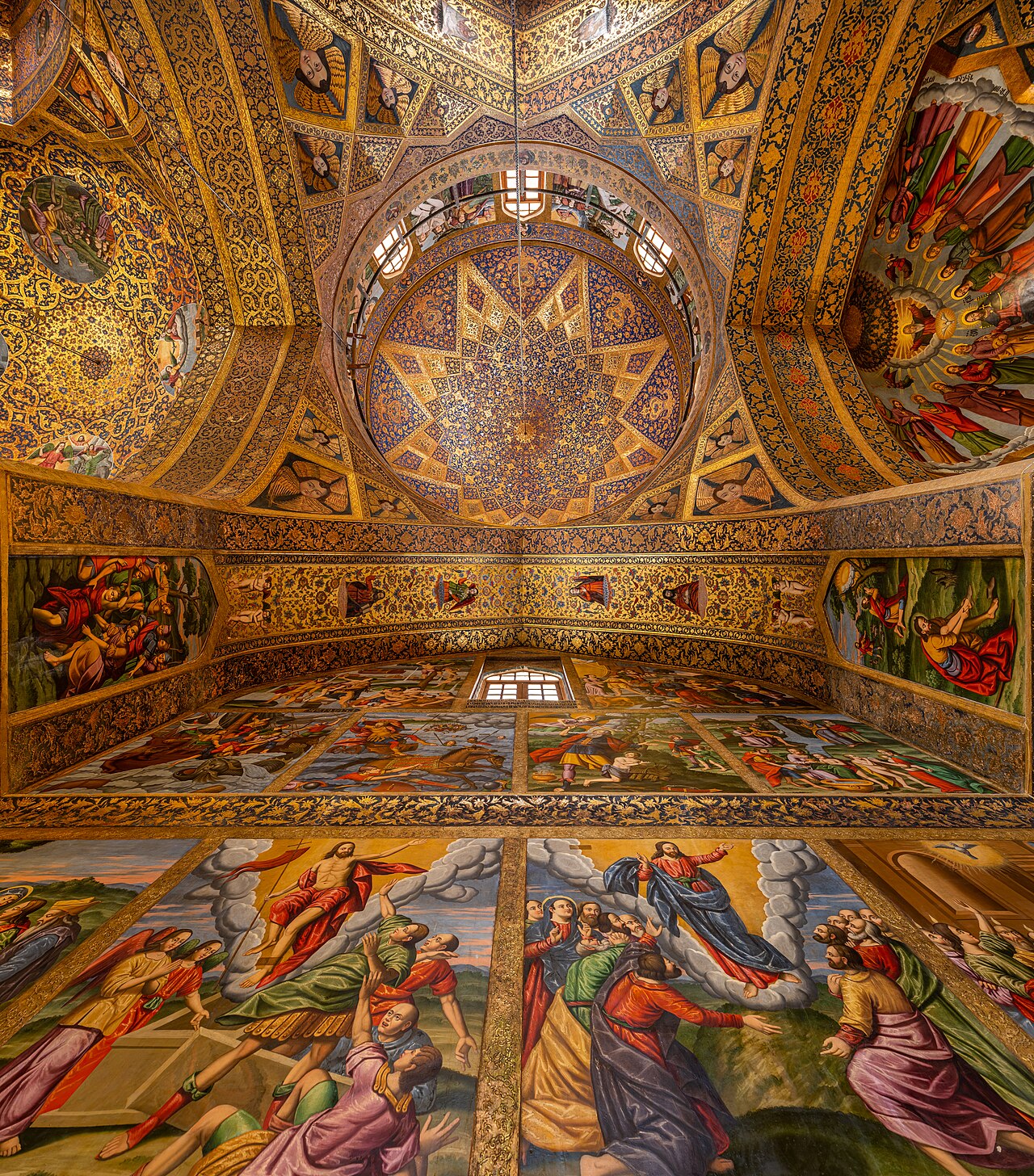
Vank Cathedral (کلیسای وانک), the Cathedral of the Holy Saviour, is the main church of the Armenian quarter of New Julfa in Isfahan, south of the Zayandeh Rud. Built in 1655–1664 for a community that Shah Abbas I had moved to Isfahan, it looks like a Persian mosque from outside and is covered inside with painted Bible scenes, gilding and Persian tiles.
| Names | Holy Saviour (Amenaprkich) Cathedral; Persian Kelisâ-ye Vânk, from the Armenian word for monastery |
|---|---|
| Built | First church c. 1606; present building 1655–1664 under Archbishop David |
| Location | New Julfa (Jolfâ), south bank of the Zayandeh Rud, Isfahan |
| Church | Seat of the Armenian Apostolic diocese of Isfahan and southern Iran |
| On site | Cathedral, bell tower, museum and library, memorial courtyard |
The story of how Armenians from Julfa on the Aras river were deported to Isfahan in 1604–1605 and built a trading network across Eurasia is told in New Julfa and the Armenian Merchants. This page is a guide to the cathedral and what to see there today.

A church that looks like a mosque
Seen from the lane outside, Vank is a plain brick building with a single dome on a drum, much like a small Safavid mosque. Only a modest cross on top of the dome shows that it is a church. That restraint was partly practical: Safavid builders worked in a local style, and Christian buildings in the Muslim capital were not meant to compete with the mosques across the river. It also reflects a community that was protected by the shahs but always dependent on their goodwill.
Inside the gate, the courtyard is calm and green. A tall, separate bell tower stands opposite the church entrance, added at the start of the 18th century.
Inside the cathedral
The interior is a surprise after the plain outside. Almost every surface is covered.
- The lower walls are faced with Persian painted tiles of flowers and vases, the same haft-rang technique used on the mosques of the city.
- The upper walls carry rows of large oil paintings telling the life of Christ and stories from the Old Testament. Their style, with crowded figures and landscapes, was learned largely from European engravings that Armenian merchants brought back from their travels.
- The dome is painted in blue and gold with the story of the Creation, from the separation of light and darkness to Adam and Eve in the garden.
- Over the entrance, a huge Last Judgement shows heaven above and hell below, with the damned being swallowed by a monster. It is the scene most visitors remember.
- Panels show the sufferings of Saint Gregory the Illuminator, who converted Armenia to Christianity in the early 4th century, in graphic detail.
The mix of Persian tiles, gilded arabesques of the kind found in Safavid palaces, and European-style Christian painting is what makes Vank unusual. It is a building made by Armenians, in Iran, using the visual languages of both.
The museum and the printing press
Across the courtyard, the cathedral museum and library hold manuscripts, illuminated Gospels, church vestments, European paintings and Safavid royal decrees concerning the Armenian community. The museum also displays the early press of Khachatur Kesaratsi, a monk of the cathedral who in the 1630s made the press and its type himself; its Psalter of 1638 is counted as the first book printed in Iran.
Two other displays draw crowds: a strand of hair on which a minute inscription has been written, seen through a microscope, and a collection of documents and photographs on the Armenian genocide of 1915. In the courtyard a memorial commemorates its victims, and on 24 April each year the community gathers here to remember them.
New Julfa beyond the cathedral
Vank is only one of a dozen or so surviving churches in New Julfa, and the quarter is worth a walk. Bethlehem Church, close to Julfa Square, was paid for by a single merchant and has its own painted interior. Many other churches are closed except for services. Around Julfa Square and the lanes nearby are cafés and restaurants that are popular with young Isfahanis in the evenings, and the area has a different, quieter character from the city centre north of the river. For the wider story of Christians in Iran, see Armenians in Iran.
Visiting
- Vank is about 15–20 minutes by taxi from Naqsh-e Jahan Square, or a walk of about half an hour from Si-o-se Pol across the river.
- Allow an hour for the cathedral and museum, and more if you want to see other churches or sit in Julfa.
- It is a working cathedral. Visitors are welcome outside services, but be quiet inside and ask before photographing people. Dress modestly; the same dress rules apply as elsewhere in Iran.
- Opening hours and tickets change, and the site may close for services and on some Armenian holidays; check current information locally.
For the rest of Isfahan, see our Isfahan city guide.
Persian words from this page
| کلیسا | kelisâ | church |
| جلفا | Jolfâ | Julfa |
| ارمنی | armani | Armenian |
| مسیحی | masihi | Christian |
| موزه | muze | museum |
| چاپخانه | châpkhâne | printing house |
Sources and further reading
- Encyclopaedia Iranica, “Julfa” (New Julfa).
- John Carswell, New Julfa: The Armenian Churches and Other Buildings (Clarendon Press, 1968).
- Sebouh David Aslanian, From the Indian Ocean to the Mediterranean: The Global Trade Networks of Armenian Merchants from New Julfa (University of California Press, 2011).
- Sheila R. Canby, The Golden Age of Persian Art 1501–1722 (British Museum Press, 1999).
Want to learn Persian? Get the free Starter Pack
Get the 14-page printable Starter Pack (all 32 letters, a 7-day reading plan, 100 core words and 20 survival phrases) and a short 5-email course. Free.
More in Top Places to Visit in Iran
- Naqsh-e Jahan Square
- Shah (Imam) Mosque, Isfahan
- Sheikh Lotfollah Mosque
- Ali Qapu Palace
- Jameh Mosque of Isfahan
- Si-o-se Pol and Khaju Bridge
- Vank Cathedral
- Hasht Behesht Palace
- Naqsh-e Rostam
- Eram Garden, Shiraz
- Nasir al-Molk (Pink) Mosque
- Tomb of Hafez (Hafezieh)
- Tomb of Saadi (Saadieh)
- Shah Cheragh Shrine
- Arg of Karim Khan
- Fin Garden, Kashan
- Historic Houses of Kashan
- Jameh Mosque of Yazd
- Yazd Fire Temple and Towers of Silence
- Dowlatabad Garden and Windcatcher
- Amir Chakhmaq Complex
- Golestan Palace
- National Museum of Iran
- Treasury of National Jewels
- Tehran Grand Bazaar
- Milad Tower
- Imam Reza Shrine, Mashhad
- Tomb of Ferdowsi, Tus
- Tomb of Omar Khayyam, Neyshabur
- Tomb of Avicenna, Hamadan
- Ganjnameh Inscriptions, Hamadan
- Behistun (Bisotun): Visiting the Site
- Taq-e Bostan: Visiting the Site
- Tabriz Historic Bazaar
- Takht-e Soleyman
- Armenian Monastic Ensembles of Iran
- Sheikh Safi al-Din Shrine, Ardabil
- Dome of Soltaniyeh
- Alamut Castle
- Falak-ol-Aflak Castle
- Shushtar Historical Hydraulic System
- Chogha Zanbil: Visiting the Ziggurat
- Susa Archaeological Site
- Arg-e Bam
- Ganjali Khan Complex, Kerman
- Shazdeh Garden, Mahan
- Rayen Castle
- Dasht-e Lut (Lut Desert)
- Maranjab Desert and Caravanserai
- Varzaneh Desert
- Mount Damavand
- Hyrcanian Forests
- Lake Urmia
- Badab-e Surt Springs
- Ali Sadr Cave
- The Kaluts of Shahdad
- Qeshm Geopark
- Hormuz Island Colours
- Visiting Persepolis: A Day Trip from Shiraz
- Visiting Pasargadae
- Persian Caravanserais
- The Qanat of Gonabad
- Meymand Village
- Sasanian Sites of Fars: Firuzabad, Bishapur and Sarvestan
- Gonbad-e Qabus: Visiting the Tower
- Zayandeh Rud and Isfahan’s Bridges
- Tochal and Darband: Hiking Above Tehran
- Mount Sabalan
- Skiing in Iran: Dizin and Shemshak
- Golestan National Park